
Challenges in practice
Today, risk management is no longer a "nice-to-have," but is mandated by common standards and customer requirements as risk-based thinking, including action management. At the same time, it is insufficient to consider risks only on a project-specific basis during development (e.g., via FMEA): A holistic view of strategic risks, opportunities, and dependencies is crucial for companies.
In practice, risk information is often scattered across numerous disorganized files, emails, or isolated repositories. Strategic goals, risks, assets, consequences, knowledge gaps, and measures are not consistently integrated. This hinders prioritization, sound decision-making regarding treatment, and transparent communication and allocation of responsibilities.
Furthermore, without a systematic approach, assessments are neither effective nor comparable, and they do not occur at the necessary, periodic intervals. Risk management based solely on documents or scattered across isolated solutions leads to a lack of clarity, and implemented measures may prove ineffective. The result: management lacks a reliable picture of top risks, trends, and effectiveness.
Solution QS1
QS1 supports you in implementing strategic risk and opportunity management transparently, methodically, and efficiently, from identification and analysis to assessment, monitoring, and reporting. The foundation is the process according to ISO 31000, which considers risks and opportunities within the context of management requirements and operational processes.
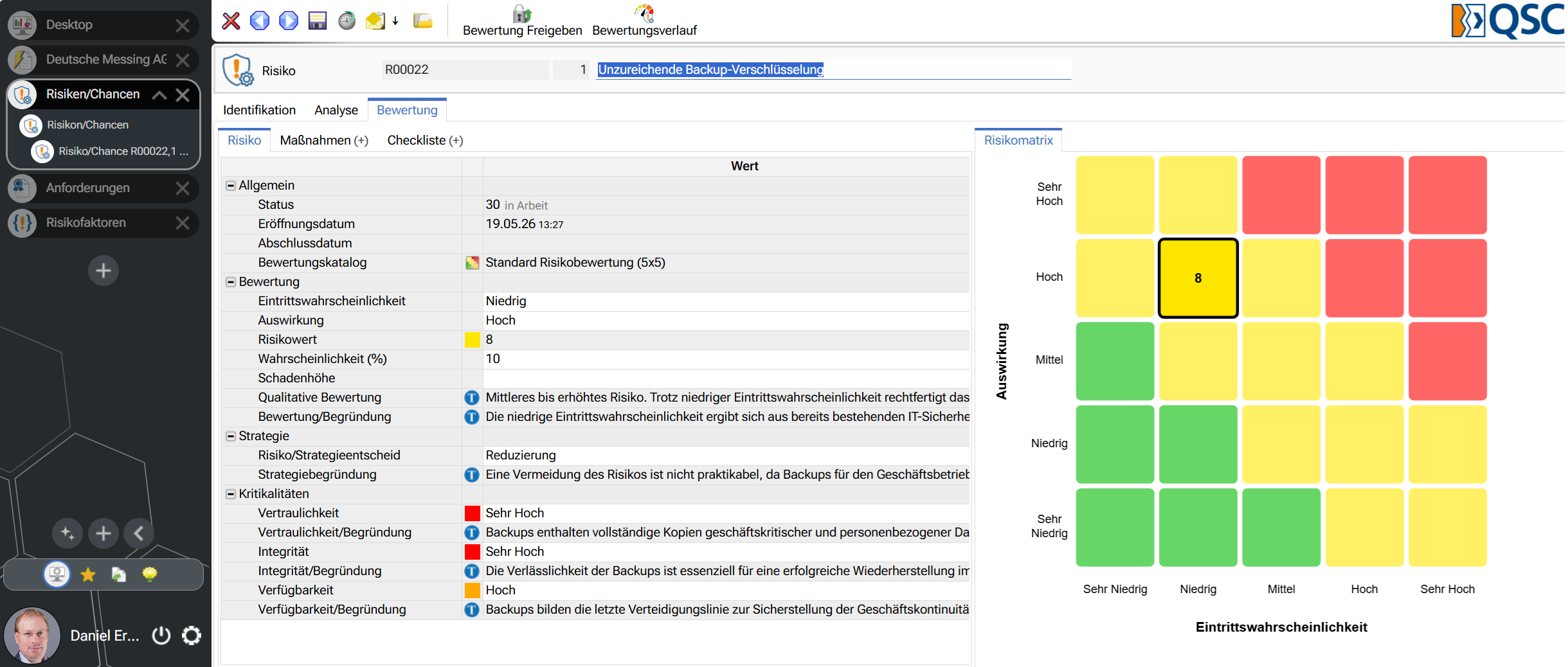
QS1 organizes key objects such as strategic objectives, risks, assets (including IT assets), KPIs/KRIs, requirements, and controls. Risks and opportunities are logically grouped and categorized in risk folders, processed using qualitative and quantitative methods and assessment catalogs, and supplemented with internal and related documents via the integrated document management system (DMS). Reassessments are performed periodically (automatically triggered by reminder functions) and on an ad-hoc basis, including versioning, historical tracking, and trend analysis.
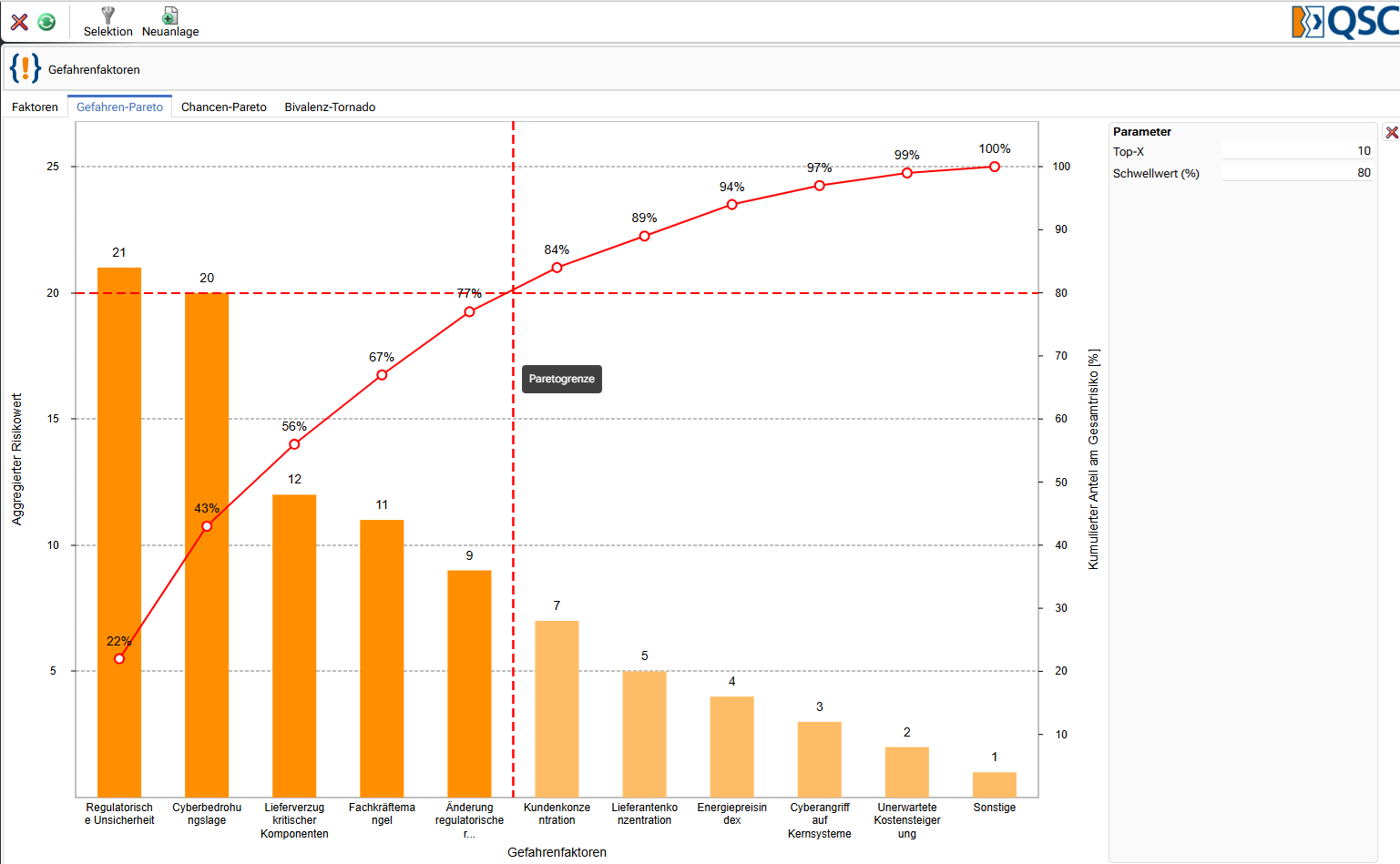
Treatment strategies are directly integrated into action and task management – with clear responsibilities, deadlines, and transparent progress monitoring. The analyses consolidate individual risks into a robust overall view: heatmaps and dashboards show risk distribution, key areas, and changes over time at a glance. Periodic management reports, culminating in the ISMS status report, provide a consistent basis for decision-making (overall risk situation, top X risks, risk trends) and identify the need for control measures early on.
- Strategic risk and opportunity management according to ISO 31000
- Joint consideration of risks and opportunities, including dependencies
- Organization of strategic goals, risks, assets (including IT assets), KPIs/KRIs, as well as requirements, controls, and responsibilities
- Structured risk identification using assessment catalogs, risk maps, classifications, risk sources, influencing factors, and affected areas/stakeholders
- Consequence modeling (financial, operational, compliance/security/strategic consequences)
- Qualitative and quantitative analysis and recording of financial and operational impacts
- Assessment catalogs with risk matrix logic; Comparable key performance indicators (KPIs) and visualization in heatmaps
- Workflow-supported action and task management for risk tracking, including deadlines/status
- Periodic reassessment with versioning, history, and automatic resubmission (review dates/reminders)
- Impact analysis via links between assets, risks, and strategic objectives
- Real-time evaluations: dashboards, KPIs, charts, ISMS status report
- Convenient data entry via online templates (selection by standards/threat scenarios/risk groups) and import of existing data
- Deep integration with DMS/SOP, process management, requirements management, BI, and workflow/action management

Does this sound familiar?
- Risk-based thinking is required by standards and customers, but internally it remains fragmented: risks, opportunities, objectives, assets, requirements, and measures are scattered across files, emails, and isolated solutions.
- Risks are considered too narrowly: FMEA covers development and product, but strategic risks, dependencies, compliance/security issues, and opportunities are not managed holistically.
- Assessments are neither comparable nor periodic: methods, scales, and catalogs vary by area, and reviews occur irregularly. Management lacks a reliable picture of top risks, trends, and effectiveness.
- Measures are ineffective: decisions are made regarding treatment, but responsibilities, deadlines, escalations, and evidence of effectiveness are not consistently transparent and traceable.
- Communication becomes cumbersome: without a clear structure and history, decisions regarding treatment (avoid, mitigate, delegate, accept) are difficult to justify (internally, externally, with audits, customers, and within the ISMS).
This should be achieved through a robust process
- A consistent end-to-end process according to ISO 31000: Identification => Analysis => Assessment => Treatment => Monitoring/Review => Reporting, including documentation/versioning.
- Central organization of core objects: strategic objectives, risks, opportunities, assets, requirements, controls, responsibilities, and KPIs/KRIs must be integrated into a single structure.
- Comparable assessments using catalogs and matrices: qualitative and quantitative methods, clear scales, consequence models (financial, operational, compliance/security, strategic), and transparent assessment logic.
- Periodic and ad-hoc reassessment: follow-up, review dates, history, and progress tracking to identify trends and prevent the risk profile from becoming outdated.
- Effective implementation instead of paperwork: treatment strategies must be directly translated into actions and tasks with status, deadlines, escalation, and effectiveness reviews, plus management reporting (top X, heatmaps, overall risk situation).
Coverage in QS1
- Organizes requirements centrally and systematically via a source management system for standards, laws, regulations, contracts, and compliance documents; requirements are categorized, freely tagged, and tracked with responsibilities, status, and completion status.
- Manages requirements in an audit-proof manner through versioning and release processes: which requirement was valid when, what changes were made, and how decisions were justified.
- Ensures system-level traceability by bidirectionally linking requirements with processes, risks/controls, documents (including DMS/SOPs), as well as actions and workflows (plus continuous documentation).
- Translates complex sources into actionable to-dos: Centrally responsible parties can specify requirements internally and distribute them in a structured manner to process and risk owners.
- Controls implementation via integrated workflow and action management: tasks, deadlines, reminders, and escalations prevent delays; comments, queries, and decisions are traceable both at the requirement object and at process, risk, and document objects.
- Automatically informs affected parties of new or changed requirements and requests the review or adjustment of affected processes, risks, controls and documents using system support; evaluation is carried out via BI dashboards and reports.
Your result: Centralized transparency across all requirements, including responsibilities and fulfillment levels; reduced risk through clear management and versioning; true traceability for audits; faster implementation through workflows; and consistent implementation in processes, SOPs, and risk management. Parallel storage becomes a thing of the past.
Your Advantages
- Comprehensive and comparable risk assessments instead of isolated individual assessments
- Continuous action tracking with deadlines, status, and responsibilities
- Clear prioritization of top risks and opportunities, including trends over time (history)
- Transparent decisions regarding handling (avoid, mitigate, delegate, accept) including documented justifications
- Improved controllability through KPIs/KRIs, heatmaps, and dashboards (also by relevant target groups)
- Faster, more consistent data capture via templates/import instead of manual parallel data storage
- Stronger integration of risk-based thinking into management systems and critical processes through process and DMS integration
