
Challenges in practice
In addition to traditional supplier evaluations, structured customer evaluations are becoming increasingly important. Companies face the challenge of systematically consolidating diverse information—from quality indicators and complaint rates to delivery and process metrics—and creating a transparent evaluation basis.
More and more often, individual criteria are also being incorporated into customer evaluations, such as audit results, joint development projects, strategic partnerships, or industry-specific requirements like GxP certifications. This information typically originates from different systems and processes and must be integrated for sound analysis. Without an integrated system, it is difficult to derive a consistent, traceable, and regularly updated evaluation.
Solution QS1
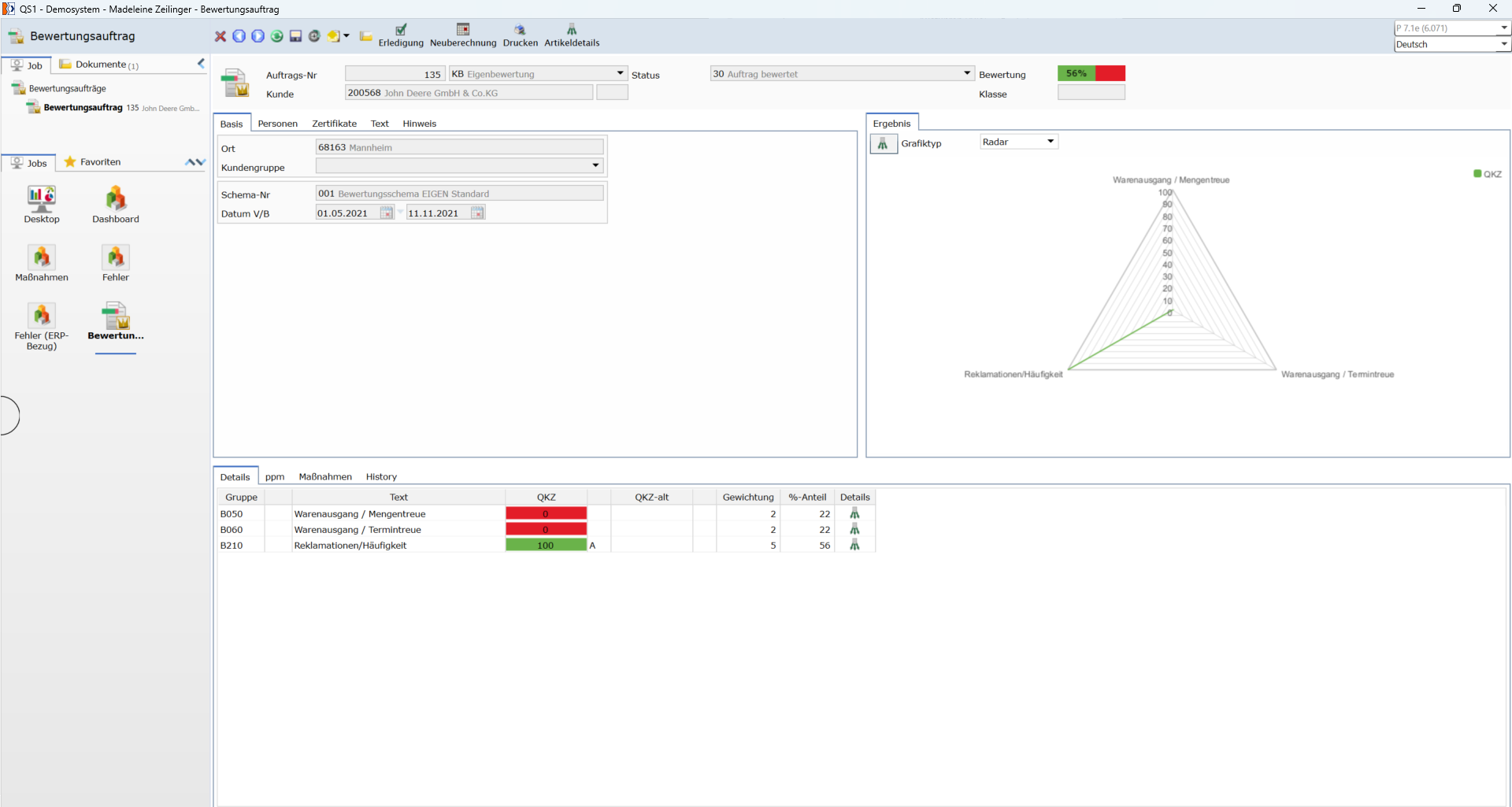
With QS1, you create structured and flexible customer evaluations based on all relevant quality and ERP data. Freely definable evaluation rules allow you to incorporate both classic quality indicators such as complaint rates, ppm values, or delivery performance, as well as individual evaluation criteria into your analyses.
Evaluations in QS1 are managed via evaluation orders, the timeframes of which can be flexibly defined – for example, monthly, quarterly, or as part of a standards-compliant annual evaluation. Thanks to direct integration with your ERP system, all relevant master data, such as orders, deliveries, or complaints, are immediately available and can be used for detailed analyses.
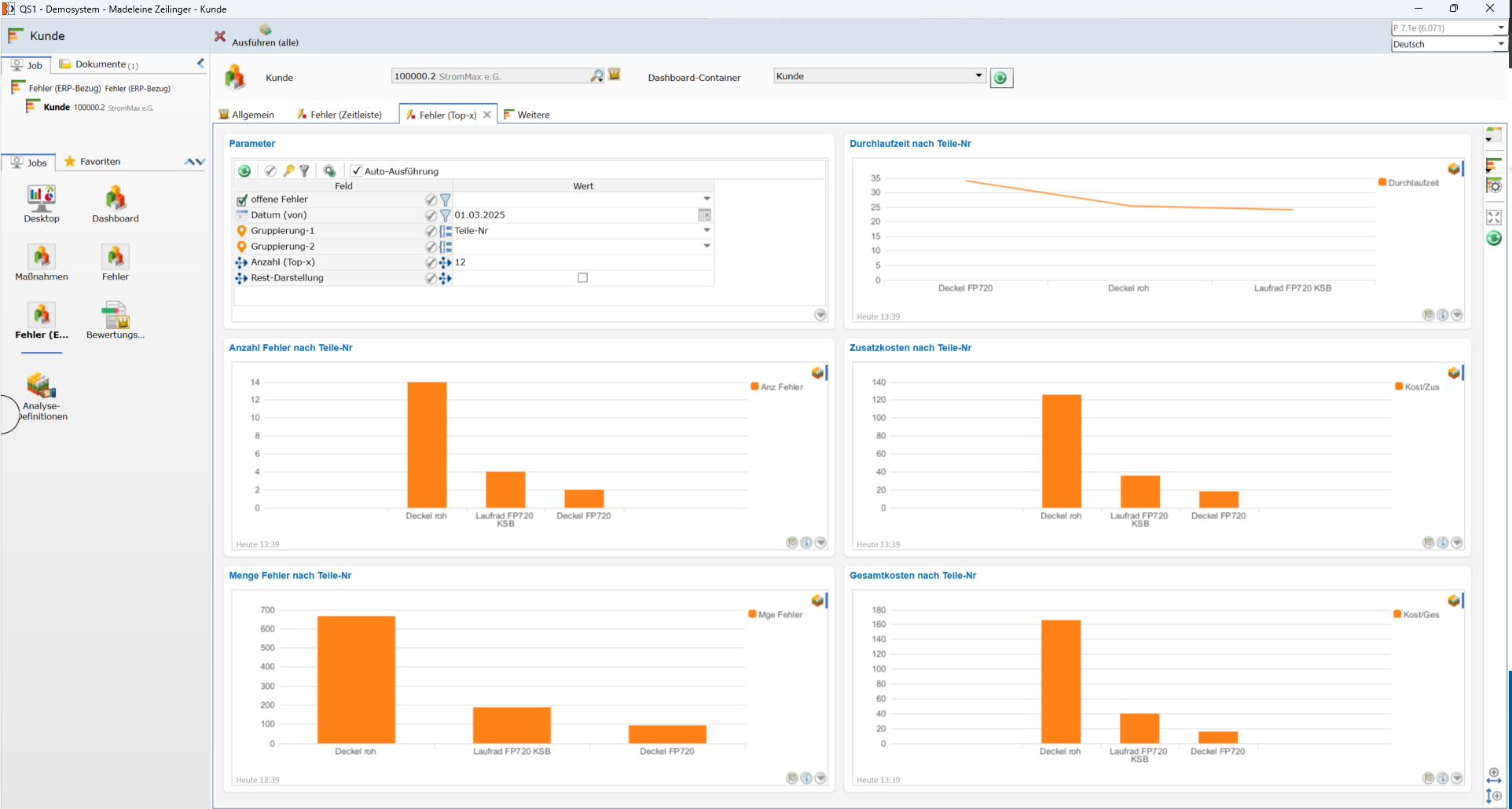
The results of the customer evaluations can be clearly presented and made available to different target groups as needed. For example, key figures and analyses can be published internally via dashboards or the intranet portal, or used specifically for management reports and strategic decisions. This creates a transparent and sound basis for actively managing customer relationships, identifying potential, and strategically developing long-term partnerships.
- Automated monitoring and benchmarking of your customers based on defined quality indicators
- Freely definable rating schemes at the customer or customer group leve
- Integration of hard facts such as on-time delivery, delivery capability, complaints, ppm, corrective actions, or price trends
- Supplementation with individual soft-fact criteria such as audit results, development partnerships, or strategic factors
- Direct connection to ERP data such as sales orders, delivery notes, or complaint information
- Drill-down analyses from the overall KPI to the individual delivery note or complaint item
- Trend analyses with freely definable comparisons to previous periods for the early identification of optimization potential
- Integrated formula editor for complex rating logics and individual KPI models
- Rating simulations to analyze the potential impact of planned changes
- Multi-level consolidation and multi-site support for cross-location ratings
- Integrated results visualization with rankings and benchmark comparisons
- Publication and communication of rating results via QS1 portals or Internal dashboards
- Historical tracking and status monitoring of all ratings for maximum transparency
- Comprehensive standard forms and freely definable reports via integrated form generator
Does this sound familiar?
- Suppliers are systematically evaluated, but a comparable, reliable view of customers is lacking: Quality indicators, complaint rates, delivery and process metrics are scattered, meaning that statements about customer quality and effort are often based on isolated pieces of information.
- Important influencing factors are not integrated into the overall picture: Audit results, joint development projects, strategic partnerships, or regulatory requirements, such as those in the GxP environment, are considered in decisions but are not consistently documented and evaluated.
- Evaluations are not reliably reproducible: Depending on the time period, data availability, and source, different results are obtained, leading to discussions and making trends visible too late.
- Traceability down to the document level is lacking: If a metric is unusual, it is unclear whether individual deliveries, complaints, or items are the cause.
- Results do not reach the relevant roles in a timely manner: Sales, quality, and management work with different perspectives because there is no central, regularly updated evaluation that can be used in daily practice.
This should be achieved through a robust process
- A central evaluation logic: Hard facts such as complaints, ppm, delivery performance, and process KPIs must be integrated, while soft facts can be added as defined criteria.
- Flexible evaluation periods and regular updates: Evaluations must be manageable on a periodic basis, such as monthly, quarterly, or annually, and their historical data must be transparently recorded.
- Clear ERP integration: Orders, delivery notes, quantity trends, and complaints must serve as references to ensure that evaluations remain grounded in the real-world business context.
- Drill-down functionality and trend analysis: It must be possible to navigate from the overall evaluation down to the individual delivery note or complaint item, and trends must be visible across defined previous periods.
- Publication tailored to specific target groups: Results must be available where decisions are made, such as via dashboards, the intranet, or management reports.
Coverage in QS1
- Creates structured and flexible customer ratings based on relevant quality and ERP data, enabling freely definable rating rules that reflect classic key performance indicators (KPIs) such as complaint rates, ppm values, and delivery performance, and can be supplemented with individual criteria.
- Manages ratings across orders with flexibly definable time periods, including monthly, quarterly, or standard-compliant annual ratings. Historical data and status tracking ensure transparency.
- Directly integrates ERP data such as sales orders, delivery notes, and complaint information, ensuring KPIs remain clearly referenced and can be analyzed in context without duplicate data entry.
- Enables drill-down analysis from the overall KPI to the individual item and supports trend analysis with freely definable comparisons to previous periods, revealing optimization potential early on.
- Supports complex rating logic via a formula editor and enables rating simulations to analyze the impact of planned changes in advance.
- Enables cross-site evaluations through multi-site support and multi-level consolidation, providing rankings and benchmark comparisons.
- Publishes results in a target-group-oriented manner by visualizing evaluations via BI and dashboards or making them available through the intranet portal, thus enabling their use in management reports and strategic decisions.
- Links the evaluation to relevant quality assurance processes, integrating results from outgoing goods inspection, customer complaints (including 8D processes), and audit results as evaluation criteria.
Your result: Transparent, objective customer evaluation based on reliable data, early trend and potential identification, better decision-making basis for sales, quality and management, clear traceability down to the document level and structured management of customer relationships that does not rely on individual knowledge.
Your advantages
- Transparent and objective evaluation of your customer relationships based on structured key performance indicators (KPIs)
- Holistic analysis through the combination of quality, process, and ERP data
- Early identification of trends and areas for improvement
- Improved decision-making basis for sales, quality, and management strategies
- Efficient management of customer development measures via integrated workflows
- Greater transparency through detailed traceability down to the individual document level
- Flexible adaptation of the evaluation system to industry-specific or company-internal requirements
- Cross-site comparability through multi-site functionality
- Time savings through automated data analysis and report generation
- Improved communication with customers through structured and comprehensible evaluation results
