
Challenges in practice
Reliable measurement results are the foundation for sound quality decisions. If measurement systems are not capable, process deviations are either overlooked or falsely detected – with direct consequences for scrap, rework, customer complaints, and audit findings.
Standards and customer requirements – especially in the automotive sector – demand structured measurement system analyses according to MSA-4 or VDA-5. In practice, however, implementation is often complex: test planning, data acquisition, statistical analysis, and documentation are sometimes performed manually or using isolated tools. This results in media breaks, a lack of standardization, and limited traceability.
Furthermore, the organizational integration of MSA into ongoing quality and production processes presents a challenge. New test equipment, changed characteristics, or process adjustments require renewed capability studies – without systematic management, this leads to significant coordination efforts.
Solution QS1
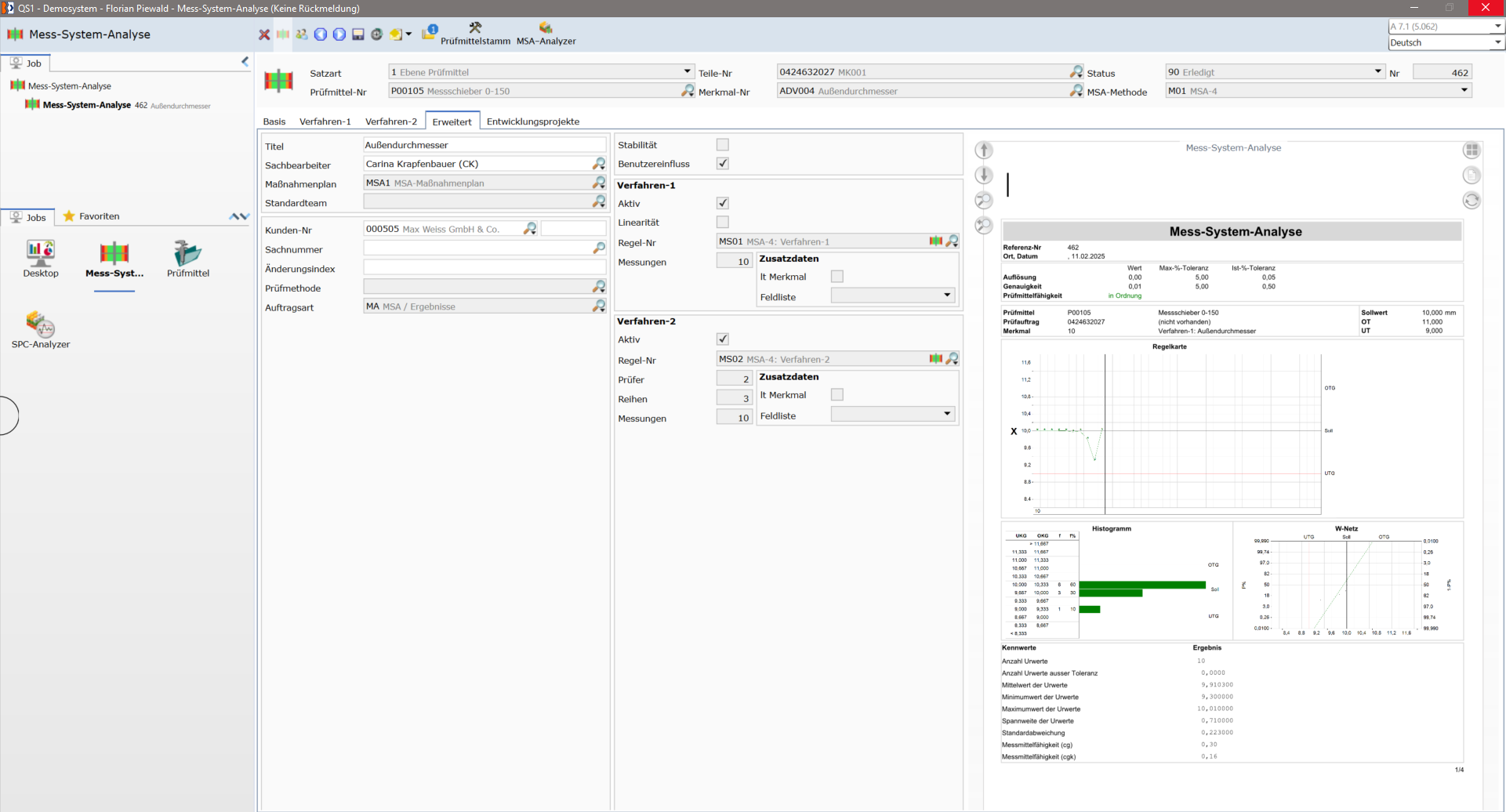
QS1 supports standards-compliant measurement system analysis (MSA) through an integrated, workflow-driven module. Standardized procedures according to MSA-4 and VDA-5 are pre-configured and can be flexibly adapted to company-specific requirements.
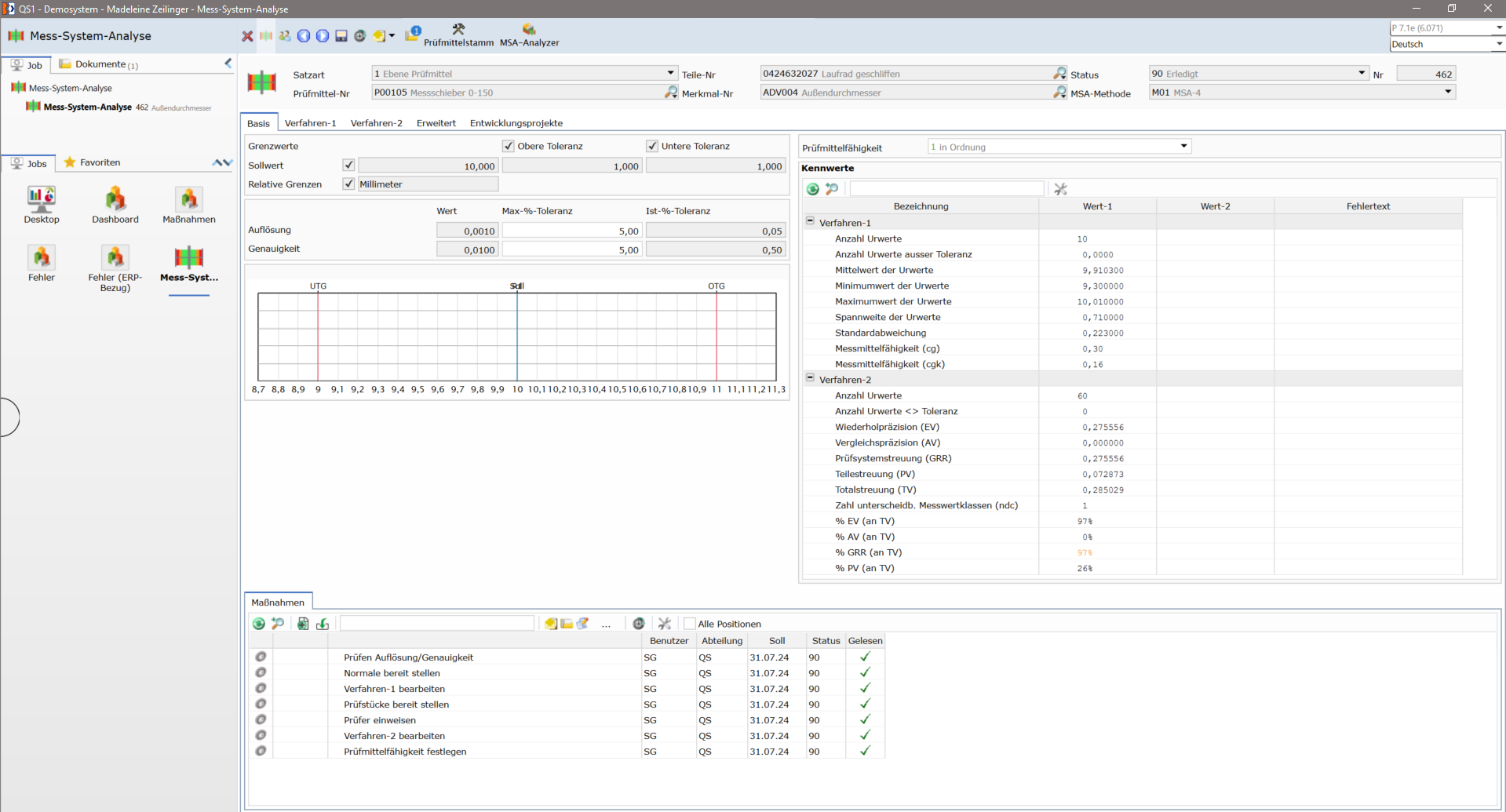
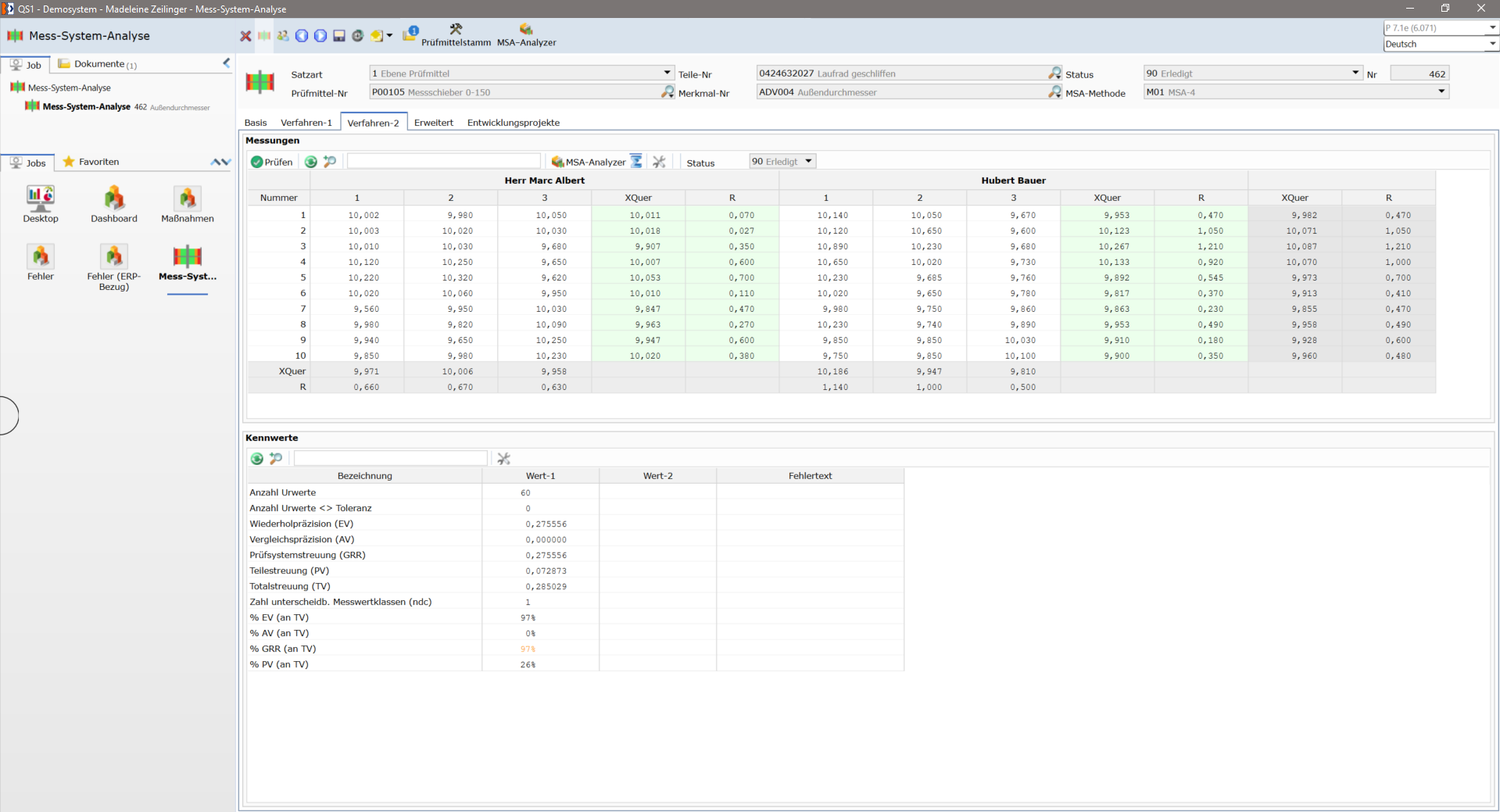
The entire MSA process—from planning and data acquisition to the automatic calculation of relevant parameters—is managed and documented by the system. Results such as standard deviations, capability indices, and rule violations are automatically evaluated and clearly assessed.
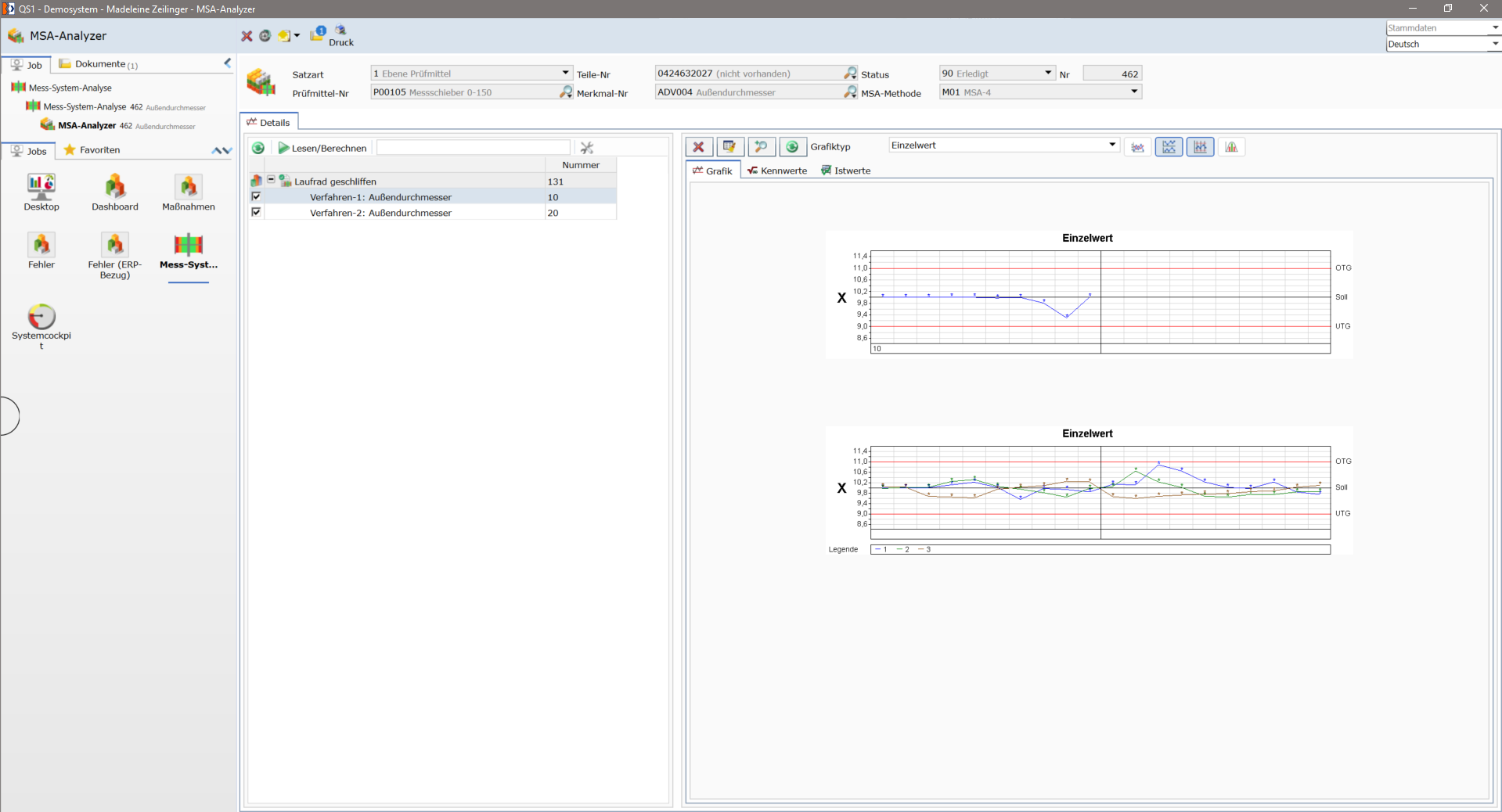
An integrated MSA analyzer enables the graphical display and detailed analysis of measurement results. By embedding it within the overall QS1 system, MSA results are directly linked to test equipment, test characteristics, and quality processes. Status changes—for example, in the case of incompatible measuring systems—immediately affect their usability in the testing process.
In addition, business intelligence functions are available to evaluate, group, and analyze MSA results in real time across different locations or test equipment.
- Pre-configured MSA and VDA methods with individual parameterization
- Automatic calculation of capability indices including rule monitoring
- Workflow-based process management with to-do lists and status logic
- Integrated MSA analyzer for detailed graphical evaluation
- Linking to test equipment, test characteristics, and tolerance limits
- Historical logging and traceability of all MSA data
- BI dashboards for grouped analysis by test equipment, location, or status
Does this sound familiar?
- You make quality decisions based on measured values, but the reliability of the measurement systems is not consistently documented: A non-compliant measurement system leads to deviations being overlooked or apparent errors occurring, directly impacting scrap, rework, and customer complaints.
- Customers and standards expect MSA-4 or VDA-5 compliant verification, but implementation is complex: Test design, data acquisition, statistical analysis, and documentation are sometimes performed manually or in separate tools, which compromises standardization and traceability.
- MSA results are not properly integrated into the testing process: A measurement system may be formally identified as critical but continue to be used because its status and release for use are not managed by the system.
- Requalifications arise in daily operations: New test equipment, changed characteristics, or process adjustments require renewed capability verification, but without systematic follow-up and coordination, significant coordination efforts are required.
- Transparency is lacking as soon as things get complex: Which testing equipment is capable, which is under observation, which is blocked, and how does the measurement system capability develop over time and locations?
This should be achieved through a robust process
- Standards-compliant, guided MSA processes: Methods according to MSA-4 and VDA-5 must be available in a standardized format, while simultaneously being adaptable to the company context.
- End-to-end process management: Planning, data acquisition, analysis, evaluation, and documentation must be integrated into the system to ensure reproducible and audit-proof results.
- Automatic calculation and clear evaluation: Relevant key performance indicators and control monitoring must be performed system-wide, with unambiguous result interpretation and status logic.
- Linking to test equipment and characteristics: MSA must be directly linked to the test equipment and test characteristic to ensure unambiguous tolerance limits and application context.
- System impact in the testing process: Incapable measuring systems must trigger consequences, such as restrictions or blocking of usability, to prevent risks from being carried over into series production.
- Transparency and controllability: BI analyses must make the status and development of MSAs visible to enable fact-based management of priorities and requalifications.
Coverage in QS1
- Supports standards-compliant execution of measurement system analyses (MSAs) through an integrated, workflow-driven MSA module that provides pre-configured procedures according to MSA-4 and VDA-5 and allows for company-specific parameterization.
- Manages the entire MSA process within the system, ensuring seamless documentation of test design, data acquisition, and the automatic calculation of relevant parameters, and providing clear evaluation of the results.
- Automates the evaluation by calculating and transparently interpreting standard deviations, capability indices, and rule violations, eliminating the need for decisions based on Excel spreadsheets or individual expertise.
- Offers an integrated MSA analyzer that enables graphical representation and detailed analysis, thus creating transparency regarding measurement behavior and variations.
- Directly links MSA results to test equipment, test characteristics, and tolerance limits, ensuring that capability studies, status, and deployment approvals are considered by the system and that non-capable measurement systems immediately impact the process.
- Supports organizational management through workflows, to-do lists, and status logic, and enables the derivation of actions with clearly defined responsibilities, which are tracked in action management.
- Complements the operational view with BI dashboards that analyze MSA results in a grouped manner, for example, by testing equipment, location, or status, thus revealing trends and areas for action early on.
Your result: Standards-compliant MSA verification with significantly less manual work, higher process reliability through guided processes, clear decision-making bases for the release of measurement systems, full auditability and a direct, effective integration of MSA into test planning, SPC and operational quality processes.
Your advantages
- Standards-compliant execution of measurement system analyses according to MSA-4 and VDA-5
- High process reliability through workflow-driven processes
- Automatic calculation and evaluation of relevant parameters
- Reduction of manual evaluations and media breaks
- Clear basis for decisions regarding the approval or restriction of measurement systems
- Complete documentation and audit compliance
- Direct integration into test planning, SPC, and quality processes
- Real-time transparency regarding the status of all performed MSAs
