
Challenges in practice
In many quality assurance/quality management processes, the consistent implementation of measures for continuous improvement is crucial. However, in the daily grind, measures often go unnoticed before they take effect, or lose their value because their implementation isn't fully tracked. Without comprehensive monitoring, the impact on identified shortcomings remains limited, and the expected benefits are lost.
This becomes particularly critical when measures aren't visible across systems – this is where the cross-module functionality in QS1 offers a decisive advantage. Thanks to seamless ERP integration, measures are derived, managed, and documented directly from the relevant business processes, ensuring they have an impact where they're needed.
Solution QS1
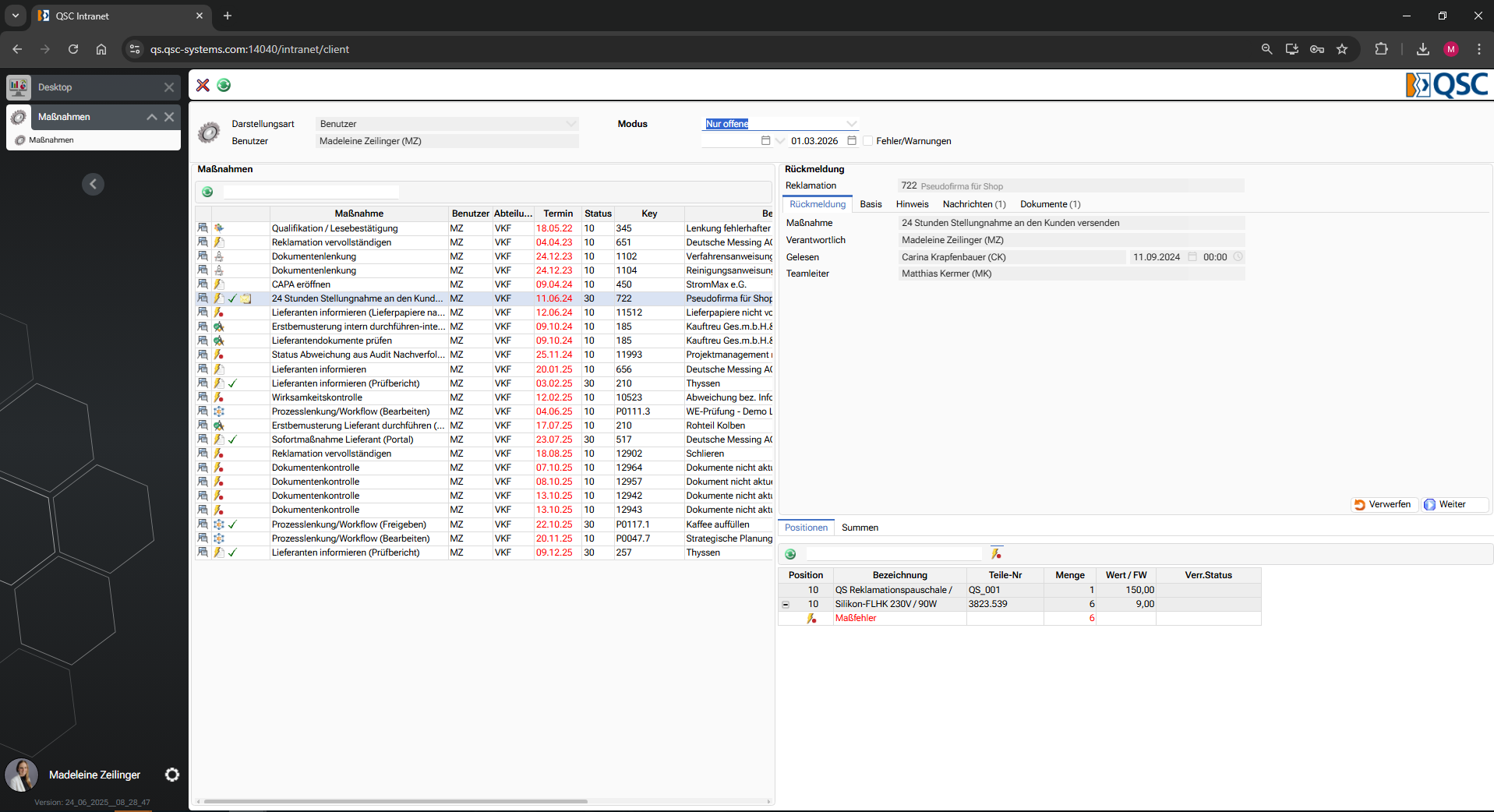
QS1 offers a seamless, workflow-based action management system used in virtually all modules – from initial sample inspections and FMEAs to comprehensive defect management. Actions are planned, controlled, and monitored directly within the context of your processes.
With integrated action monitoring, to-do lists, email notifications, mobile access, and escalation functions, your employees are informed promptly and flexibly. This ensures that no tasks are overlooked in daily operations.
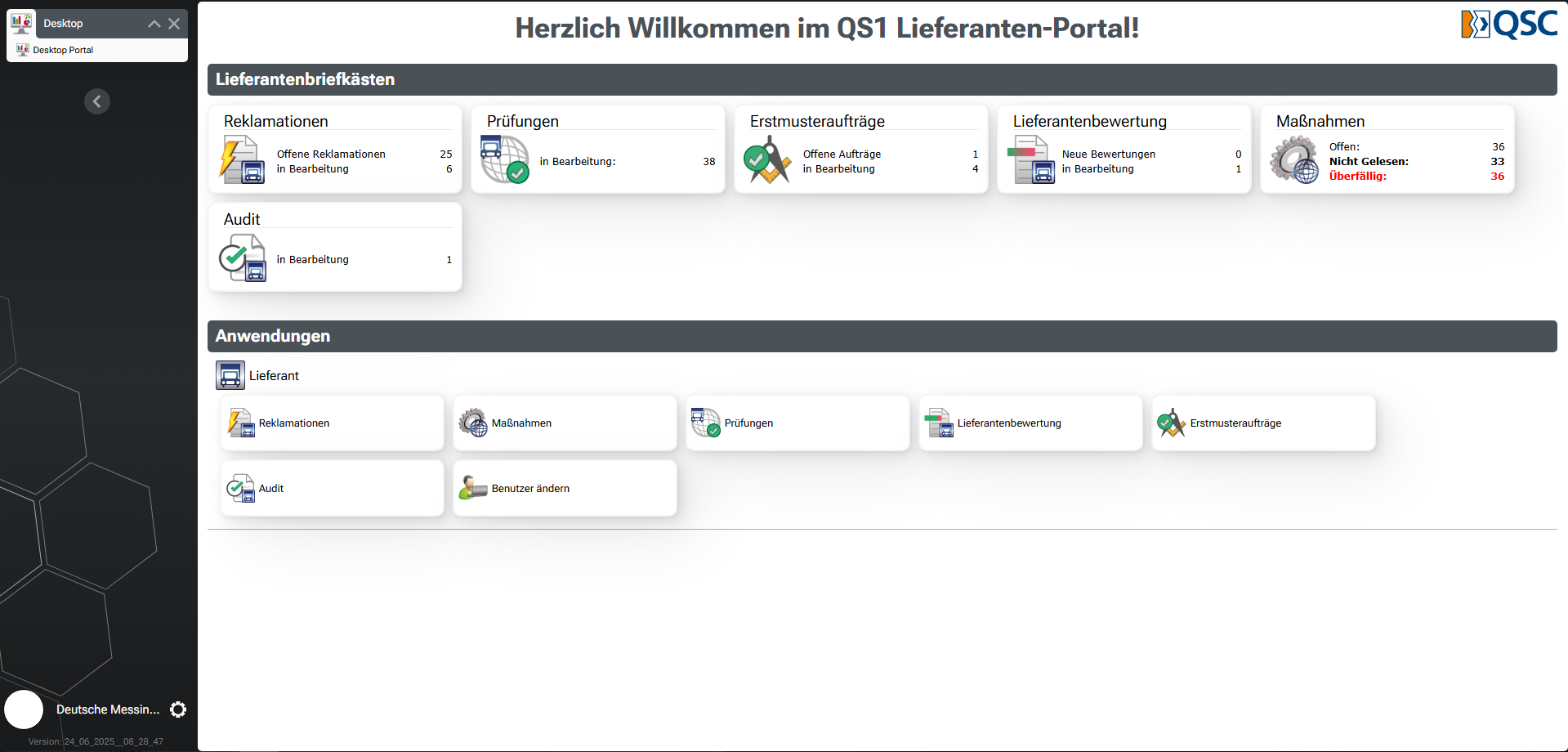
Your business partners can also be integrated via the QS1 portal solutions – with all tasks in the appropriate context, for example, in deviation management or initial sample inspections.
In addition to manually created actions, such as those derived from FMEA action statuses, QS1 also supports automatically generated, event-driven actions, enabling even more dynamic and efficient process control.
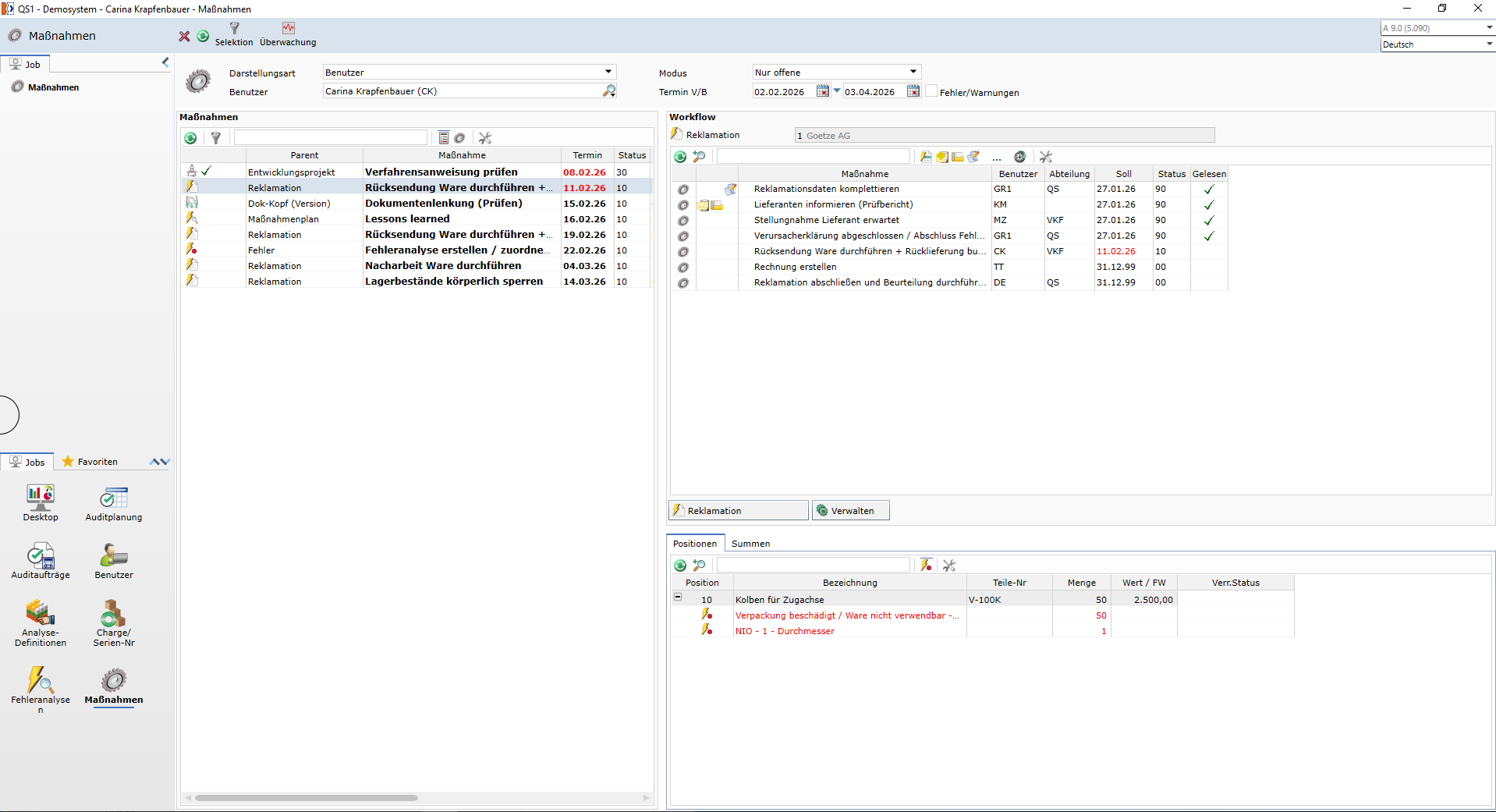
- Actions: Free definition of actions and tasks for all QS1 objects (e.g., CAPAs, qualification matrix, FMEA, test equipment management)
- Messages: Integrated message management with email integration
- Workflows: Predefinable standard workflows with automatic assignment
- Links: Creation and sending of links for all QS1 objects
- Events: Event-driven activation of actions
- Status: Status tracking for actions and tasks
- Monitoring: Freely definable monitoring rules
- Roles: Role concept and team building
- Automation: Automatic email sending by the monitoring agent
- Escalation: Multi-level escalation management
- History: History tracking of actions, tasks, and messages
- ERP Integration: Integration with the workflow functionalities of your ERP system
Does this sound familiar?
- Measures are decided upon, but get lost in the daily grind: tasks are postponed, responsibilities become blurred, and ultimately it's unclear whether any effect has been achieved.
- Status and priorities are not centrally visible: each department maintains its own list, and there's no consistent view of open, overdue, or critical measures.
- Measures exist "off" the surface of the process: deviations, audits, FMEAs, or EMPBs generate insights, but implementation takes place in separate tools or emails, without a clear link to the origin.
- Escalations come too late or not at all: without rules, reminders, and a clear hierarchy, "urgent" quickly becomes "sometime in the future."
- External partners are difficult to involve: suppliers and customers are expected to handle measures, but collaboration ends with PDFs, email chains, and media breaks.
This should be achieved through a robust process
- Contextualized action management: Every action must be clearly linked to the triggering object (e.g., deviation, CAPA, audit finding, FMEA, test equipment, qualification matrix, etc.).
- Workflow-based processing: Responsibilities, deadlines, status, escalations, and effectiveness checks must be managed reliably, not simply as a list.
- Central transparency: To-do lists, monitoring, and a management view of open, overdue, and risk-relevant actions must be available at all times.
- Automation instead of follow-up: Event-driven actions, automatic assignment, notifications, and monitoring rules reduce coordination efforts and prevent delays.
- Cross-company and cross-partner collaboration: Internal teams and external business partners must be able to be involved in the right context, with clear permissions, and without any media breaks.
Coverage in QS1
- Provides a consistent, workflow-based action management system as a cross-module foundation and is usable in virtually all QS1 modules – from EMPB and FMEA to the entire deviation and complaint management process.
- Enables the free definition of actions and tasks for all QS1 objects, ensuring that implementation and documentation are always clearly anchored at the source.
- Controls processing and monitoring via to-do lists, status tracking, freely definable monitoring rules, multi-level escalation management, and audit-proof archiving of actions, tasks, and communication.
- Automats notification and follow-up via integrated message management with email integration and automatic dispatch through monitoring and workflow mechanisms.
- Supports standardized, predefinable workflows and templates with automatic assignment, role and team concepts, and event-driven activation of actions directly from relevant QS/QM processes.
- Offers a QS1 portal solution that allows both external partners such as suppliers and customers, as well as internal employees, to process their assigned actions in the correct context (without media breaks and with clear authorization control).
- Seamlessly integrates action processes into ERP-related workflows, enabling actions to be derived from business processes, managed, and documented, and to take effect where needed.
Your result: No more “lost” actions, clear responsibilities and deadlines, transparent status and escalation logic, reduced coordination effort through automation, better evidence of effectiveness and a uniform improvement process across modules (internally and with business partners).
Your Advantages
- Standardization: QS1 standardizes your quality-related processes – company-wide, across modules, and sustainably.
- Templates: Predefined templates ensure consistent and efficient processes.
- Workflow: Integrated workflow functions create process reliability for all involved.
- Networking: Action workflows can be used in all modules and connect your company internally as well as with business partners.
- Analysis: Integrated analysis options allow you to map key performance indicators and present them via freely configurable dashboards.
