
Challenges in practice
Today, customers expect not only a flawless product, but also comprehensive and individualized quality assurance documentation for each delivery, batch, serial number, or vehicle ID.
The necessary documentation is generated along the entire value chain and must be complete and readily available at the time of delivery. In addition to acceptance documents such as the 3.1 certificate, test reports, certificates of competence, or certificates from your suppliers are frequently required.
Missing or incomplete documentation quickly leads to delays, queries, or, in the worst case, delivery stoppages – even though the product itself is already ready for shipment.
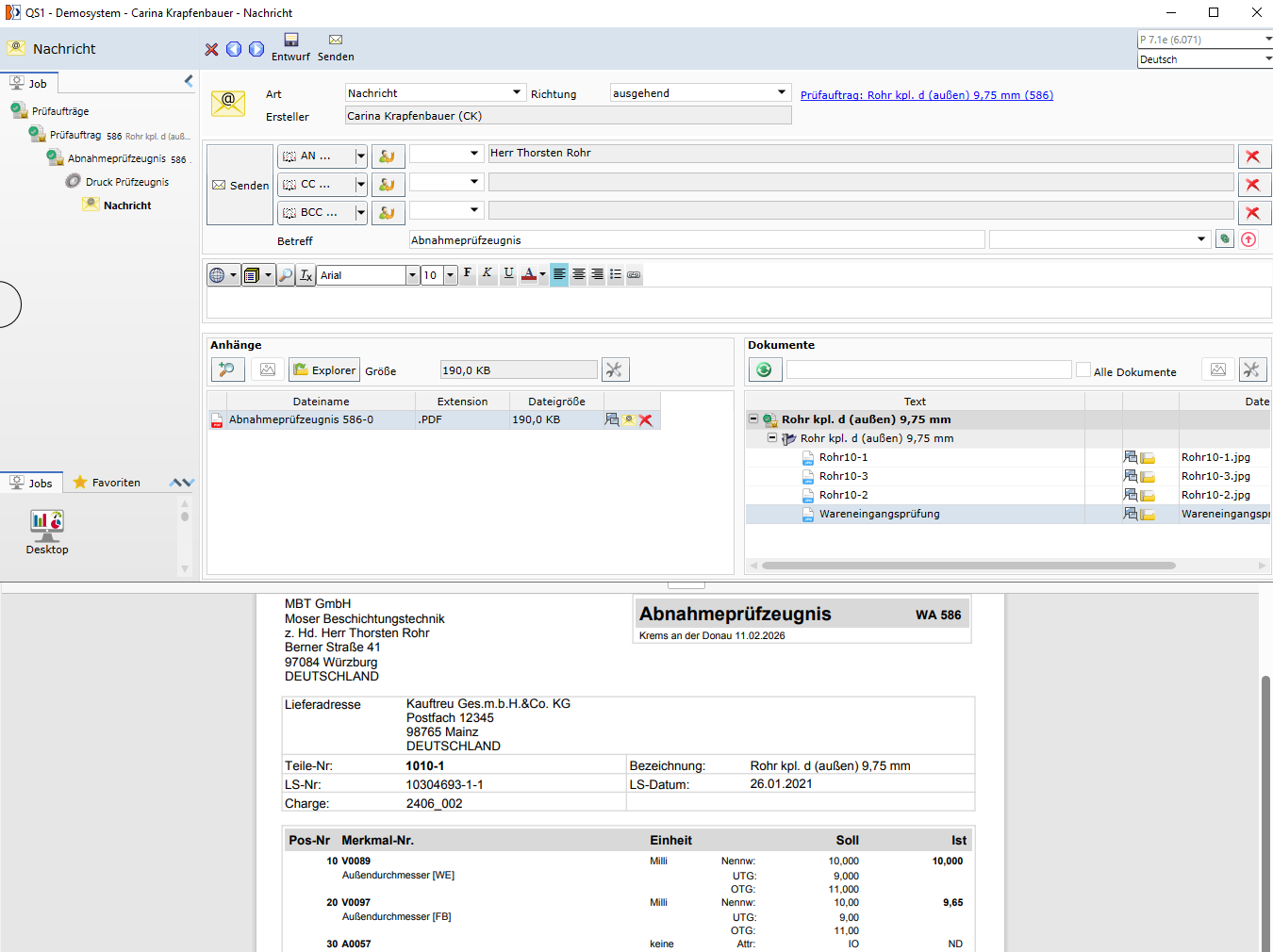
Solution QS1
With QS1, you plan and control your outgoing goods inspections in direct integration with the flow of goods in your ERP system. Sales orders or delivery notes in the shipping process automatically generate the corresponding inspection orders – seamlessly integrated into your workflows.
Flexible inspection intensity adjustment allows inspection effort and depth to adapt precisely to customer requirements, risk assessments, or quality levels. This ensures the required quality standards while optimizing resource utilization.
QS1 supports various methods for distributing inspection orders company-wide. Your employees are guided intuitively through the inspection steps and receive all relevant, customer-specific information for each characteristic – from text and images to documents and CAD data.
To reduce inspection effort, results and documentation from upstream processes, such as production inspections, can be directly referenced. Combined with batch and serial number tracking, you maintain a complete overview of your quality records along the entire value chain – from your supplier's outgoing goods inspection to the delivery note to your customer.
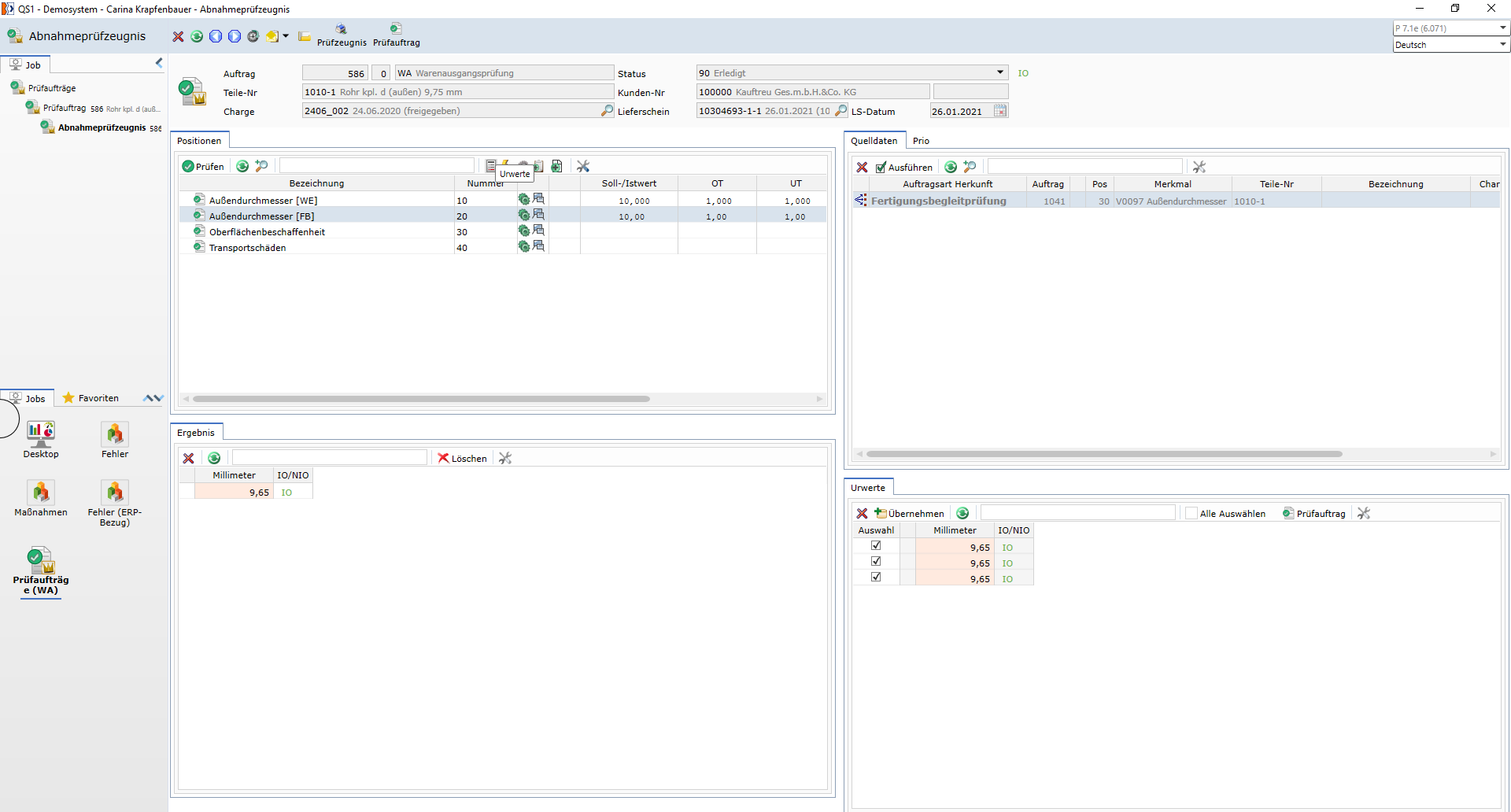
- Inspection results from the value chain: Actual values from production are reused in outgoing goods.
- Delivery-related inspection orders: Inspection orders are generated specifically for planned customer deliveries and provided in a structured format.
- ERP automation: Sales and shipping data from your ERP system automatically generate inspection orders.
- Inspection station management: Comprehensive functions enable targeted control and utilization of your inspection stations.
- Measuring instrument connectivity: All common measuring instruments and machines can be directly connected.
- Traceability: Batches, serial numbers, cavities, as well as additional and process data are fully documented.
- Audit trail: A history function at all data levels ensures maximum transparency and traceability.
- Standard forms: Comprehensive inspection certificates, factory inspection certificates, and forms are immediately available for use.
- Information distribution: Automatic transfer of relevant information via workflows and agents.
- Complaint processing: In the event of a defect, complaint processes can be initiated directly.
- Customer evaluation: Quality results are directly incorporated into self-assessment and customer management.
- Document control: Centralized management and versioning of quality-relevant documents.
- Transparent key performance indicators: Analyses, evaluations, and dashboards provide a sound basis for decision-making in real time.
Does this sound familiar?
- The goods are ready for shipment, but the documentation isn't: Acceptance documents, test reports, supplier certificates, or qualification certificates are not fully available at the time of shipment.
- Customer-specific requirements vary per delivery/batch/serial number: The testing effort is either set too high (cost) or too low (risk) because clear rules and data are lacking.
- Documents are scattered along the value chain: Results from production and goods receipt are not properly referenced, leading to duplicate checks, media breaks, and queries.
- Missing or incomplete documentation leads to delays, queries, or delivery stoppages, even though the product itself has long since been classified as OK.
- In the event of a defect, there is no clear line of defense: Deviations are identified, but complaint/CAPA processes are not consistently initiated and followed up.
This should be achieved through a robust process
- Delivery-related inspection control: Inspection orders must be generated specifically for individual customer deliveries, directly from the sales order/delivery note, not from manual planning.
- Dynamic inspection intensity: Inspection depth and scope must adapt to customer requirements, quality levels, and risk assessments without creating inspection plan chaos.
- Reuse of existing results: Actual values and evidence from upstream processes (e.g., production inspection) must be referenceable instead of being collected again.
- Seamless traceability: Batch, serial number, and additional and process data must be linked to inspection results and documentation in an audit-proof manner.
- Automated, standardized document generation: Certificates, inspection reports, plant inspection certificates, and forms must be generated completely and correctly, including legally compliant approvals.
Coverage in QS1
- Plans and controls outgoing goods inspections in direct integration with the ERP flow of goods: Sales orders and shipping data automatically generate inspection orders on a delivery-specific basis.
- Flexibly adjusts the inspection intensity based on customer requirements, risk assessments, or quality levels, and supports the company-wide distribution of inspection orders via processes, workflows, and agents.
- Guides employees intuitively through the inspection steps and provides all relevant, customer-specific information for each characteristic (texts, images, documents, CAD data).
- References results and documentation from upstream processes (e.g., actual values from production) in outgoing goods, reduces duplicate inspections, and ensures continuous traceability along the value chain.
- Ensures traceability and documentation through complete documentation of batches, serial numbers, and additional and process data, including an audit trail at all data levels.
- Automatically generates QA output documents such as certificates, test reports, and inspection reports, and enables legally compliant, signed releases, if required, via the Qualified Person release cockpit using the x-eyes principle.
- In the event of an error, it directly initiates complaint processes and links deviations to error analysis/CAPA, ensuring that critical final assembly or shipping problems are resolved systematically.
Your result: Shipping releases without documentation bottlenecks, fewer delivery stops and queries, optimized testing effort despite customer-specific variants, continuous traceability and audit-proof evidence including automatically generated, legally compliant QS output documents.
Your advantages
- Automated document creation: Quality assurance output documents such as certificates, test reports, and inspection reports are generated fully automatically and completely.
- Legally compliant releases: Explicit, signed batch and serial number releases – if required, with dual control via the Qualified Person release cockpit.
- Reduced administrative effort: The clearly structured allocation of required inspections at various levels, in conjunction with your ERP data, minimizes maintenance and administration efforts for inspection plans.
- Seamless ERP integration: Inspection orders with customer-specific requirements are automatically generated through direct data and process communication with your ERP system.
