
Challenges in practice
In dynamic markets, continuous and transparent supplier evaluation is a key success factor. Quality, on-time delivery, complaint handling, and service levels must be regularly analyzed and objectively assessed.
In practice, however, evaluations are often communicated with a time lag, via email, or in isolated reports. Inquiries, objections, or necessary actions for supplier development are inadequately documented and difficult to track.
Therefore, digital integration of your business partners into ongoing monitoring is essential for effective supplier management. Evaluations must be provided in a structured manner, be readily analyzable, and directly linked to actionable steps.
Naturally, all processes must be easily and transparently accessible to your suppliers online, without complex cloud access or replication mechanisms.
Solution QS1
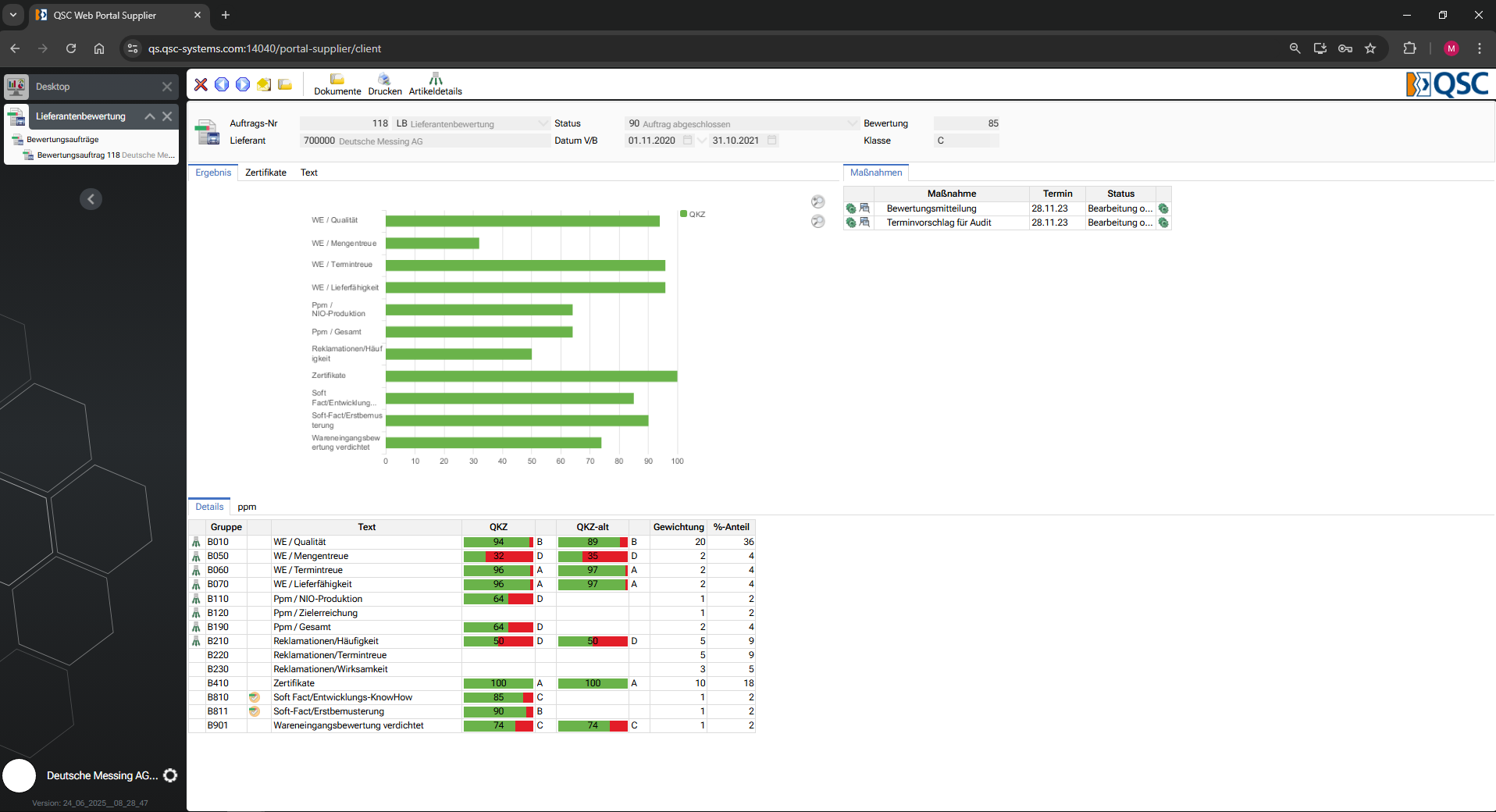
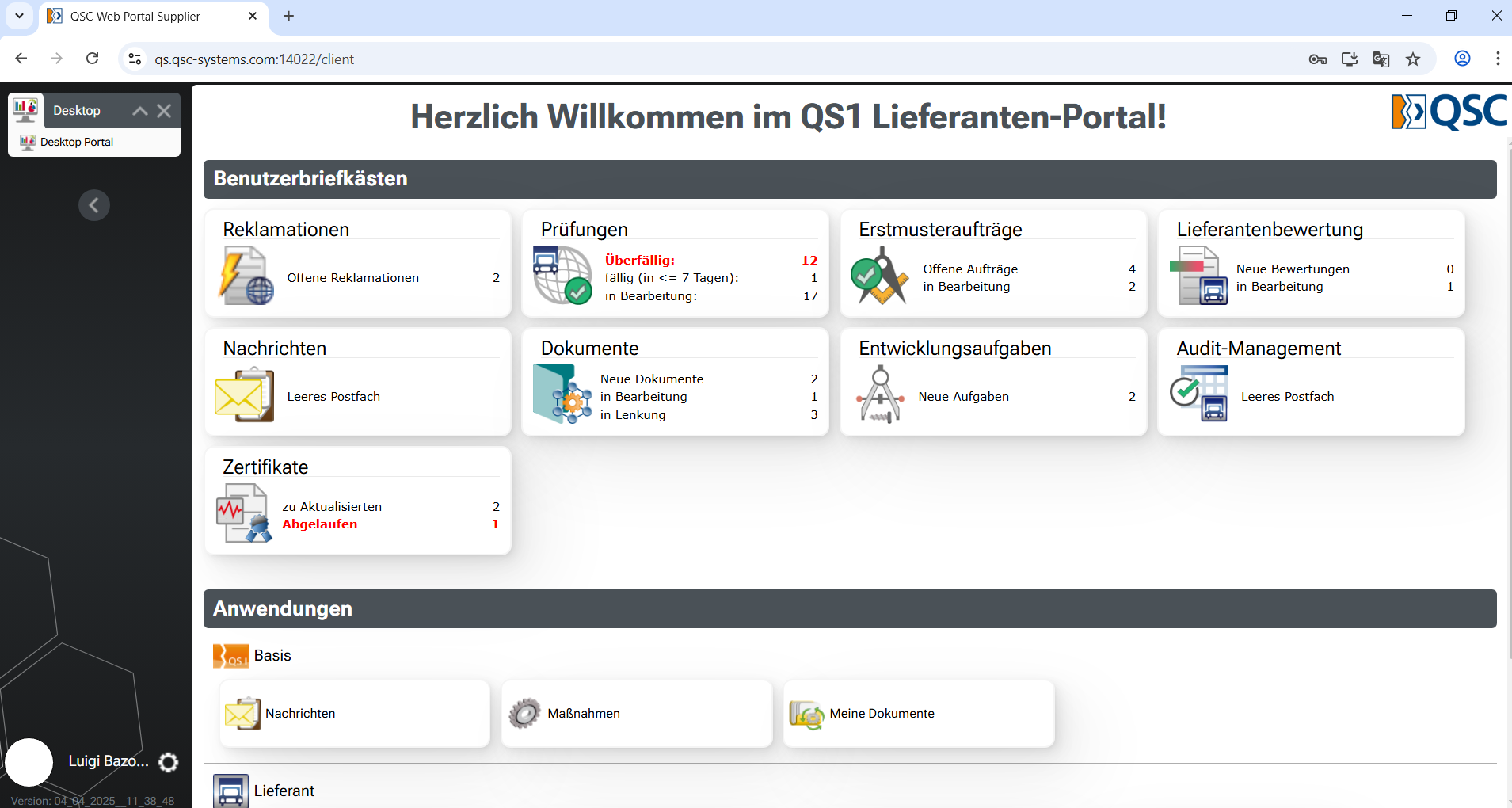
The QS1 supplier portal allows you to provide your suppliers with their current ratings – whether monthly, quarterly, semi-annually, or annually – in a structured and transparent manner.
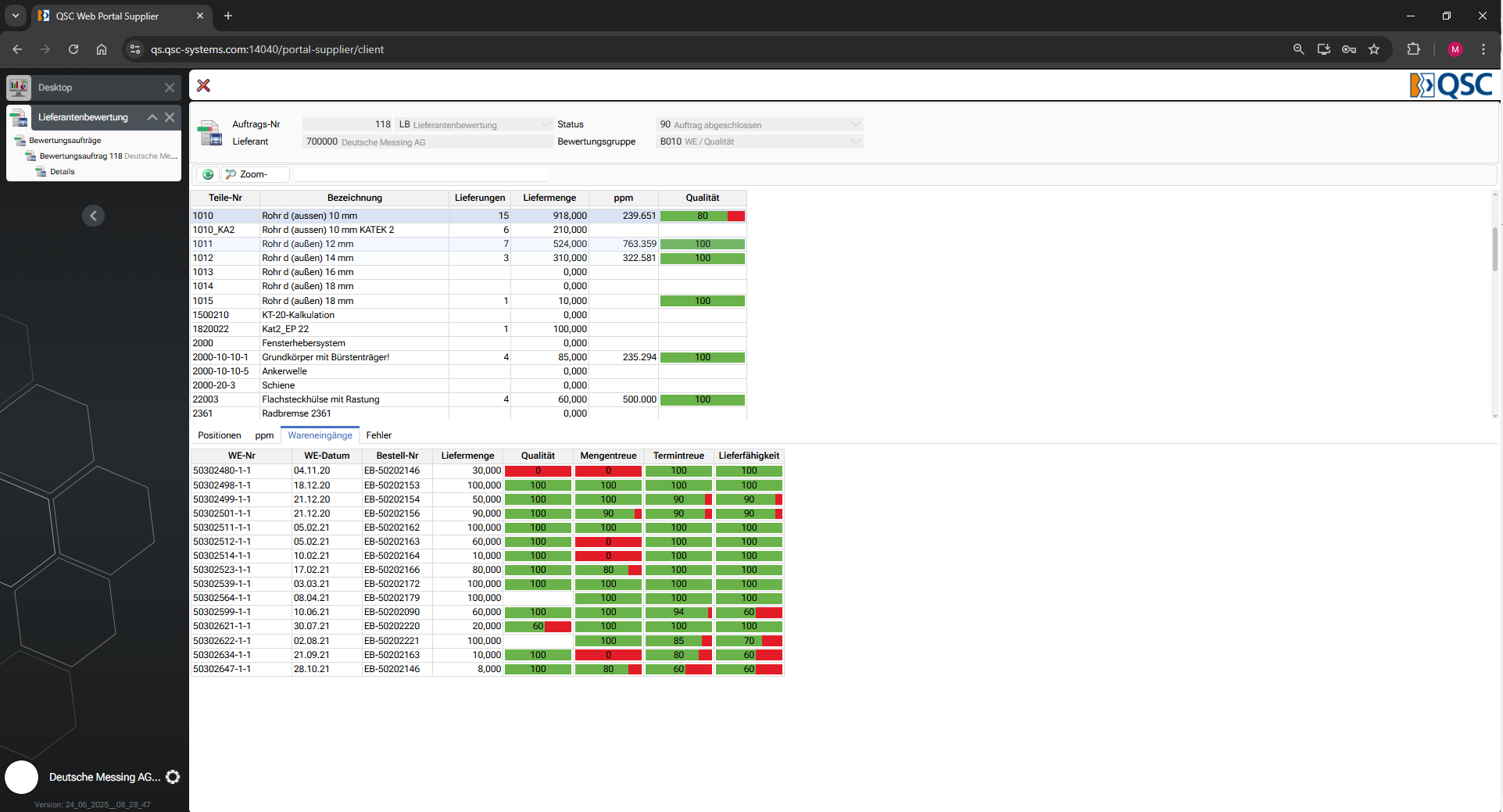
In addition to the rating itself, suppliers gain access to detailed supplementary information. Drill-down mechanisms allow them to analyze the composition of their rating down to the level of individual ERP goods receipts or delivery note items. This creates transparency and an objective basis for discussion.
At the same time, interaction is key: Objections, comments, or suggestions for improvement can be communicated directly via the portal. Supplier development measures are planned, assigned, and managed and monitored through the integrated workflow-based action management system.
This transforms supplier evaluation from a static report into an active management tool – transparent, dialogue-oriented, and fully documented within the QS1 system.
- Online provision of monthly, quarterly, semi-annual, and annual evaluations
- Transparent display of all evaluation-relevant key performance indicators (KPIs)
- Drill-down function down to ERP goods receipt and delivery note item
- Direct access for the supplier to evaluation details and background information
- Interactive communication of objections and comments
- Workflow-driven planning and tracking of development measures
- Complete documentation of all evaluations and action histories
- Easy browser-based use without installation
- "Internal" and "external" views for maximum transparency
- Seamless integration into existing QS1 processes
Does this sound familiar?
- Supplier evaluation is technically important, but operationally inefficient: Reports are generated periodically, sent via email, or stored as isolated files. It can sometimes take weeks to resolve issues.
- Inquiries and objections are handled in an unstructured manner: Discussions take place by phone or email, justifications and decisions are not properly documented and are difficult to trace later.
- Suppliers only see an overall score, but not the underlying reasons: Without drill-down to the document level, transparency is lacking. This leads to unnecessary loops and subjective debates instead of facts.
- Supplier development remains non-committal: Measures are agreed upon, but not consistently assigned, monitored, or checked for implementation; status and adherence to deadlines are opaque.
- Digital integration fails due to IT hurdles: Complex cloud access or replication mechanisms reduce acceptance. Nevertheless, a clean, online solution is needed.
This should be achieved through a robust process
- Structured, timely provision of ratings: Monthly, quarterly, semi-annual, or annual ratings must be available directly without any media breaks.
- Transparency down to the document level: Suppliers must be able to understand which key performance indicators (KPIs) and which specific goods receipts/delivery note items drive their ratings.
- Open communication within the system: Objections, comments, and clarifications must be recorded as robust documentation, versioned, and archived.
- Linking to development and action: Measures must be derivable from rating deviations, assigned, scheduled, escalated, and their effectiveness monitored.
- Simple, controlled online access: Browser-based, no installation required, with clear roles and permissions (consistent internally and externally).
Coverage in QS1
- Provides up-to-date supplier ratings flexibly by period (monthly, quarterly, semi-annually, annually) via the QS1 supplier portal and makes rating-relevant key performance indicators (KPIs) transparent.
- Enables drill-down to the ERP document level: Suppliers can trace how the rating is calculated down to individual goods receipts or delivery note items, thus gaining an objective basis for evaluation.
- Offers an interactive communication layer: Objections, comments, and suggestions for improvement are recorded directly in the portal and remain fully documented and traceable.
- Links ratings with workflow-based action management: Development measures are planned in a structured manner, assigned to the supplier, monitored, and tracked, including deadlines, status, escalations, and effectiveness reviews.
- Ensures a complete history: Ratings, KPIs, objections, and action histories are documented in an audit-proof manner. Internal and external views create maximum transparency.
- Integrates the assessment into existing QS1 processes: Results from supplier complaints and key performance indicators from incoming goods inspection are automatically incorporated. ERP data (orders, delivery dates, goods receipts) form the basis for date- and quantity-related key performance indicators.
Your Result: Transparent, traceable supplier evaluations without email reports, faster clarification of deviations through drill-down and documented dialogue, binding supplier development via measures with status and effectiveness, and strategically controllable supplier performance based on reliable data.
Your Advantages
- Greater transparency in supplier relationships
- Objective and verifiable evaluation criteria
- Faster resolution of evaluation deviations
- Structured supplier development through targeted measures
- Reduction of manual coordination processes
- Improved communication quality with your suppliers
- Early identification of performance deviations
- Sustainable quality and performance improvement
- Clear responsibilities and documented traceability
- Strategic management of your supplier portfolio based on reliable key performance indicators
