
Challenges in practice
Requirements arising from standards, laws, regulations, contracts, traceability and compliance are constantly increasing. At the same time, expectations for traceability and control are rising: Which requirements are currently valid, where do they apply, who is responsible, and what is the degree of fulfillment?
Without a central structure, gaps and duplication of effort quickly arise. Requirements are maintained in parallel, interpreted differently, and not consistently distributed to all relevant departments. Responsibilities, implementation status, and deadlines then become opaque, and changes get lost in the daily grind.
For management systems, traceability is also crucial. It must be possible to trace how a requirement is implemented in processes, documents/SOPs, risks, and measures, and how changes are versioned, approved, and controlled.
Solution QS1
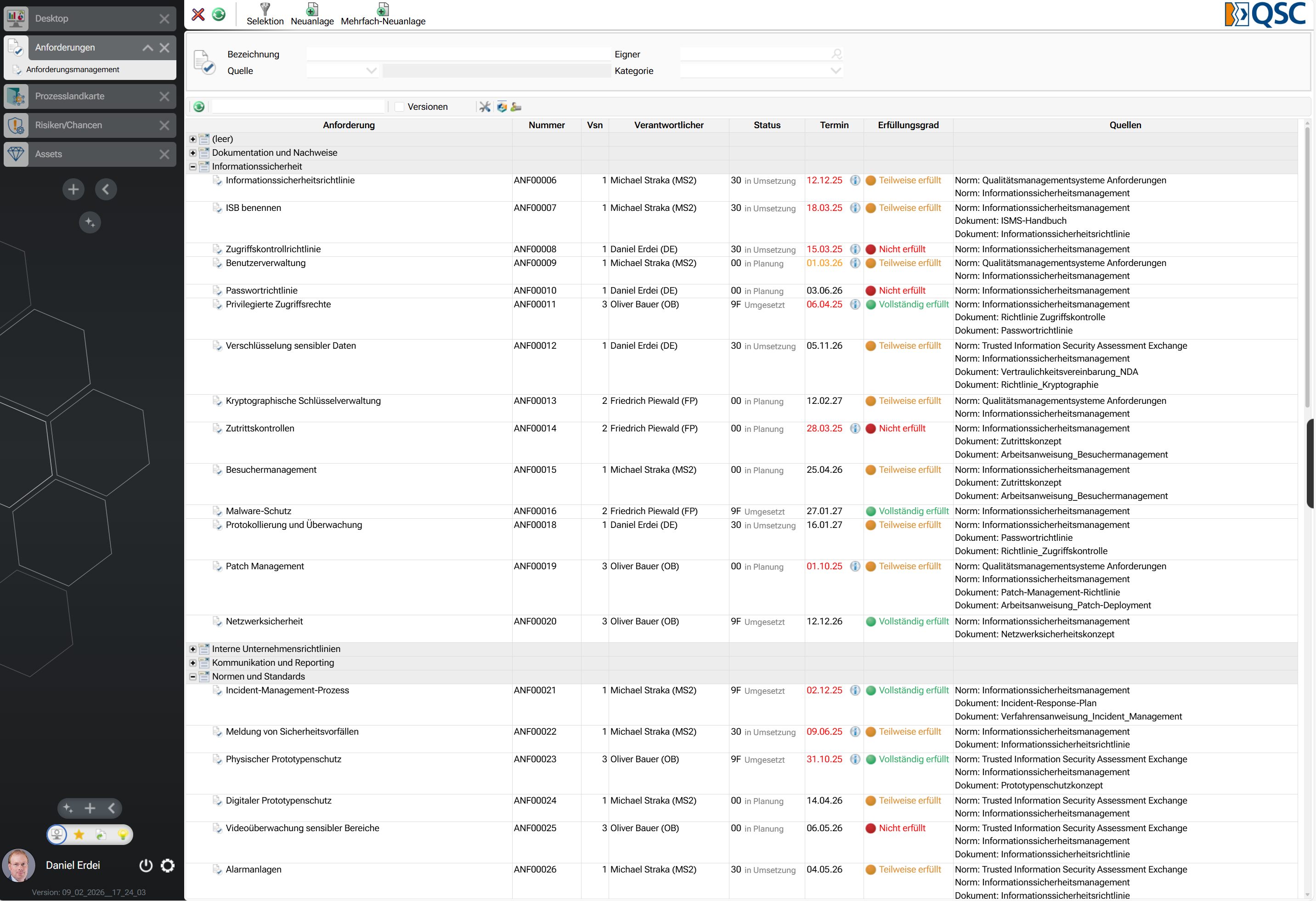
QS1 enables the centralized and structured organization of all requirements across all aspects of quality management. This includes source management for standards, laws, regulations, contracts, and compliance requirements. Requirements are individually categorized, freely tagged, and tracked with responsibilities, implementation status, and fulfillment level.
The core principle is traceability: Requirements are systematically linked to processes, risks, documents (including DMS/SOPs), as well as actions and workflows. Versioning and control ensure transparency, making it possible to track which requirement was valid when and how implementation and documentation have progressed.
For operational implementation, QS1 supports integrated workflow management with approval processes, escalations, and real-time processing status. Calendar and reminder functions, along with history tracking, ensure that changes, decisions, and implementation statuses remain permanently traceable.
The complete real-time connection to your ERP system ensures that all relevant information—suppliers, articles, orders, and goods receipts—is automatically available. As soon as a goods receipt is posted in the ERP, QS1 automatically generates an inspection order, which is assigned to the responsible inspection station or workstation and displayed there immediately.
Inspections can be carried out on-site or remotely using the QS1 web version on tablets. Employees are guided intuitively through attributive and variable inspections and receive all necessary additional information for each inspection characteristic, such as texts, images, documents, or CAD data. Inspection plans can be derived and created particularly efficiently directly from CAD drawings or via group inspection plans.
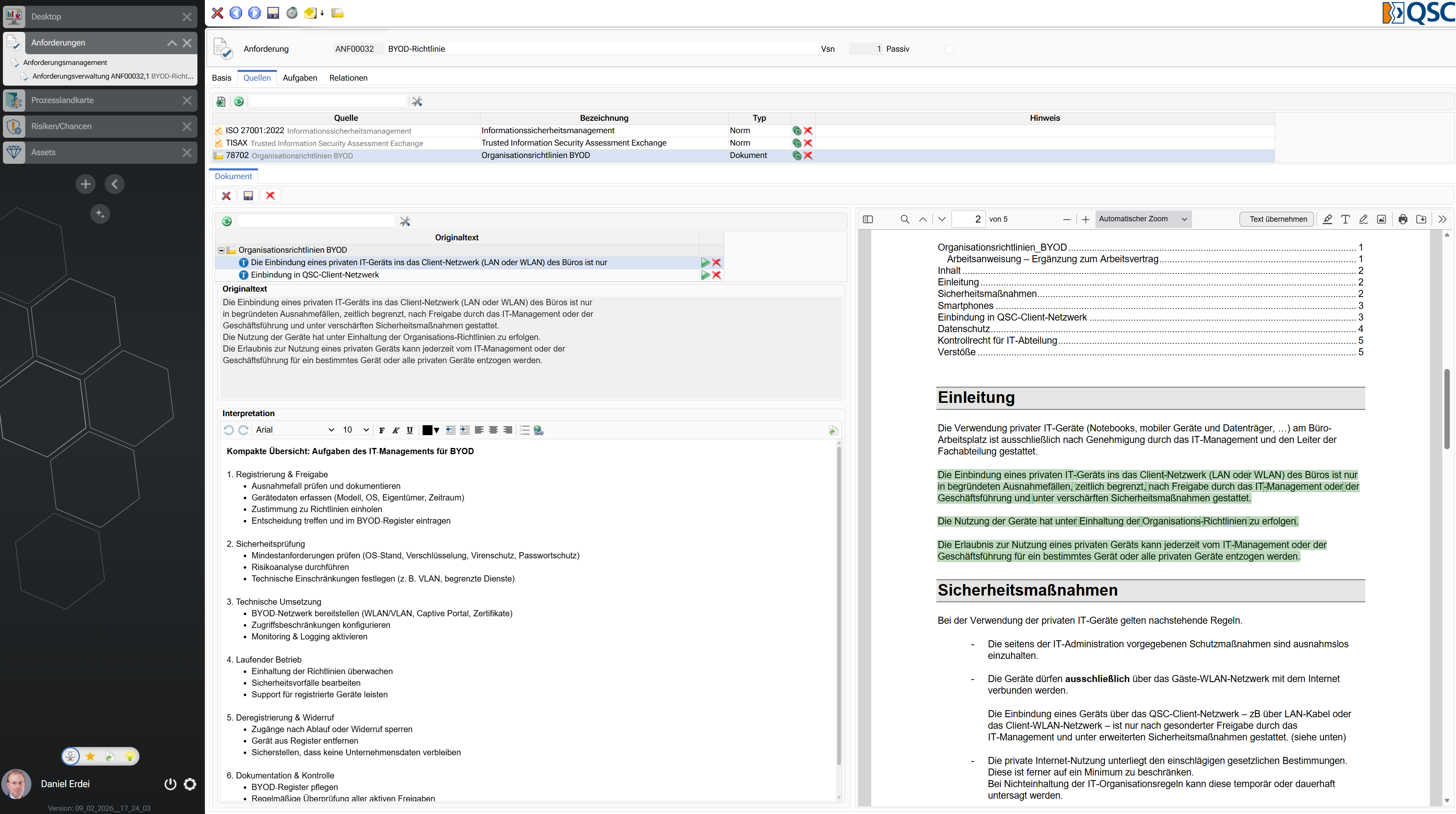
- Centralized, structured organization of all requirements
- Cross-module organization across QM modules (e.g., process and risk management, DMS/SOP)
- Source management: standards, laws, regulations, contracts, compliance
- Custom categorization and free tagging
- Transparent responsibilities, implementation status, and degree of compliance
- Integrated workflow management with approvals, escalations, and real-time status updates
- Traceability through links to processes, risks, documents, actions, and workflows
- Version control and tracking of requirements and implementations
- Calendar and reminder functions, as well as history tracking
- Clear analysis via BI dashboards and reports
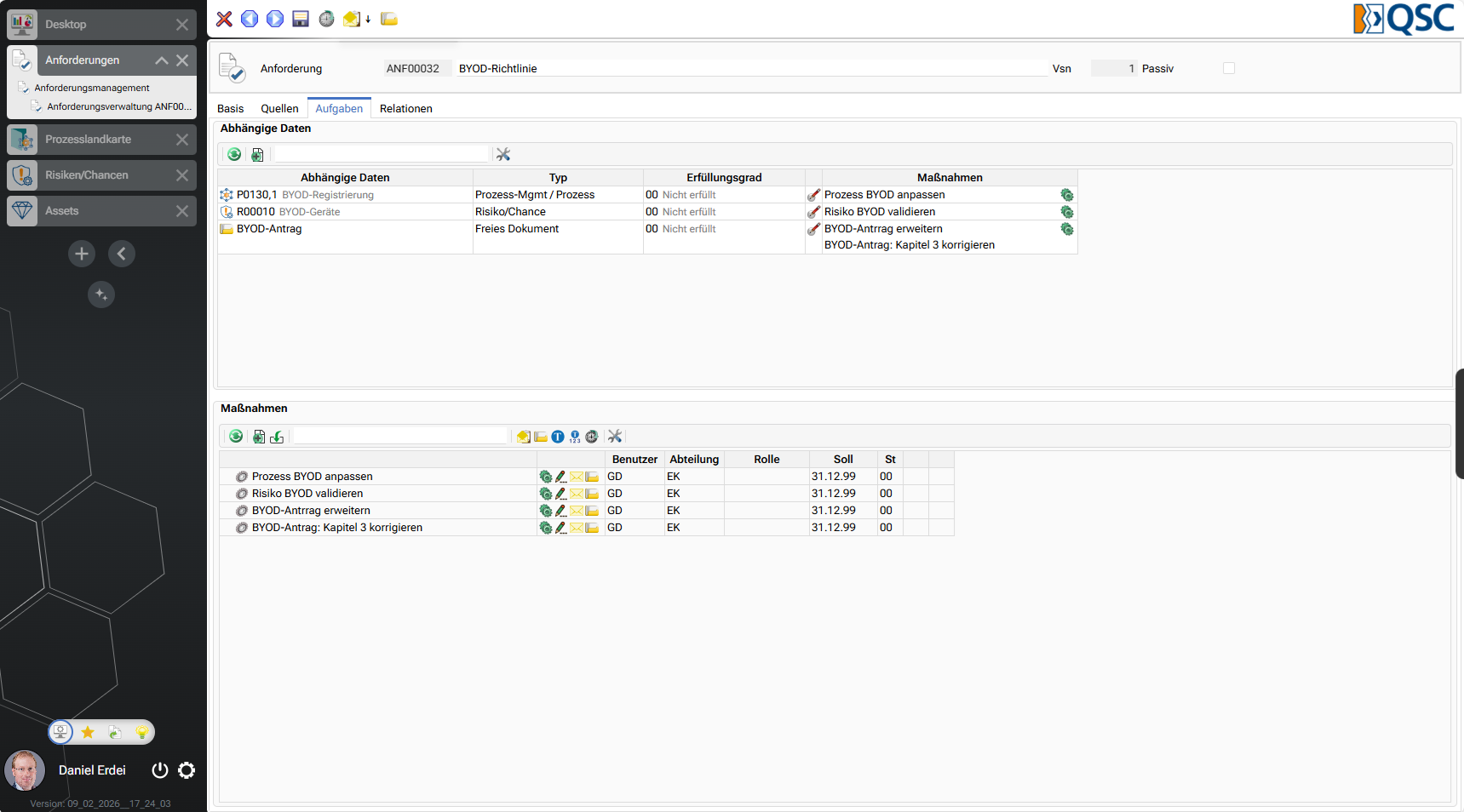
- Clear internal translation of complex sources: The central point of contact translates standards, contractual, and legal requirements into understandable, actionable tasks for process and/or risk managers.
- Centralized, bidirectional documentation of implementation: Comments, inquiries, and decisions regarding processing are exchanged via the action/task management system and can be traced back to both the requirement object and the relevant process, risk, or document objects.
- Automatic notification of process and risk managers regarding new or changed requirements (including a request to review and, if necessary, adjust the affected processes, risks, controls, and documents).
Does this sound familiar?
- Requirements from standards, laws, customer contracts, and compliance regulations are constantly increasing, yet no one can immediately say: What is currently valid, where does it apply, who is responsible, and what is the level of compliance?
- Requirements are maintained in parallel in various repositories and interpreted differently: This leads to gaps, duplication of effort, and contradictory implementations, especially when changes are made.
- Changes get lost in the shuffle of daily operations: New/revised requirements are not systematically distributed, reviewed, and tracked; decisions and justifications remain unclear.
- Traceability is subjective rather than verifiable: Audits cannot clearly demonstrate how a requirement is implemented in processes, SOPs/documents, risks/controls, and measures, and how this has evolved across different versions.
- Responsibilities and implementation occur without oversight: Status, deadlines, approvals, and escalations are opaque; tasks remain unfinished or are completed late.
This should be achieved through a robust process
- Central source and requirements structure: Standards, laws, regulations, contracts, and compliance guidelines must be managed as sources, and requirements must be derived from them in a structured manner.
- Clear control instead of a proliferation of variants: Requirements must be versioned, approved, and managed with a validity-based system, including a traceable history.
- • End-to-end traceability as a core principle: Requirements must be systematically linked to processes, documents/SOPs, risks/controls, as well as measures and workflows.
- Operational implementation as a workflow: Responsibilities, tasks, deadlines, reminders, escalations, and real-time status must be reliably mapped.
- Audit- and management-ready transparency: Filters, reports, and dashboards must show which requirements are open, critical, overdue, or unfulfilled.
Coverage in QS1
- Organizes requirements centrally and systematically via a source management system for standards, laws, regulations, contracts, and compliance documents; requirements are categorized, freely tagged, and tracked with responsibilities, status, and completion status.
- Manages requirements in an audit-proof manner through versioning and release processes: which requirement was valid when, what changes were made, and how decisions were justified.
- Ensures system-level traceability by bidirectionally linking requirements with processes, risks/controls, documents (including DMS/SOPs), as well as actions and workflows (plus continuous documentation).
- Translates complex sources into actionable to-dos: Centrally responsible parties can specify requirements internally and distribute them in a structured manner to process and risk owners.
- Controls implementation via integrated workflow and action management: tasks, deadlines, reminders, and escalations prevent delays; comments, queries, and decisions are traceable both at the requirement object and at process, risk, and document objects.
- Automatically informs affected parties of new or changed requirements and requests the review or adjustment of affected processes, risks, controls and documents using system support; evaluation is carried out via BI dashboards and reports.
Your result: Centralized transparency across all requirements, including responsibilities and fulfillment levels; reduced risk through clear management and versioning; true traceability for audits; faster implementation through workflows; and consistent implementation in processes, SOPs, and risk management. Parallel storage becomes a thing of the past.
Your Advantages
- Optimisation and digitalisation of your business processes for greater efficiency
- Better overview and control of process chains and workflows
- Compliance with legal regulations and industry standards for improved auditability
- Increased collaboration between departments and locations by standardising processes
- Increased efficiency and optimise resources by automating processes
- Improved product quality and fulfilment of customer requirements
- Increased transparency and traceability for improved decision-making
- Continuous improvement of processes for long-term business success
- Ability to adapt to changing market conditions and customer requirements
- Maximise added value through integration with other QS1 modules and functions
