
Challenges in practice
In many companies, assembly, testing and acceptance processes are still carried out paper-based or with isolated checklists. Particularly in mechanical and plant engineering, complex product structures, numerous variants and project-specific requirements lead to high coordination efforts and media disruptions.
Work instructions, test steps and documentation are often distributed across different systems. Recurring test content is maintained several times, changes to assemblies or parts lists have to be made manually and the current processing status is difficult to understand.
In addition, there is often a lack of a consistent connection between ERP, assembly, quality assurance and defect management. Although identified deviations are documented, they do not automatically lead to rework, complaints or improvement processes.
Solution QS1
With its Acceptance Checklists module, QS1 digitizes the entire assembly, testing, and acceptance process – from the assembly of individual components and in-process inspections to the final acceptance of complete machines and systems.
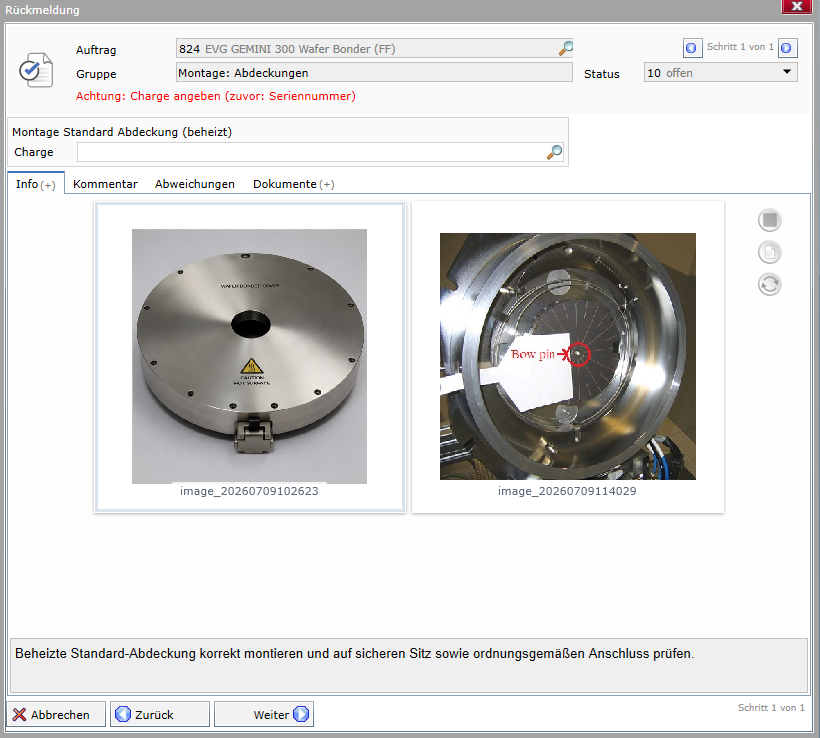
The system is based on modular, versioned checklist modules that can be created once and reused as often as needed. Based on ERP data such as production orders, work steps, bills of materials, or assembly structures, QS1 automatically generates the appropriate checklist order. The individual modules are assigned to the respective assemblies or work steps and combined into a complete assembly and testing sequence.
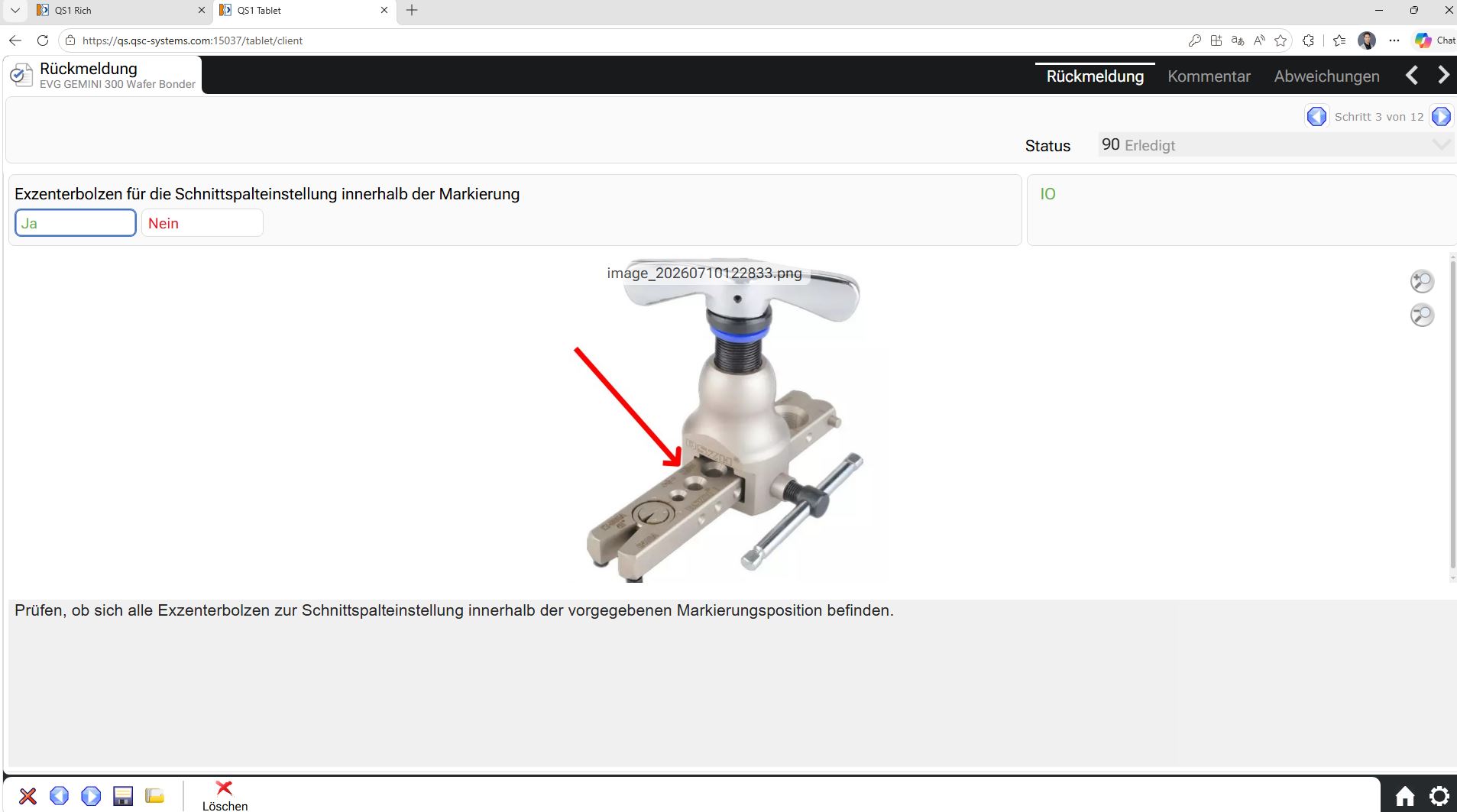
During processing, employees are guided step-by-step through the entire acceptance process. The current processing status is transparent and traceable at all times – from individual test steps to assemblies and the complete system. Work and assembly instructions, images, documents, and videos provide direct support to the user at each test step. Test results, measurements, batches, serial numbers, as well as photo and documentation evidence can be captured immediately – even on a tablet – and documented in an audit-proof manner.
- Digitization of the entire assembly, testing, and acceptance process
- ERP-supported generation of checklist orders based on production order, work step, and bill of materials
- Modular, versioned, and reusable checklist modules
- Automatic compilation of individual assembly and acceptance processes
- Guided operator support with work and assembly instructions
- Dynamic testing processes through rule-based activation of test steps, checklists, and corrective actions
- Mobile feedback including measured values, batches, serial numbers, and photo and documentation evidence
- Workflow-driven error, corrective action, and complaint management
- Transparent processing status at the test step, assembly, and plant level
- Seamless ERP integration and complete traceability
Does this sound familiar?
- Acceptance testing for systems, assemblies, or components relies on static checklists and individual documents, resulting in a lack of transparency, inconsistent documentation, and manual rework.
- Each project operates independently: structures, terminology, and inspection points differ, leading to a loss of comparability and preventing the seamless reuse of established acceptance procedures.
- Defects are documented but not consistently transferred to subsequent processes: deviations are recorded in the checklist, while corrective actions, CAPAs, or complaints are handled separately and therefore not reliably tracked.
- Complex product structures complicate the process: serial numbers, assemblies, and variants make it difficult to accurately trace the acceptance status from individual items to the complete system.
- Data capture does not occur at the point of use: feedback is transmitted later, photos and additional information are stored separately, and the acceptance status is not available in real time.
This should be achieved through a robust process
- Modular standardization with project-specific flexibility: Reusable checklist components must be versioned and remain combinable for specific projects.
- Guided, digital acceptance orders: Modules must be used to create concrete checklist orders that are processed based on roles and workflows, with status and progress visible at all times.
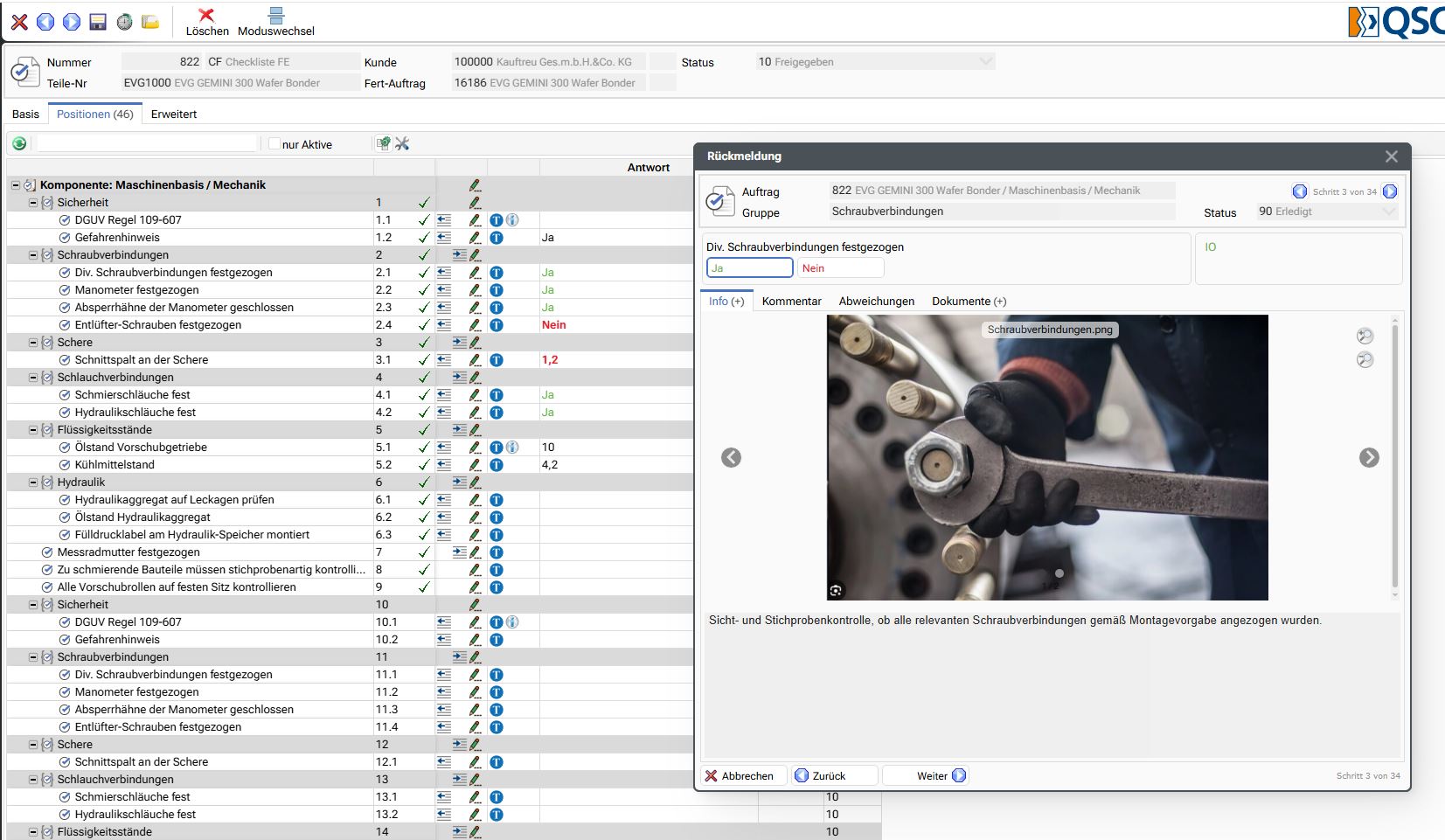
- Structure for complex systems: Tree structures must represent the system, assembly, and component, ensuring traceability from the individual item to the complete system.
- Diverse feedback types in context: Yes/No decisions, measured values, attributes, texts, and documents must be captured directly at the inspection point record, with dynamic activation possible depending on the context.
- Direct link to error and corrective action processes: NIO (Nonconformity) findings must automatically trigger follow-up processes so that acceptance is not only documented but also effectively improved.
Coverage in QS1
- The Acceptance Checklists module provides a modular, fully digital approach based on versioned checklist modules that serve as reusable building blocks for systems, assemblies, or functional areas.
- From these modules, it generates specific checklist tasks that map the acceptance process for individual machines or components. Processing is workflow-driven and role-based, and feedback can be captured even on mobile devices at the test station.
- Supports multi-level tree structures that clearly organize systems, assemblies, and components, enabling a transparent status view from individual items to the entire system or project.
- Offers flexible feedback types, including yes/no ratings, measured values, attributes, text, and documents, and enables rule-based activation of inspection points for dynamic, context-dependent processes.
- Automatically evaluates OK and NOK at the item, group, and project levels, making the acceptance status reliable and comparable at all times.
- Directly integrates error and corrective action processes, enabling follow-up processes to be triggered in case of deviations and allowing for the structured creation and tracking of corrective actions, 8D reports, or complaints.
- Links acceptances to project and serial number structures and can optionally be extended to complete inspection planning, allowing simple checklists to be seamlessly integrated into more complex inspection processes.
- Integrates document management, enabling checklists, results, and related documents to be versioned, approved, and archived in compliance with audit requirements.
Your result: Standardized acceptance processes with high flexibility, significantly better transparency regarding the status of plants and projects, less manual documentation, complete traceability of all feedback and assessments, and a direct link between acceptance, fault control and action management, which makes acceptances measurably more effective.
Your advantages
- Standardized assembly, testing, and acceptance processes across all projects and product variants
- Reduced maintenance effort through modular and reusable checklists
- Faster and safer execution thanks to guided operator support and digital work instructions
- Automatic generation of order-related checklists based on ERP data
- High transparency regarding the current processing status of assemblies, machines, and projects
- Complete documentation and traceability of test results, measurements, batches, and serial numbers
- Fewer media breaks through mobile data capture directly at the workstation
- Automated follow-up processes through integrated error, corrective action, and complaint management
- High flexibility through dynamic testing procedures and project-specific adjustments
- Seamless integration into existing ERP and quality processes
