
Challenges in practice
Quality management systems today are heavily document-driven. Numerous standards and industry benchmarks require structured and audit-proof document management – from quality manuals and work instructions to SOPs and process documentation. In practice, this often results in complex document landscapes that quickly become unwieldy without a suitable system.
The challenge lies not only in storage but, above all, in the controlled management of documents: versioning, approvals, change processes, and the traceability of who created, modified, or approved which documents and when. At the same time, documents often need to be directly available in various quality processes – for example, in inspection orders, audits, FMEAs, or product files. Without integrated document management, redundant storage, media breaks, and high administrative overhead quickly arise.
Solution QS1
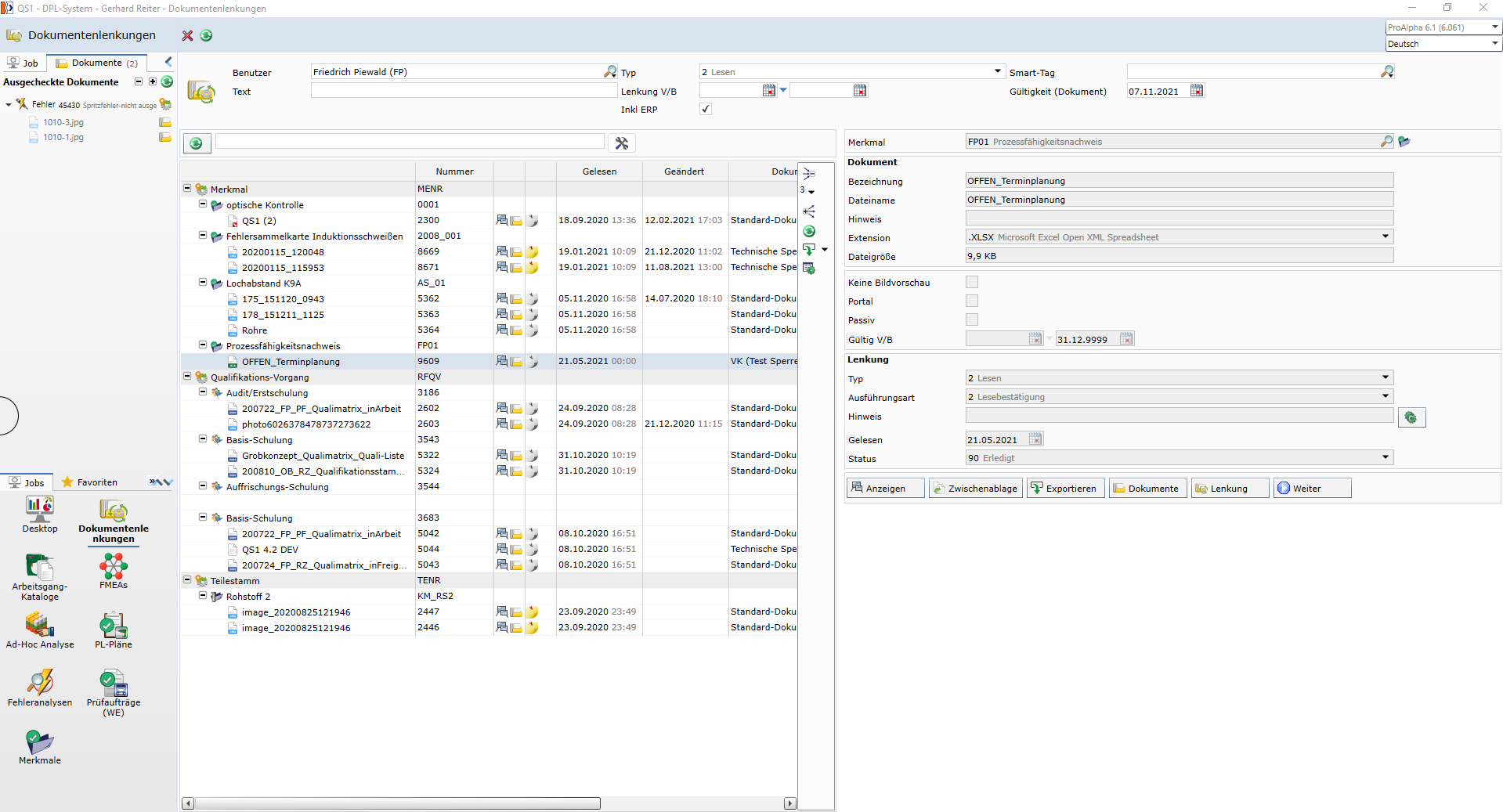
With the QS1 document management and SOP module, you can manage all quality-relevant documents centrally, in an audit-proof manner, and fully integrated into your quality processes. Both classic QM documents such as quality manuals, work instructions, and SOPs, as well as process-related documents, can be created, stored, and versioned directly within the system.
A particular advantage lies in the close integration with the QS processes: Documents can be directly linked to any objects such as inspection orders, test equipment, products, batches, FMEAs, or other QS1 modules. This ensures that all relevant information is always available precisely where it is needed in the process.
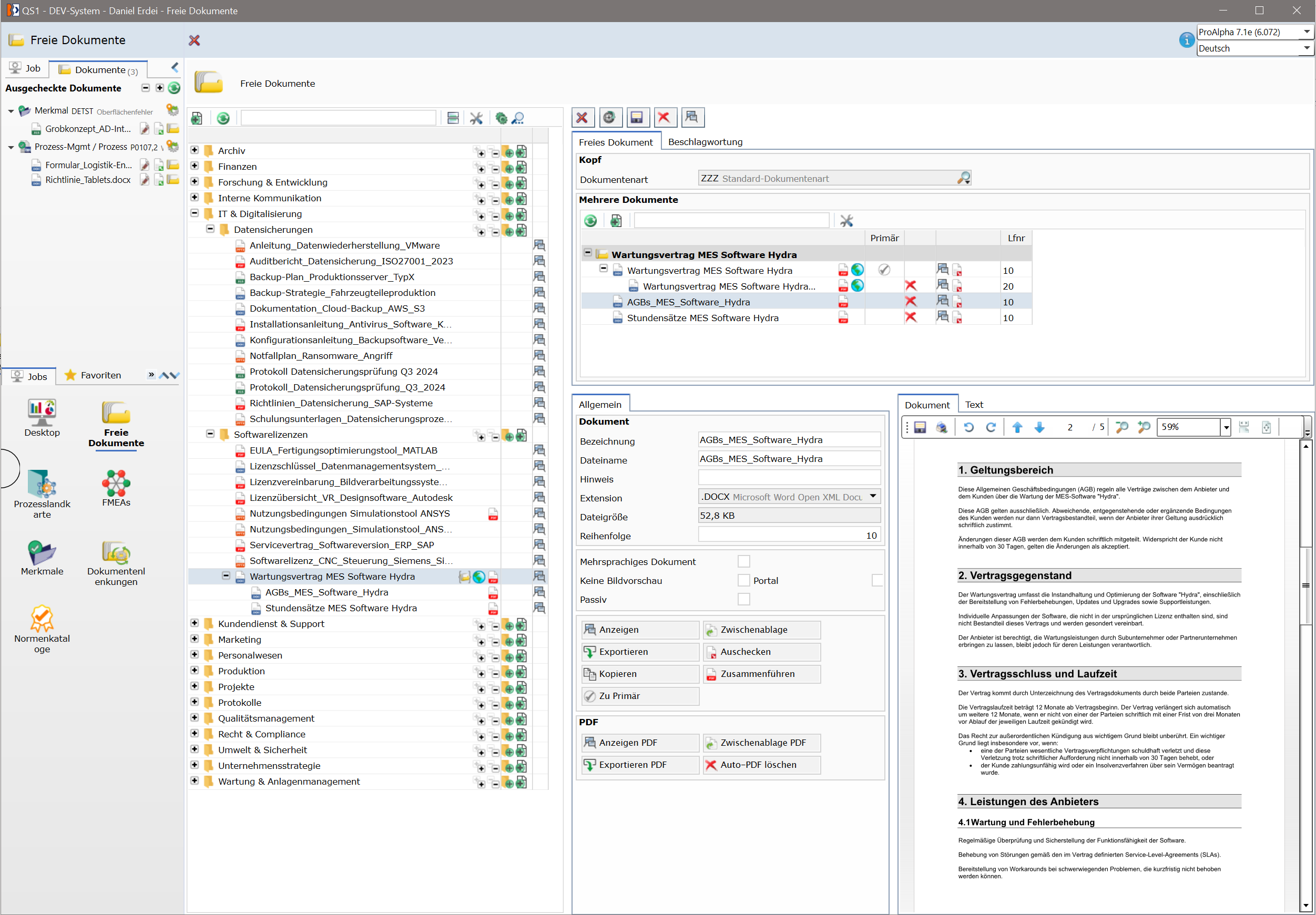
The integrated workflow and authorization management system allows you to flexibly control approval and change processes according to your requirements – including digital signatures, multi-stage approvals, and the four- or six-eyes principle. Automatically generated documents from quality assurance processes, such as test reports or certificates, are automatically versioned and archived.
Thanks to integration with your ERP system, existing ERP documents can also be used directly in QS1 processes. Documents can be displayed from the ERP system as well as automatically stored there, creating a seamless document landscape without media breaks.
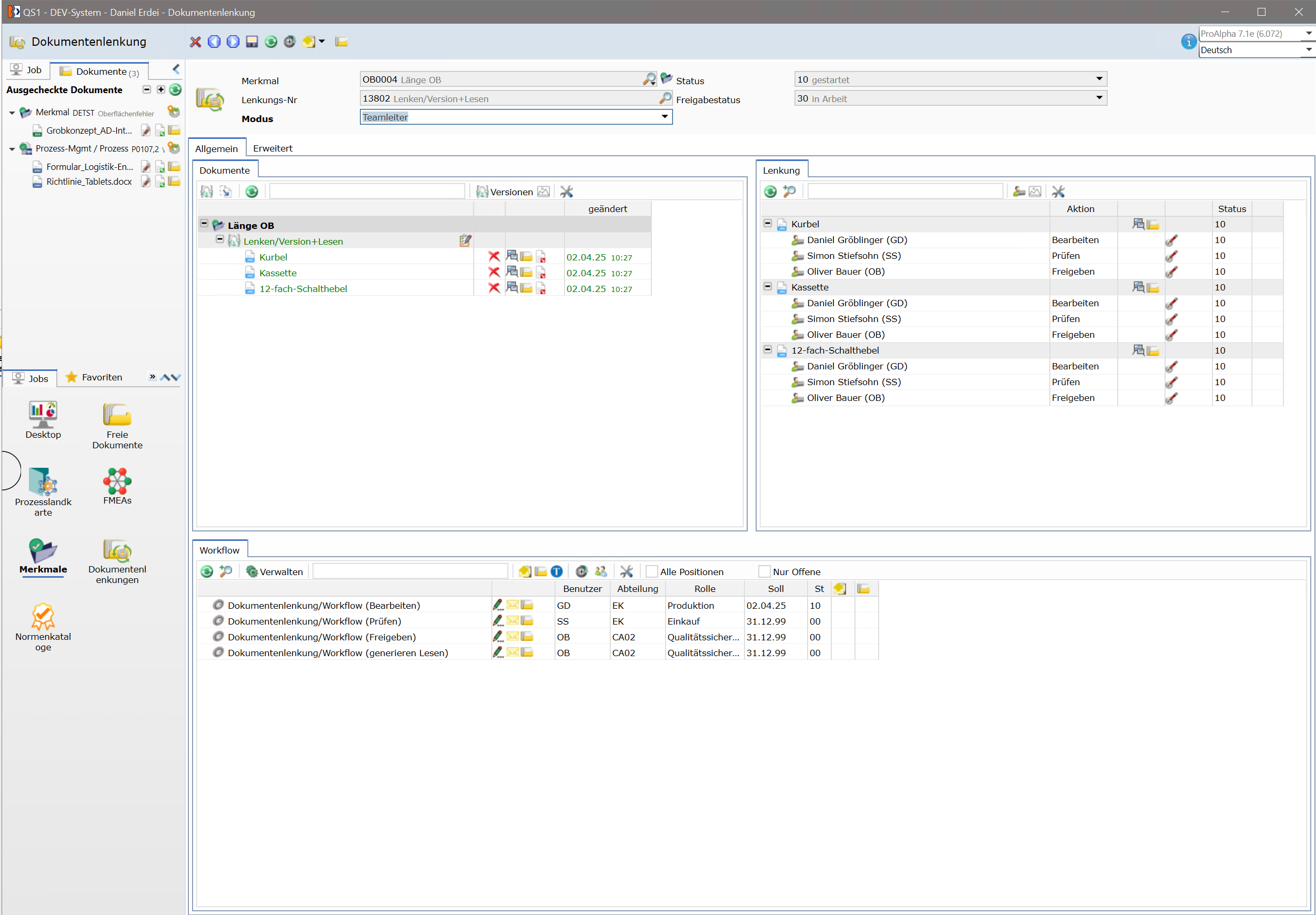
- Standards-compliant document control with audit-proof versioning
- Digital signatures and multi-stage approval processes (e.g., four-eyes/six-eyes principle)
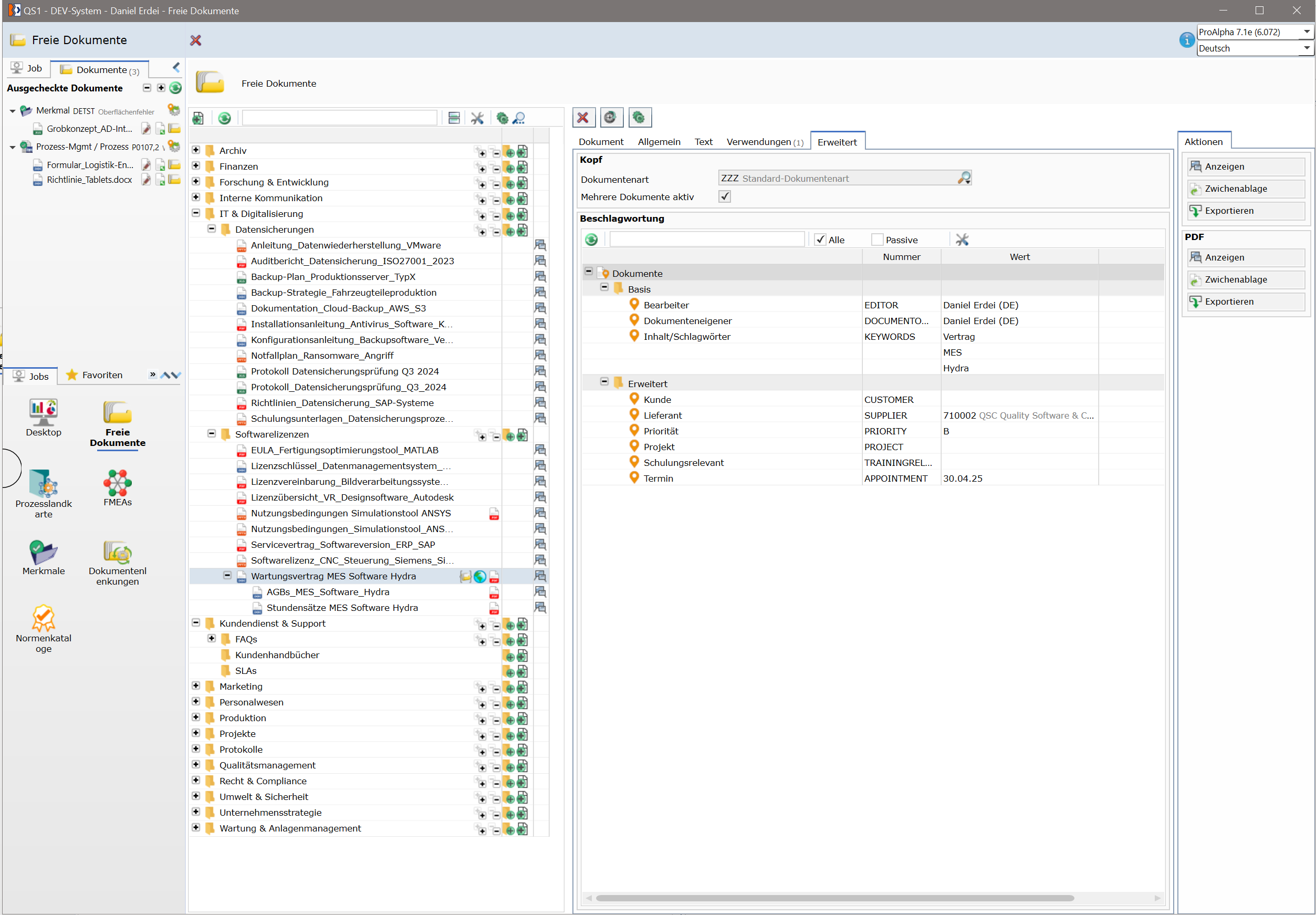
- Freely definable document types, document properties, and classifications
- Direct document linking with quality assurance processes, master data, and transaction data
- Deployment across all QS1 modules – from inspections to complaint management
- ERP integration with direct access to existing ERP documents
- Document capture also possible via portal processes by suppliers or customers
- Location- and platform-independent access to documents (desktop, tablet, smartphone, portals)
- Workflow-driven change management including document control
- Documents can be defined as process prerequisites (e.g., proof of approvals or transactions)
- Full-text search in documents combined with QS1 data for rapid information retrieval
- Automated creation of device- or product-related documentation from quality assurance processes
- Email integration with automatic notifications and Report delivery
- Extensive parameterization and flexible adaptation to individual company requirements
Does this sound familiar?
- Your management system is document-driven, but the document landscape is becoming increasingly disorganized: Quality manuals, work instructions, SOPs, and process-related documentation are scattered across different repositories and are difficult to maintain consistently.
- The real problem isn't the storage, but the control: Versions, approvals, and changes are handled informally, and during audits, it's impossible to clearly document who created, changed, or approved what and when.
- Documents aren't readily available where they're needed in the process: Test orders, audits, FMEAs, product files, or test equipment processes reference files that are difficult to search for or copies that become outdated.
- Redundant storage and media breaks are created: Documents are saved multiple times, distributed via email, and manually updated, which wastes time and increases the likelihood of errors.
- Documents are often prerequisites for approvals, transactions, or decisions, but the process logic doesn't enforce this: This creates gaps that only become apparent during audits or in the event of a claim.
This should be achieved through a robust process
- Standards-compliant document control: Versioning, approvals, history, and traceability must be ensured by the system, including digital signatures and multi-stage approvals.
- Documents in the context of quality assurance processes: SOPs and documentation must be directly available with the respective object, such as the test order, product, process, test equipment, batch, or FMEA.
- Process reliability through document-driven rules: Documents must be definable as process prerequisites so that approvals or transactions only occur if documentation is complete and valid.
- Integration instead of parallel systems: ERP documents must be usable in the quality assurance process, and documents from quality assurance processes must be archived centrally without media breaks or duplicate data storage.
- Fast retrieval instead of searching: Full-text search and structured classification must make information findable without requiring employees to navigate through multiple repositories.
Coverage in QS1
- Centrally manages all quality-relevant documents in an audit-proof manner, including QM documents such as quality manuals, work instructions, and SOPs, as well as process-related documentation.
- Ensures standards-compliant document control through audit-proof versioning, workflow-driven change management, and flexible approval processes that support digital signatures, multi-stage approvals, and the four- or six-eyes principle.
- Directly links documents to QA processes, master data, and transaction data, making relevant information available within the process context, for example, for test orders, test equipment, products, batches, FMEAs, or complaint management.
- Allows documents to be defined as process prerequisites, ensuring that approvals and transactions only occur when the required documentation is complete and valid.
- Automatically archives automatically generated documents from QA processes, such as test reports or certificates, in a versioned and audit-proof manner, ensuring that documentation can be reliably reproduced at any time.
- Integrates ERP documents into QS1 processes, allowing documents to be displayed or automatically filed from the ERP system, creating a seamless document landscape without media breaks.
- Supports document capture via portal processes by suppliers or customers and offers location-independent access via desktop, tablet, smartphone, and portals, with centrally managed permissions.
- Facilitates information access through full-text search in documents, which can be combined with QS1 data, and supports automatic notifications and report distribution via email integration.
Your result: Audit-proof and standards-compliant document control without parallel storage, clear approval and change processes with complete history, documents exactly where they are needed in the process, fewer media breaks through ERP and QS integration, and significantly higher process security in audits and regulatory requirements.
Your advantages
- Audit-proof and standards-compliant management of all quality-relevant documents
- Central document platform for all quality processes within the company
- Reduction of media breaks through integration with ERP and QA processes
- High transparency through complete versioning and history tracking of all changes
- Time savings through automated document creation and management
- Improved collaboration between departments, locations, and with customers and suppliers
- Fast access to required documents directly within the respective process context
- Increased process reliability through document-driven approvals and workflows
- Support for compliance with standards and regulatory requirements (e.g., GxP)
- Easy data backup and centralized management through a unified document repository
