
Challenges in practice
A stable and quality-assured flow of goods is a key prerequisite for holistic quality management. Companies face the challenge of ensuring that delivered materials and components exactly match the specifications ordered – while at the same time facing increasing cost pressure and ever shorter lead times.
Incoming goods inspection is therefore an indispensable part of logistics and quality processes. In practice, however, manual processes, a lack of transparency, insufficiently integrated ERP systems, and time-consuming test plan creation make efficient implementation difficult. In addition, it is important to flexibly take into account sampling logic, group test plans, skip lot procedures, and supplier-specific features without unnecessarily increasing the testing effort. The challenge is to dynamically adapt the scope of inspection to the actual quality performance of suppliers and items. Rigid inspection plans either lead to unnecessarily high inspection costs or to an increased quality risk, as findings from previous inspections are often not systematically incorporated into future goods receipt inspections.
Modern companies therefore need a solution that seamlessly integrates incoming goods inspections into existing ERP and supplier processes, provides digital support, and at the same time enables inspectors to work in a simple, intuitive manner – ideally directly at their workplace or on the go via tablets.

Solution QS1
With QS1, you can accelerate and automate your incoming goods inspection and integrate it seamlessly into your existing logistics and ERP processes. You ensure compliance with all inspection regulations, reduce manual effort, and lower your quality costs in the long term.
Inspection plans can be created flexibly and centrally—globally, for article groups, individual articles, or specific article/supplier relationships. Automatic dynamization based on defined sampling and skip lot logic directs the inspection effort specifically where it is needed. Any number of dynamization levels can be mapped, such as reduced inspection, normal inspection, enhanced inspection, initial delivery inspection, or skip lot. The scope of the inspection automatically adapts to the results of previous goods receipt inspections.
The complete real-time connection to your ERP system ensures that all relevant information—suppliers, articles, orders, and goods receipts—is automatically available. As soon as a goods receipt is posted in the ERP, QS1 automatically generates an inspection order, which is assigned to the responsible inspection station or workstation and displayed there immediately.
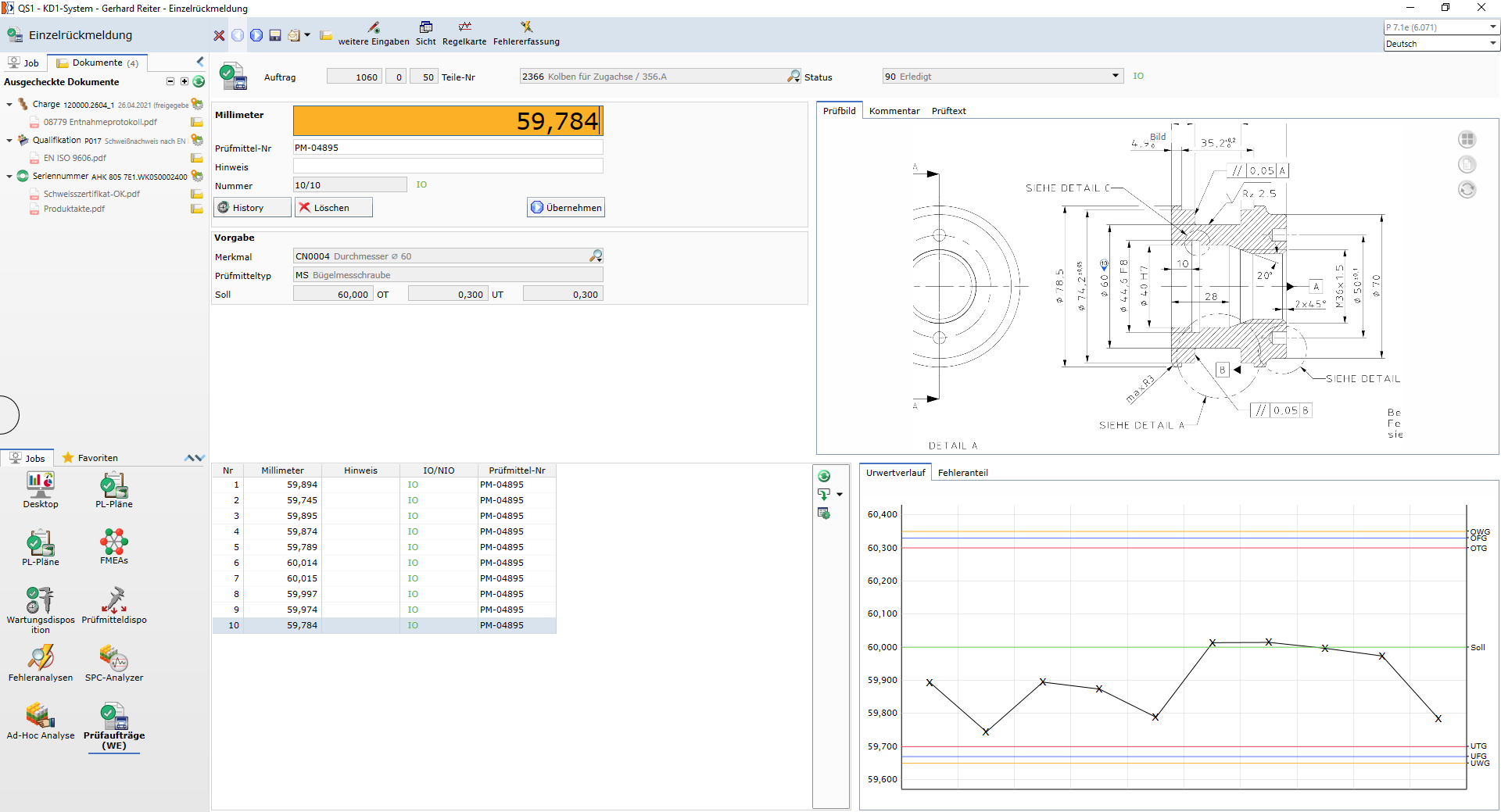
Inspections can be carried out on-site or remotely using the QS1 web version on tablets. Employees are guided intuitively through attributive and variable inspections and receive all necessary additional information for each inspection characteristic, such as texts, images, documents, or CAD data. Inspection plans can be derived and created particularly efficiently directly from CAD drawings or via group inspection plans.

Another key component is the optional integration of suppliers via the supplier portal. Suppliers can already record and document their outgoing goods inspection there. When goods are received, QS1 simply performs a targeted cross-check – for significantly faster throughput times and greater transparency along the supply chain.
The inspection results are automatically reported back to the ERP system. Depending on the result, a release or block entry is made, the material is stored, and batch or serial numbers are released.
In the case of non-conformities, the integrated workflow automatically informs the responsible employees in complaint management. Deviations are processed directly in the QS1 complaint module, inspection reports can be sent automatically, and complaints can be released for the supplier portal.
The result: a consistent, digital goods receipt inspection – transparent, efficient, and fully integrated into your quality, logistics, and supplier processes.

- Automated inspection orders for incoming goods from suppliers or external processing – including direct ERP connection
- Inspection plans can be derived directly from CAD or group plans – for fast and consistent inspection plan creation
- Dynamic, risk-based inspection scope: adjustment of the inspection based on previous results or supplier performance
- Integrated laboratory information and management system (LIMS) for all inspection data
- Workflow-based, intuitive inspection station control – also mobile via tablet and web
- Barcode integration & measuring equipment connection: Hand-held measuring equipment, testing machines, and analysis devices fully integrated
- Flexible feedback at feature level – including additional information such as texts, images, documents, or CAD data
- Batch, serial number, cavity, and process parameter management
- Automatic ERP feedback: approvals, blocks, storage orders, or QA status implemented directly
- Supplier portal & goods issue inspection: suppliers record inspections and certificates digitally in advance
- History and audit trail at all data levels—including digital signatures and the dual control principle in the GxP environment
- Automatic complaint derivation and supplier evaluation
- Document control, key figures, dashboards, and analysis functions
Does this sound familiar?
- Audit efforts are not risk-based: the same level of scrutiny is applied to “top suppliers” and “problem suppliers.” This results in costs and inefficiencies.
- Media discontinuity prevents traceability: Excel, email, paper—and ultimately, there is no clear chain for audits and complaints.
- ERP status does not match reality: Audit decisions and ERP consequences are not synchronized. This leads to subsequent errors in the process.
- Locked storage becomes a black box: What is locked, why, since when, and what is the next action?
- Approvals become a bottleneck: The material is there, production is pressing. QA is supposed to decide, but data is missing or contradictory.
This should be achieved through a robust process
- End-to-end status logic without workarounds: quarantine => inspection => decision => ERP consequence.
- Risk-based inspection planning: inspection depth based on supplier performance, part criticality, history.
- Clear assignment: Batch/lot/serial number <=> inspection result <=> documents <=> decision.
- Audit-proof decision: Who approved/blocked what, when, and why, including signature/audit trail.
- Scalable, deep ERP integration: Clear interfaces, roles/rights, clean management of all master, transaction, and process data.
Coverage in QS1
- Controls goods receipt as a process, not as an “inspection form”: quarantine, inspection order, decision, release/block.
- Links inspections live with ERP data (item, supplier, batch, order) and transfers status/results consistently.
- Automates risk-based inspection logic (random sampling, skip/lot, escalation in case of anomalies).
- Audit-proof, complete documentation: inspection report, documents/certificates, decisions, deviations.
- Accelerates complaints through structured deviation => action => supplier communication.
Your result: fewer blocked stocks, faster throughput times, reliable decisions, less audit pressure.
Your advantages
- Time savings & efficiency: Automatic inspection orders and dynamic inspection schedules significantly reduce administrative effort and inspection time.
- Maximum transparency: Inspection results, supplier certificates, and inspection histories are available digitally at any time—stationary or mobile.
- Process-oriented & integrated: ERP integration ensures automatic material releases, blocks, and storage orders.
- Risk-based quality assurance: Inspection effort intelligently adapts to previous results, supplier performance, and sampling rules
- Seamless collaboration with suppliers: Pre-inspection by suppliers via the portal reduces effort in goods receipt
- Fast decision-making: Dashboard and analysis functions provide key figures on test status, error rate, and supplier quality
- Audit-proof & auditable: All data is recorded in an audit-proof manner – including digital signatures, audit trails, and FMEA links
