
Challenges in practice
As early as the development process, the necessary testing steps along the entire value chain must be planned – ideally as a result of the associated FMEAs. Depending on the industry, these quality assurance measures are documented in accordance with standards in the production control plan and coordinated with and approved by the customer.
In practice, however, production control plans are often created only once and then rarely updated. Changes in test plans, processes, or products quickly lead to outdated control plans – a particular risk during customer or certification audits.
At the same time, the information required for a production control plan is already available in various systems, such as ERP bills of materials, work plans, or existing test plans. Without seamless integration, however, this data must be compiled manually – a time-consuming and error-prone process.
Solution QS1
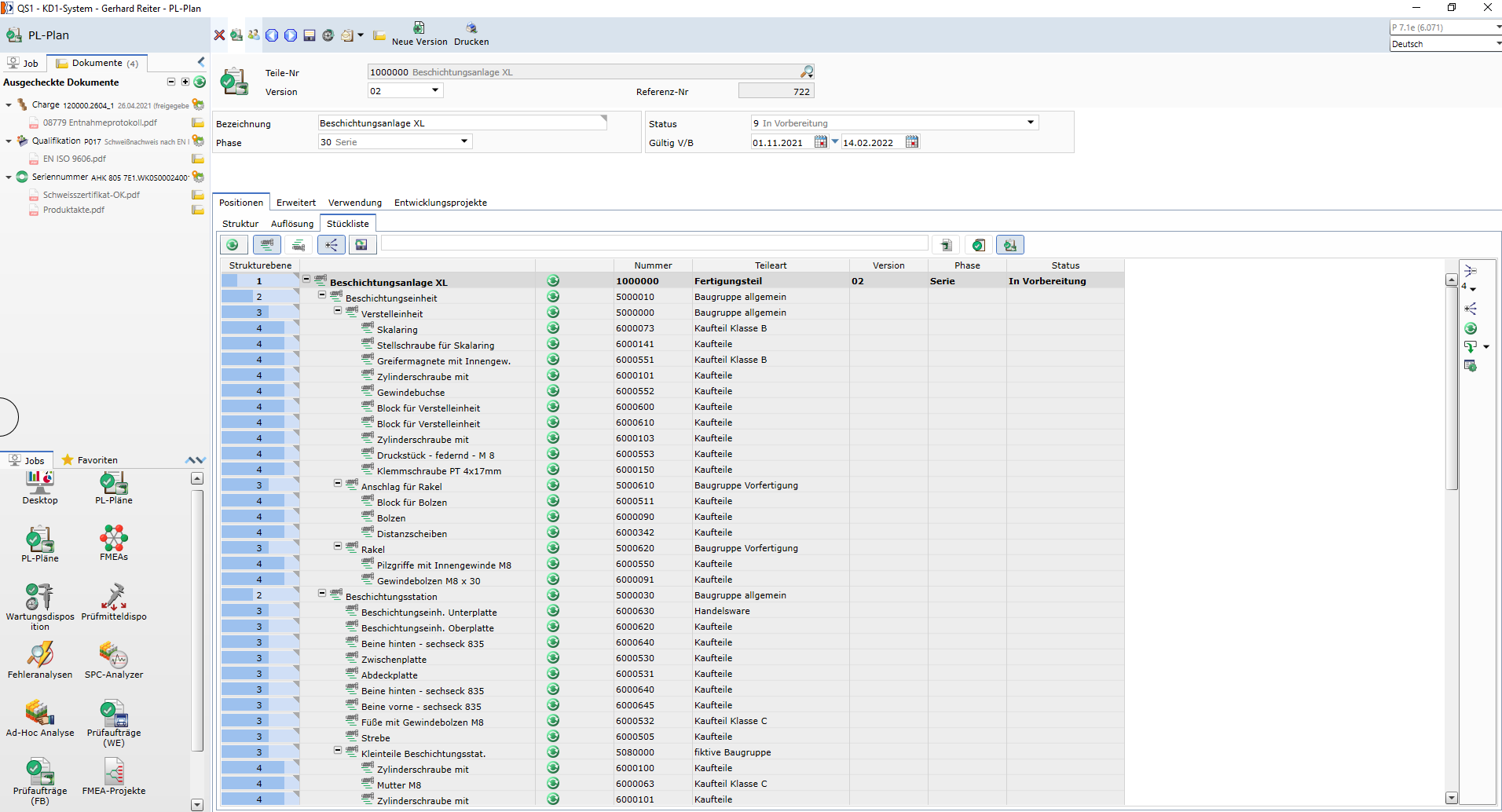
With QS1, you can plan your quality assurance measures digitally and in an integrated manner along the entire value chain. Through the quality control loop, comprising FMEA, inspection planning, production control plan, and failure analysis, your quality processes remain consistently linked and versioned.
Thanks to seamless ERP integration, the necessary production structure data, such as bills of materials, work plans, and operations, are automatically available in QS1. If the inspection plans for goods receipt, production, or supplier inspections are already maintained, the production control plan can be generated from this data at the touch of a button.
Changes to the underlying inspection plans are automatically incorporated, ensuring that the production control plan always reflects the current status of your quality planning. This prevents outdated documentation and guarantees that you always have an up-to-date and standards-compliant control plan, even for customer or certification audits.
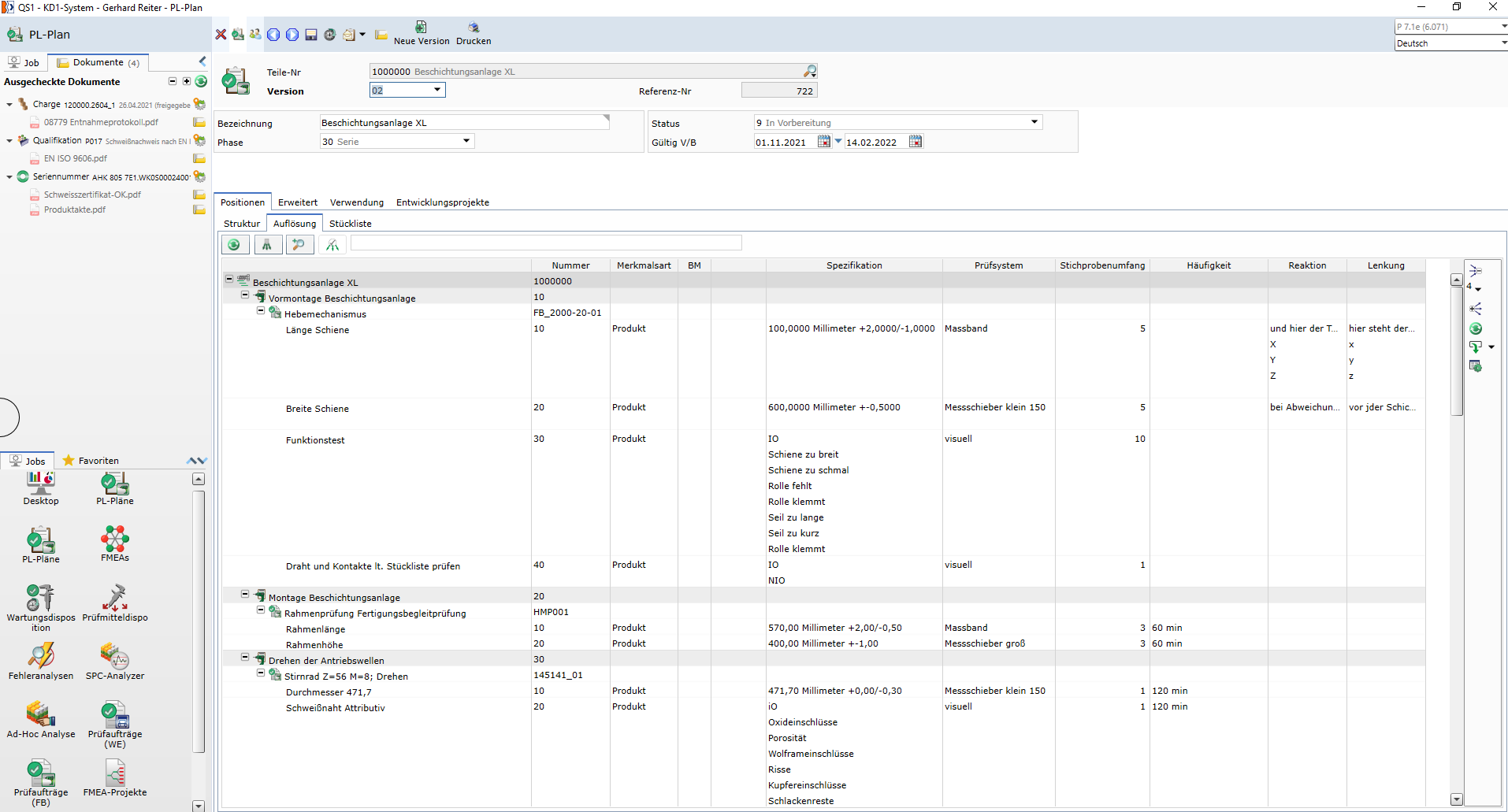
- Automatic generation of the production control plan based on existing inspection planning data
- Direct integration of production structures from the ERP system (bills of materials, work plans, operations)
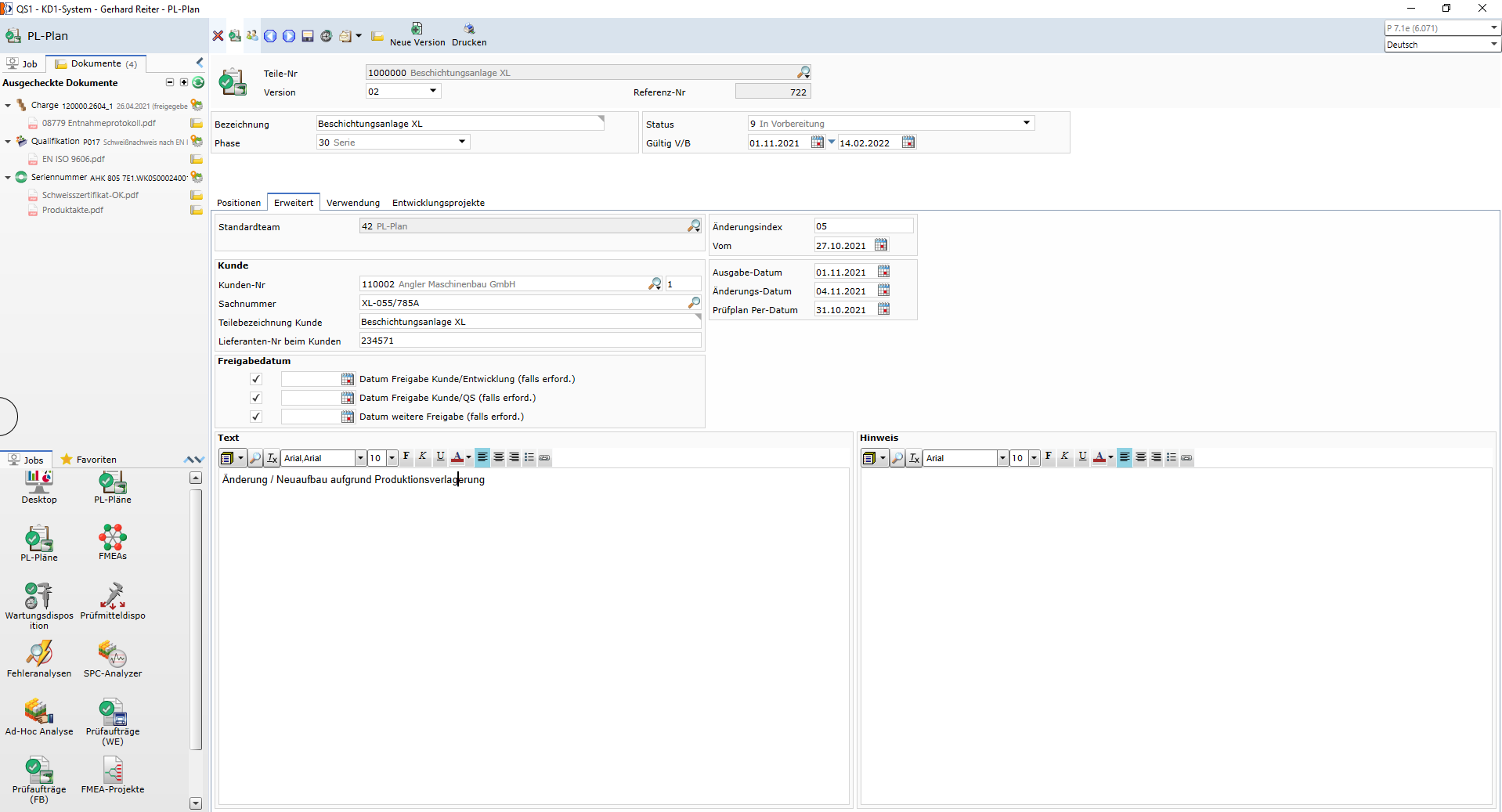
- Versioning and phase management for prototypes, pre-production, and series production
- Redundancy-free linking with FMEA, inspection planning, and failure analyses
- Automatic updates when changes are made to the underlying inspection plans
- Standards-compliant documentation of the entire value chain
- Transparent presentation of all quality assurance measures and inspections
Does this sound familiar?
- Control plans are created during the development project and agreed upon with the customer, but then they are left untouched. Changes continue during series production, but the production control plan no longer reflects reality.
- Test plans, processes, and products change, and the control plan is not consistently updated. During customer or certification audits, it becomes apparent that the documentation and the actual process are diverging.
- The necessary information already exists (ERP bills of materials, work plans/operations, test plans), but it must be manually compiled. This is time-consuming, error-prone, and leads to redundant data maintenance.
- FMEA, test planning, control plans, and failure analysis are not properly linked. Risks are assessed, tests are conducted, deviations occur, but lessons learned are not reliably fed back into quality planning.
- Versions and phases (prototype/pre-production/series) become confusing: Which plan was valid when? Without proper versioning, traceability becomes unnecessarily difficult.
This should be achieved through a robust process
- A continuous quality control loop: FMEA => Inspection Planning => Production Control Plan => Failure Analysis/CAPA, with consistent linking, versioning, and feedback of findings.
- Generation from leading data sources instead of manual creation: Production structure data from the ERP system and existing inspection plans must form the basis, not copy/paste.
- Automatic updates: Changes in inspection plans and process structures must be reflected in the Control Plan without requiring the maintenance of a parallel document.
- Standards-compliant representation along the entire value chain: Goods receipt, production, supplier inspections, and goods issue must be consistently mapped.
- Phase and version management: Prototypes, pre-production, and series production require traceable statuses, approvals, and history.
Coverage in QS1
- Digitally plans quality assurance measures along the entire value chain and integrates and links FMEA, inspection planning, production control plans, and failure analyses in a continuous, versioned quality control loop.
- Through direct ERP integration, it automatically transfers relevant production structure data into QS1, especially bills of materials, work plans, and operations, and uses this as a robust structural foundation.
- Generates the production control plan at the touch of a button based on existing inspection planning data (e.g., incoming goods, production, supplier, and outgoing goods inspections), thus reducing manual creation and coordination efforts.
- Automatically keeps the production control plan up to date: Changes in the underlying inspection plans are taken into account, so the control plan always reflects the current state of quality planning.
- Supports versioning and phase management for prototypes, pre-production, and series production, ensuring a traceable history and audit-proof documentation.
- Provides a standards-compliant, transparent presentation of all quality assurance measures and tests, thus supporting customer coordination as well as audit and certification requirements.
The result: A control plan that is always up-to-date and compliant with standards, without redundant data maintenance, significantly less manual effort through automatic generation, continuous traceability in audits, and a closed control loop that reliably feeds changes and "lessons learned" back into quality planning.
Your Advantages
- Production control plans always up-to-date – ideal for customer and certification audits
- Significant time savings through automatic generation instead of manual creation
- Elimination of redundant data maintenance through complete integration into the CAQ system
- Complete and traceable documentation of all quality measures
- End-to-end quality control loop from FMEA through test planning to failure analysis
- Feedback of deviations and lessons learned into quality planning
