
Challenges in practise
Failure Mode and Effects Analysis (FMEA) is a key tool for preventive quality assurance. Since the harmonization of the FMEA methodology through the AIAG VDA standard, structured risk analyses have become a mandatory component of development and production processes in many industries – particularly the automotive sector. This presents companies with the challenge of implementing complex requirements systematically and transparently.
In practice, however, implementation is often cumbersome: information is distributed across various systems, FMEAs are created multiple times or maintained in parallel, and valuable insights from failure analyses are not consistently integrated into existing FMEAs. At the same time, important product and process information – such as bills of materials, work steps, or production structures – is already available in ERP systems but cannot be directly used for FMEA creation. This leads to redundant data structures, increased maintenance effort, and hinders a consistent, structured risk analysis along the actual production processes.
Solution QS1
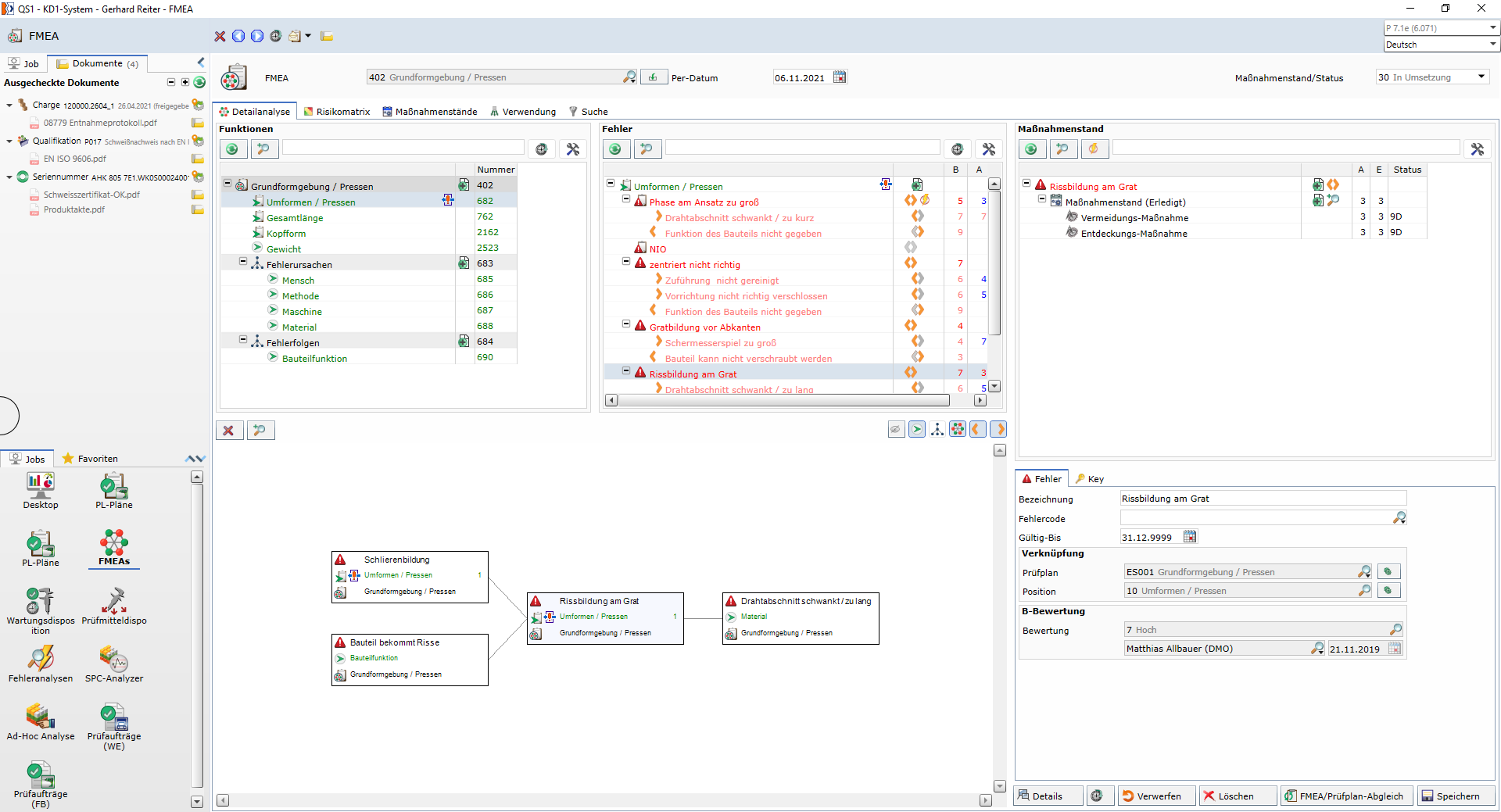
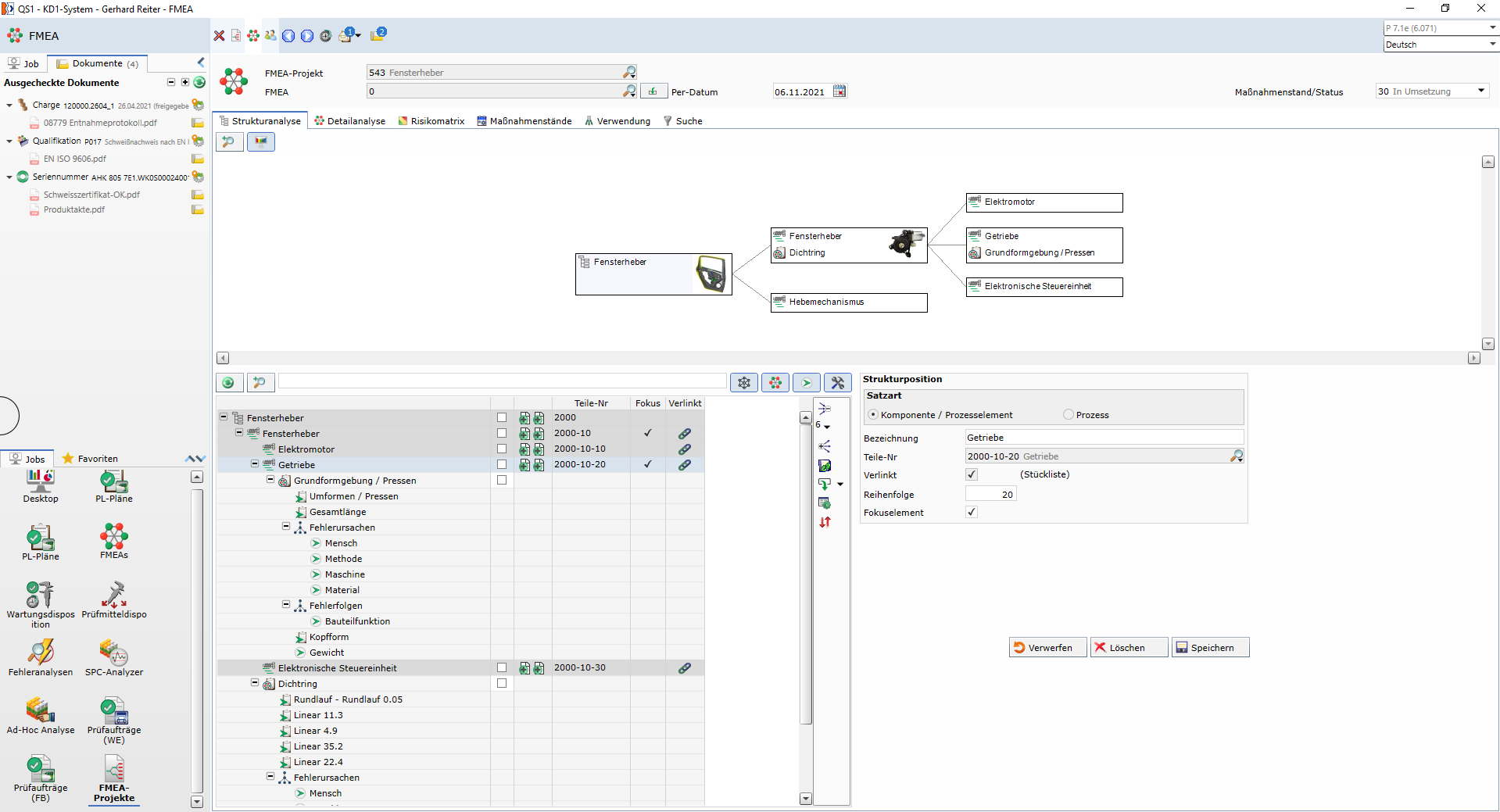
With the QS1 FMEA module, you seamlessly integrate Failure Mode and Effects Analysis (FMEA) into your quality processes and create a central, structured foundation for your risk analyses in accordance with current standards such as AIAG VDA. Production control plans, inspection plans, and FMEAs are mapped modularly and without redundant data storage: FMEA subtrees correspond to inspection plans and can be flexibly reused.
At the part number level, all FMEA subtrees are consolidated in a central knowledge database. This "single-loop system" enables the automatic comparison of actual defects from failure analysis (CAPA) within deviation management with the knowledge base and their direct integration into existing FMEAs. This continuously expands existing quality knowledge and makes it systematically available for future risk analyses.
Thanks to the integration of your ERP production structure data—such as bills of materials, recipes, and operations and activities—FMEA analyses can be performed directly based on this data. This allows for the efficient, structured, and consistent creation of both design FMEAs and process FMEAs.
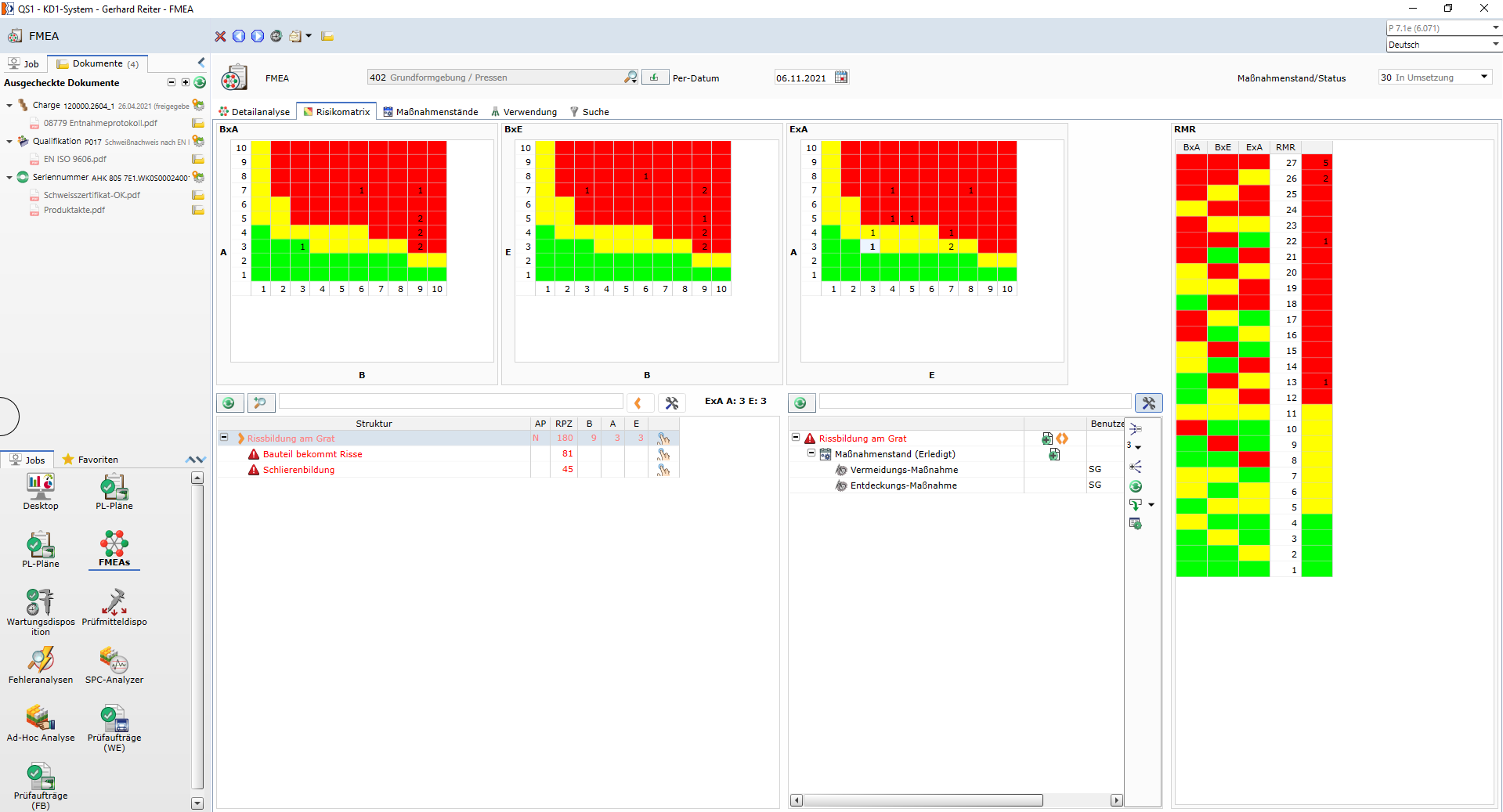
- Redundancy-free structure: Recurring FMEA structures are managed as subtrees and flexibly assigned to processes or part numbers.
- Central knowledge base: All FMEA subtrees are consolidated in a shared knowledge database at the part number level.
- Integrated test planning: Test plans and FMEAs can be jointly assigned to processes or part numbers and directly linked.
- FMEA-MSR monitoring: Support for monitoring risks and automated system responses for quality assurance.
- Flexible failure analysis: Structured analysis of failures, optionally via fault network or fault tree.
- Fault tree calculation: Systematic evaluation of complex failure relationships using calculation functions.
- Variant matrix: Efficient management and evaluation of different product or process variants.
- Cause-and-effect mapping: Transparent documentation and tracking of cause-and-effect relationships.
- Flexible risk assessment: Assessment of risks according to various methods and standards.
- Version Management: Seamless historical tracking and traceable versioning of your FMEA data.
- Integrated Action Management: Direct planning, control, and tracking of corrective actions.
- Component-Function Matrix: Support for the structured analysis of components and functions.
- Management Summary Sheets: Clear summaries for management and decision-making processes.
- Statistical Evaluations: Comprehensive analyses such as Pareto, difference, frequency, and completion analyses.
Does this sound familiar?
- FMEAs are mandatory and their methodology is clear (AIAG-VDA), but in practice they are difficult to keep "alive": Content is created multiple times, maintained in parallel, and quickly loses its connection to reality.
- Knowledge from failure analyses is lost: Actual defects from complaints, deviations, and CAPAs are processed, but not consistently fed back into existing FMEAs.
- Product and process structures are present in the ERP system (bills of materials, operations, recipes), but are not used for FMEAs: The result is redundant data, high maintenance effort, and inconsistent structures.
- FMEA, inspection planning, and production control are run separately: Risk analysis, inspection characteristics, and inspection control do not mesh seamlessly, even though they should be ensuring the same process.
- Versions and documentation become cumbersome: Changes, approvals, history, and action tracking are difficult to map in a revision-proof and audit-proof manner in traditional setups.
This should be achieved through a robust process
- Redundancy-free structure with reusability: Recurring FMEA structures must be modular and flexibly assignable to processes or part numbers.
- Central knowledge base instead of individual files: FMEA knowledge must be collected and reusable on a part number or process basis, not scattered across documents.
- Closed control loop with failure analysis/CAPA: Actual failures must be systematically compared with the knowledge base and transferred back into the FMEA, including corrective actions and proof of effectiveness.
- Integration with ERP structures: FMEAs should be based on real production structure data (BOM, operations, activities) to ensure that design and process FMEAs are consistent, efficient, and realistic.
- Seamless linking with inspection planning: Inspection plans and the production control plan must be derivable from the risk analysis and linked within the same system.
Coverage in QS1
- Supports standards-compliant FMEA processes according to current standards such as AIAG-VDA and seamlessly integrates FMEAs into your quality processes.
- Maps production control plans, inspection plans, and FMEAs modularly and without redundancy: FMEA subtrees correspond to inspection plans, can be reused, and flexibly assigned to processes or part numbers.
- Consolidates all FMEA subtrees at the part number level in a central knowledge database (“single-circuit system”), thus creating a structured foundation for sustainable knowledge building.
- Closes the control loop for failure analysis: Actual failures from CAPA analyses of deviation and complaint management are automatically compared with the knowledge base and directly fed back into existing FMEAs.
- Integrates ERP production structure data (e.g., bills of materials, recipes, operations, and activities), enabling the efficient creation and consistency of design and process FMEAs based on real-world structures.
- Supports flexible risk assessment according to various methods/standards, AP task prioritization, version management with history, and integrated action management for planning, control, and tracking.
- Enables comprehensive analysis and transparency (including Pareto, frequency, difference, and completion analyses) and supports root cause analysis with established methods such as 5 Whys and Ishikawa diagrams.
The result: Standards-compliant, structured FMEAs without redundant data maintenance, a closed control loop from actual failure back to prevention, a central knowledge base instead of scattered files, consistent derivation and linking of test planning and risk analysis. And ultimately: significantly fewer recurring errors through systematic knowledge feedback.
Your advantages
- Standards-compliant implementation: Support for structured FMEA processes according to current requirements such as AIAG-VDA.
- No redundant data maintenance: Seamless integration of FMEA, inspection planning, and production control plans.
- Automatic knowledge feedback: Actual defects from CAPA analyses are directly fed back into existing FMEAs.
- Sustainable knowledge building: Central knowledge database for the long-term utilization of your quality expertise.
- Structured risk prioritization: Risk assessment using AP task priorities.
- Sound root cause analysis: Support for established methods such as 5 Whys and Ishikawa.
