
Challenges in practice
The seamless traceability of products and batches presents many companies with practical challenges. Every movement, processing, or change to a batch must be documented and assigned to the corresponding quality data – often across different departments. At the same time, the effort required for this documentation must not negatively impact production efficiency. This becomes particularly critical when ERP data has to be transferred manually or when redundant data is generated – here, efficient integration determines whether batch tracking functions transparently, precisely, and practically.
Solution QS1
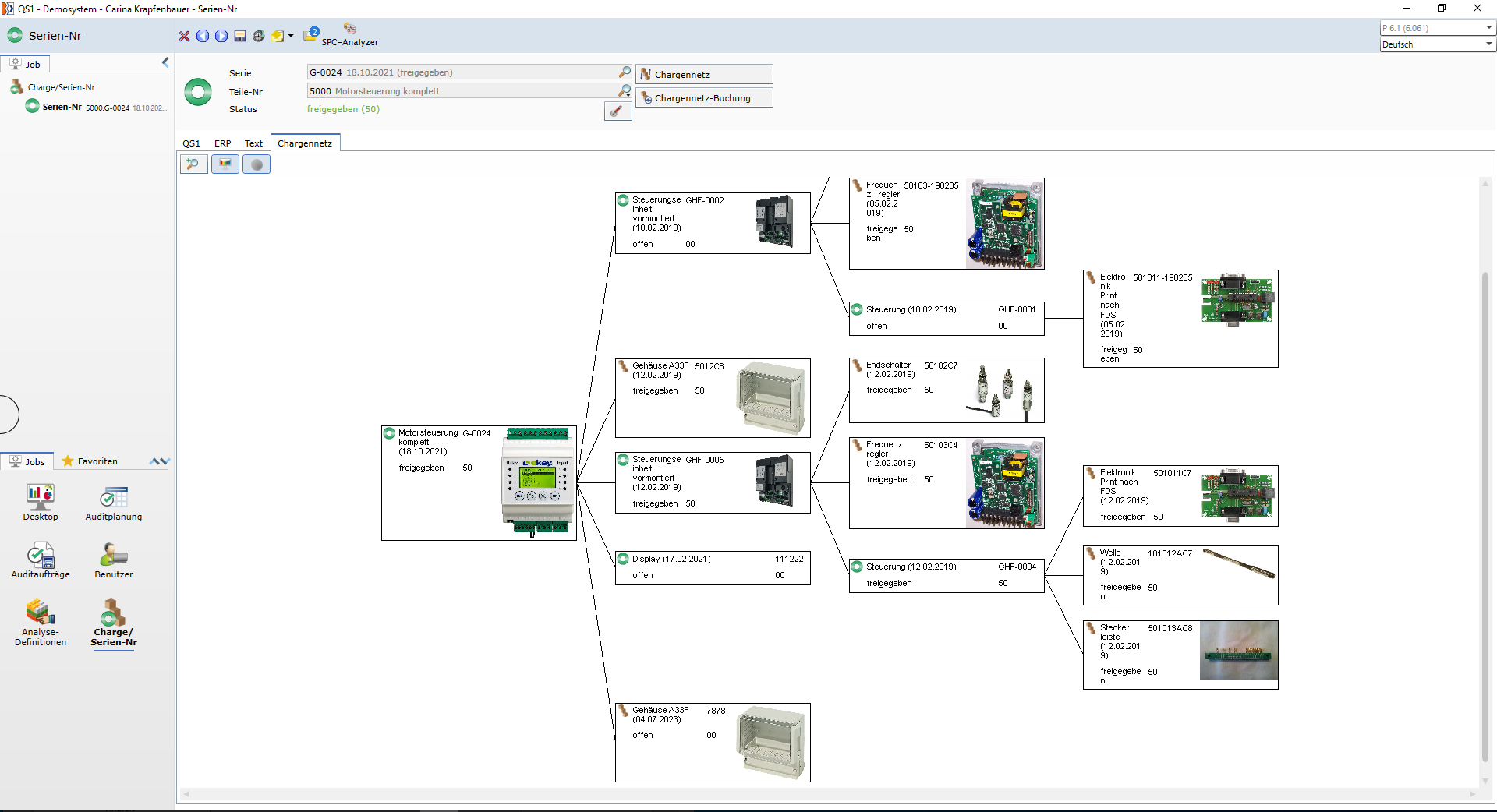
QS1 offers a tailored solution for your individual requirements, enabling seamless monitoring of finished products, their constituent parts, and raw materials – all based on batch or serial number.
All relevant information is automatically transferred from your ERP system in real time. There, it can be supplemented or adjusted – without generating redundant data.
If your ERP system does not track batch or serial numbers, QS1 supports supplementary functions to capture even untracked parts in a process-oriented, time-saving, and mobile manner.
With QS1, you maintain complete transparency across your product structure: top-down from the finished product back to the raw materials, or bottom-up from raw materials to the finished product – both analysis approaches are supported.
Furthermore, all test and process data, as well as documented deviations and associated corrective actions, are centrally recorded. QS1 analysis tools enable ad-hoc evaluation across the entire batch and serial number network, including the linked ERP data.
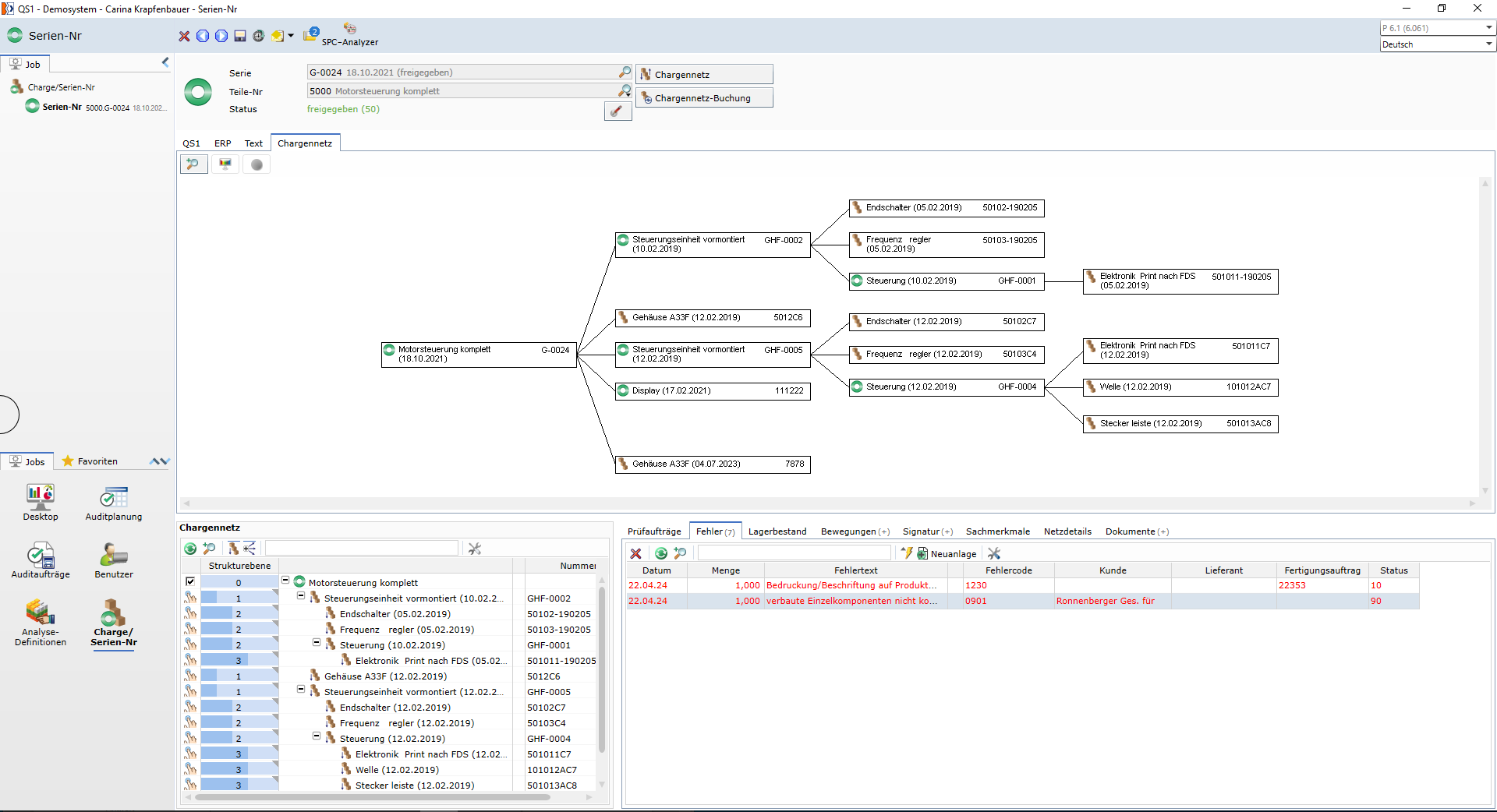
- Master data: Batch and serial numbers from your ERP system
- Status: Current status of each batch/serial number
- Network postings: Recording of all movements in the batch/serial number network
- Linking: Outgoing and incoming information between batches/serial numbers
- Combination: Integrated posting variants from ERP and QS1
- Regeneration: New batches/serial numbers in the QS1 inspection process
- Assignment: Assign installed components directly in the inspection process
- Acceptance: Inspection certificates based on the complete batch/serial number network
- Inventory queries: Retrieve material movements directly in the ERP system
- Graphics: Visual representation of the batch/serial number network with analysis functions
- Material characteristics: Properties of the batch/serial number from the ERP system
- PC analyzer: Statistical process control on batch/serial numbers
- Defect management: Defect analysis, FMEA, and quality measures in the network
Does this sound familiar?
- Traceability is required, but the reality is fragmented: Batch movements, processing stages, and quality data are scattered across departments and systems. Establishing a complete chain of custody is therefore difficult.
- Documentation effort and cost-effectiveness clash: Every movement and processing step should be traceable, but manual transfers and additional documentation are not scalable.
- ERP data is not readily usable: Batch/serial information would either have to be transferred manually, or redundant data sets with version conflicts would be created.
- In critical situations, speed is paramount: In the event of deviations or complaints, a reliable response is needed within minutes, not days of research.
- Quality data is not networked: Inspections, deviations, blocking, approvals, and corrective actions are not consistently linked to batch/serial numbers, resulting in incomplete root cause analysis and documentation.
This should be achieved through a robust process
- Seamless batch/serial network without additional effort: Movements, inflows, outflows, and conversions must be recorded directly from the leading ERP system, closely aligned with the process.
- Top-down and bottom-up analysis: The chain must be traceable from the finished product back to the raw material and vice versa, for example, with visual representations or drill-down functionality.
- Quality data in context: Test results, process data, deviations, corrective actions, blocking/release orders, and certificates must be directly linked to the batch/serial number.
- Pragmatic handling of gaps: If the ERP system does not track batch/serial numbers, data capture must still be process-based, time-saving, and mobile.
Coverage in QS1
- Enables seamless monitoring of finished products, sub-assemblies, and raw materials based on batch or serial number.
- Retrieves all relevant information from the ERP system in real time, thus preventing redundant data.
- Captures movements and interconnections within the batch/serial network and supports combined posting options from ERP and QS1 (including network postings and optional regeneration of batch/serial numbers during the QS1 inspection process).
- Provides a transparent view of the product structure and allows for bidirectional analysis: top-down from the finished product back to the raw material, and bottom-up from the raw material to the finished product.
- Centrally links inspection and process data, documented deviations, and associated corrective actions within the batch network, enabling ad-hoc analyses across the entire batch/serial number network.
- Supplements missing ERP functionality: If batch/serial numbers are not managed in the ERP system, QS1 offers functions for process-based, mobile data capture, so that traceability is still possible..
Your Result: 100% traceability with practical effort, faster origin and impact analyses in case of emergency, central view of tests, deviations and releases in the batch network, less integration and maintenance effort through redundancy-free ERP connection and audit-proof evidence at the touch of a button.
Your advantages
- Traceability: 100% traceability of your product and batch structures
- Origin analysis: Complete overview from raw material to finished product
- Transparency: Inspections, deviations, certificates, and releases are centrally accessible
- Releases: Signed batch/serial number releases via dual control
- Documentation: Fully automated generation of acceptance documents
- Efficiency: Minimized administrative effort through structured allocation and ERP integration
- Flexibility: Top-down and bottom-up analyses are possible
- Data capture: Easy recording even for parts without ERP batch/serial numbers
- Integration: Transfer MES postings directly into the ERP system
- Analysis: Qualitative data such as inspections, blocking/releases, and defect management can be evaluated within the batch network
- Tools: QS1 Quality Analyzer and product file including test certificates
