
Challenges in practice
Today, qualified employees are more than just a resource – they are a crucial success factor for your company. Increasingly complex products, growing product variety, and rising demands from standards like ISO 9001 or ISO 13485 make structured qualification and knowledge management indispensable. Without intelligent software, mountains of data quickly accumulate, which are unusable without proper management. This is precisely where our system comes in: for efficient, transparent, and auditable qualification processes.
Solution QS1
General – the module at a glance
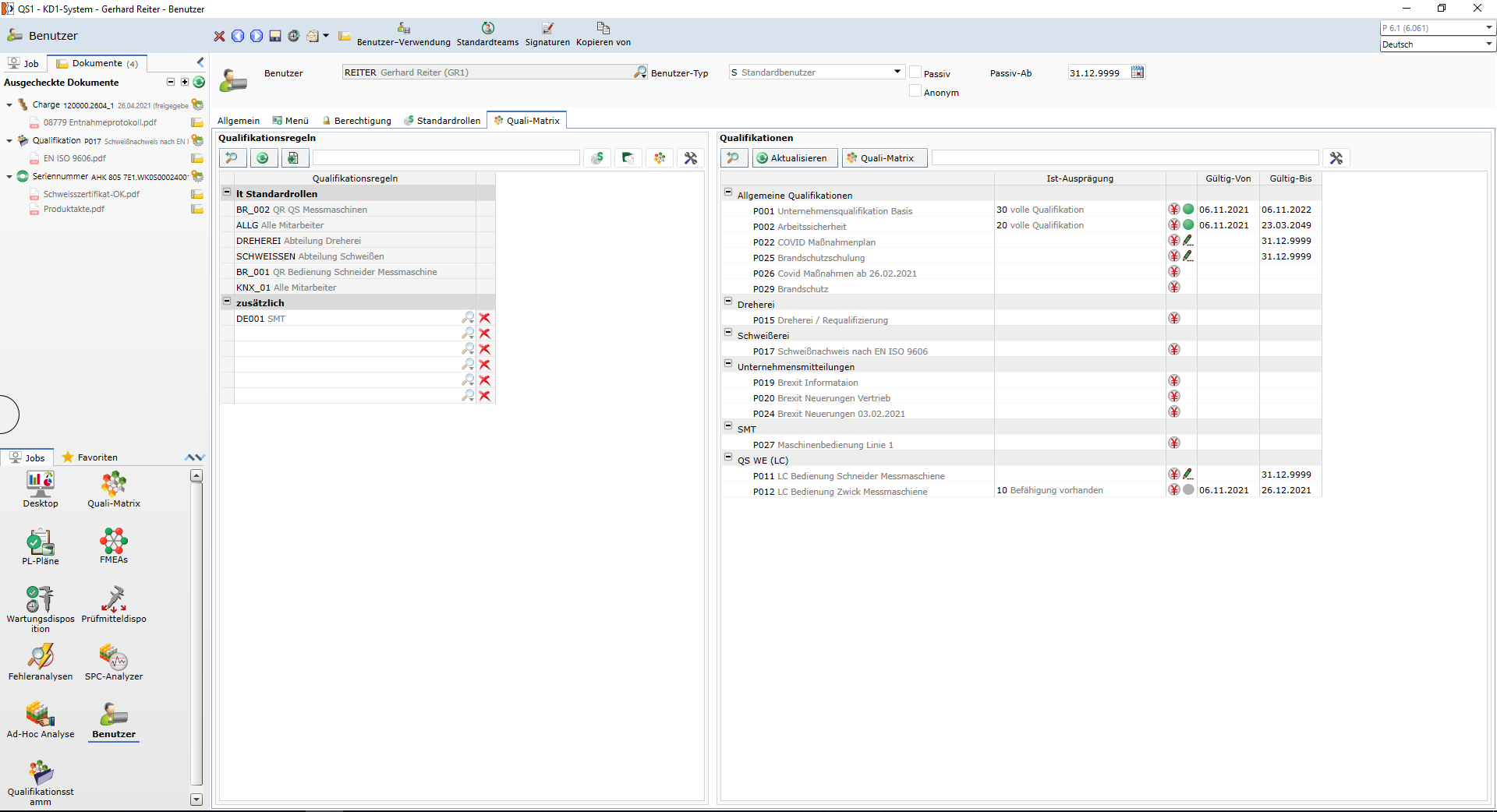
With QS1 Qualification Management, you receive a powerful yet intuitive solution that meets all the requirements of modern qualification and competency management. The module allows you to centrally manage and systematically develop skills, competencies, and qualification requirements. Freely configurable processes provide maximum flexibility to optimally reflect your individual company structures.
You define qualification steps, including their validity periods, store training materials and e-learning content, and conveniently control the assignment of relevant qualifications via roles and rules.
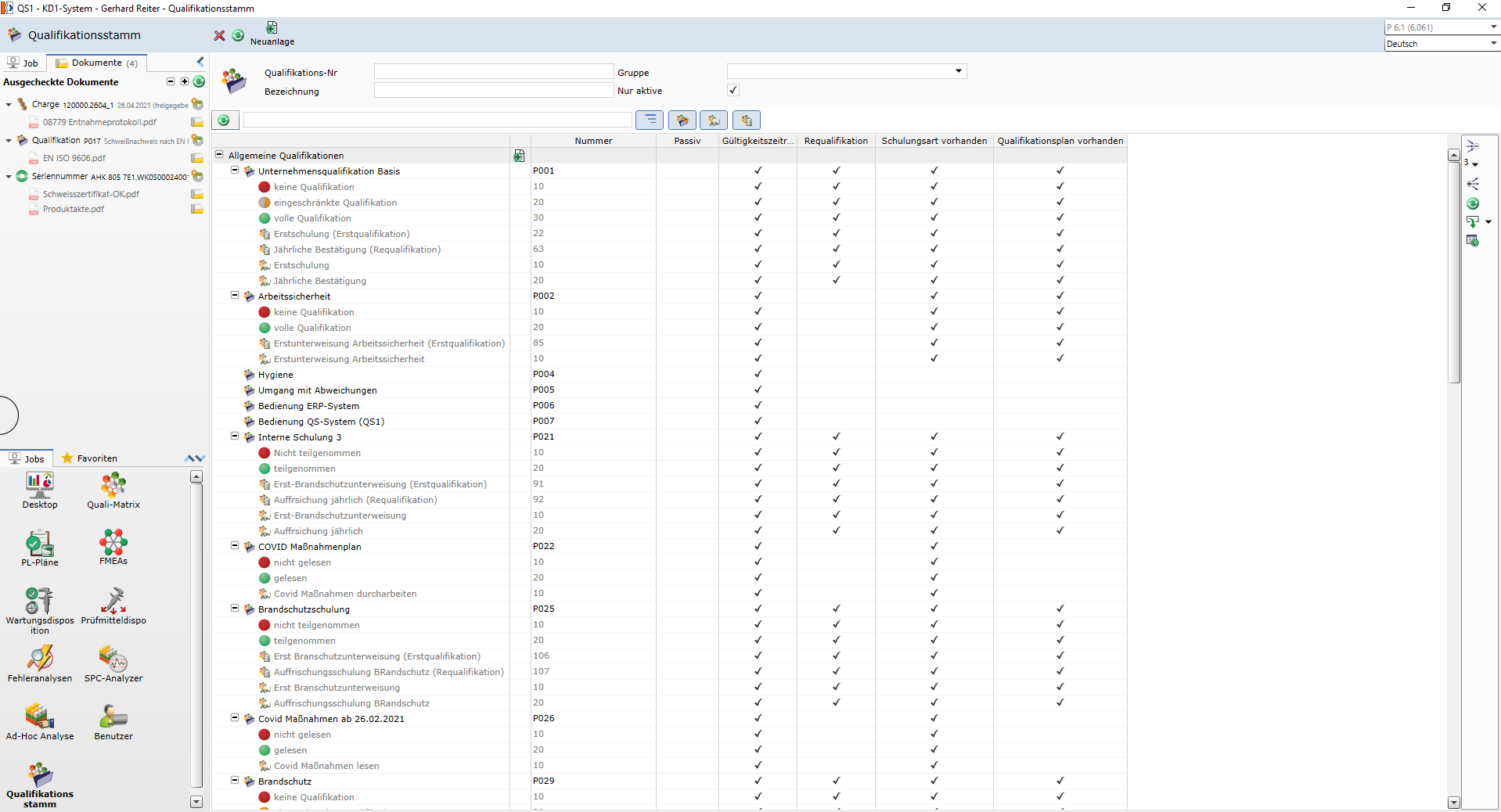
The clear qualification matrix allows you to keep track of the current status at all times. The integration of employee interactions via intranet or mobile devices ensures direct involvement in the process. Furthermore, the connection to your ERP system enables real-time or background monitoring of qualification-relevant manufacturing processes. This creates end-to-end transparency – from planning to operational implementation.

Training Management & E-Learning
The integrated training management system offers you a comprehensive portfolio for organizing and managing all learning formats – from traditional classroom events and external or remote training to modern e-learning concepts. You determine how knowledge is imparted and design learning processes precisely according to your requirements.
Intelligent workflows support participants, trainers, and supervisors alike, ensuring smooth processes – from registration and delivery to certificate issuance.
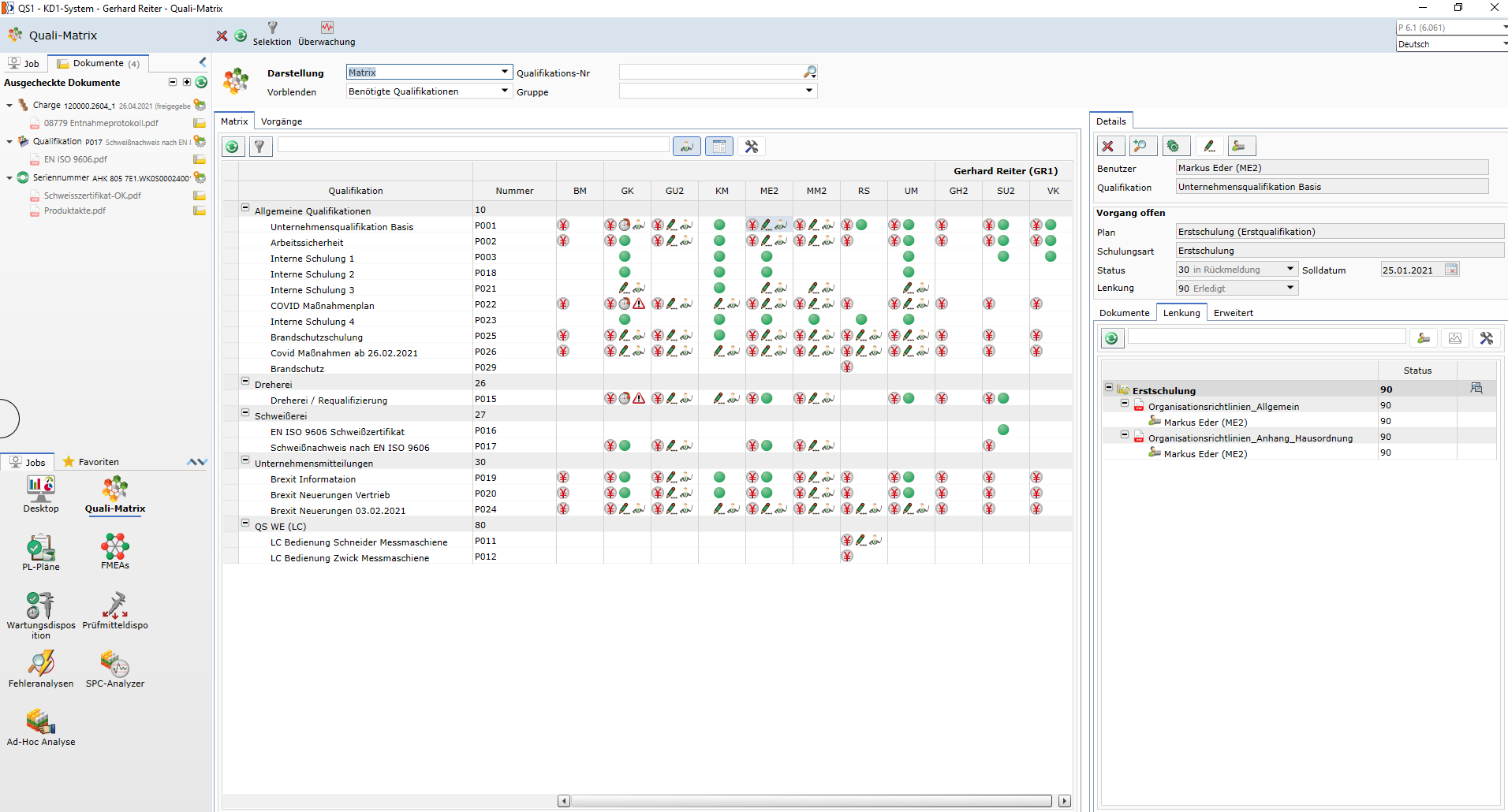
Automated processes significantly reduce administrative effort while simultaneously creating maximum transparency. Learning anytime, anywhere via intranet or mobile devices enables flexible knowledge transfer in everyday work. Optionally integrated knowledge assessments with individually configurable tests, as well as structured feedback and evaluation mechanisms, ensure that qualifications are not only documented but also sustainably secured and continuously improved.

- Qualification Matrix (Quali-Matrix): Intuitive cockpit view with role- and function-related display of all qualification requirements.
- Role-based assignment: Automatic linking of functions, work processes, and required competencies.
- Free parameterization: Individually definable qualifications, assessment logics, and requirement profiles.
- E-Learning: Digital training delivery including scheduling, certificates of participation, and knowledge assessment.
- Training assignments: Intelligent workflows for the efficient planning, scheduling, documentation and approval of training courses.
- ERP integration: Monitoring of qualification-relevant process data through direct integration into your ERP system.
- Key performance indicator (KPI) analysis: Evaluations and management overviews via the Quality Analyzer for managing effort and compliance.
Does this sound familiar?
- Qualifications are documented informally, resulting in a lack of transparency in daily operations: Who is authorized to perform which tasks, which qualifications have expired, and where are the critical gaps?
- More complex products, more variants, and increasing standards requirements (e.g., ISO 9001, ISO 13485) increase the pressure to provide complete and auditable documentation of training, certifications, and validity periods.
- Qualification management relies on Excel spreadsheets and binders: Lists are outdated, and changes are difficult to track. This creates administrative overhead that does not contribute to value creation.
- Training is organized but poorly managed: Registrations, approvals, participation, certificates, knowledge assessments, and feedback are distributed across various departments. The entire process is not centrally controlled.
- The connection to operational production is missing: Qualification requirements are not linked to roles, tasks, or ERP processes, meaning that missing qualifications only become apparent when the situation becomes critical.
This should be achieved through a robust process
- Centralized management instead of list maintenance: Qualifications, competencies, requirements, validity periods, and documentation must be managed in a single system with clear rules and responsibilities.
- Role- and process-related requirements: Qualifications must be automatically derived and assigned based on functions, roles, and processes.
- Audit-proof and legally compliant documentation: Training courses, participation, certificates, knowledge assessments, and approvals are archived in a revision-proof manner and accessible at any time.
- Early warning for mandatory qualifications: Expiration dates, reminders, and automatic notifications should prevent critical qualifications from expiring unnoticed.
- Integrated training and e-learning management: In-person, remote, external, and e-learning must be planned, implemented, and documented within a single workflow.
- Operational integration: Qualification requirements must be integrated into ERP and quality assurance processes to ensure that missing qualifications are identified early, not after the fact.
Coverage in QS1
- Centrally manages skills, competencies, and qualification requirements, enabling freely configurable qualification processes that reflect company structure and role models.
- Defines qualification steps, including validity periods, stores training materials and e-learning content, and controls the allocation of relevant qualifications via roles and rules.
- Provides a clear qualification matrix (qualification matrix) as a dashboard, making qualification levels, requirements, and gaps transparent in relation to roles and functions.
- Supports integrated training management for in-person, remote, and external training, as well as e-learning, including workflow support for registration, execution, participation confirmation, and certificate issuance.
- Enables optional knowledge assessments with configurable tests, feedback, and evaluation mechanisms, ensuring that qualifications are not only documented but also verifiably secured.
- Digitally engages employees via intranet or mobile devices and facilitates confirmations, e-learning, and action processing directly within daily work.
- Integrates with your ERP system to monitor qualification-relevant manufacturing processes. Required competencies can be embedded at the work step, allowing for the early identification of qualification gaps in production.
- Enables key performance indicator (KPI) analysis and management overviews via the Quality Analyzer to control effort, compliance, and skills development.
Your result: Transparency regarding qualification levels and gaps, less list maintenance and administrative effort, audit-proof documentation, legally compliant monitoring of mandatory qualifications and a direct integration of qualification, training and operational process execution.
Your Advantages
- Transparency: A complete overview of all your employees' qualifications, requirements, and competency levels in a central qualification matrix.
- Audit compliance: Audit-proof documentation of all training courses, certificates, and knowledge assessments – accessible at any time for internal and external audits.
- Legal compliance: Systematic monitoring of mandatory qualifications and automated reminders for expiration dates.
- Efficiency: Reduction of manual lists and administrative effort through digital, workflow-based processes.
- Planning reliability: Early identification of qualification gaps and targeted management of training measures.
- Integration: Seamless integration into existing ERP and QS1 processes without any media breaks.
- Employee participation: Digital integration via intranet or mobile devices for easy confirmation and completion of training courses.
