
Standardized Yet Flexible
How Modular Checklists Enable End-to-End Inspection Processes in Machinery and Plant Engineering
Acceptance checklists are an integral component of quality assurance in machinery and plant engineering. Yet virtually no two machines are identical: varying subassemblies, configuration variants, and customer-specific requirements mean that acceptance testing differs from project to project. At the same time, numerous inspection steps and verification requirements recur on a regular basis.
The consequences become evident in daily operations: proven workflows can only be reused to a limited extent, revisions must be maintained redundantly across multiple locations, and comparability across projects is progressively lost. Simultaneously, machines, subassemblies, and customer requirements often diverge so significantly that rigid, monolithic standard checklists do not represent a viable solution.
Organizations thus face an apparent paradox: How can acceptance processes be standardized without losing the flexibility required for distinct, customized projects?
This is precisely where the new "Acceptance Checklists" module in QS1 provides the solution: Rather than compiling separate checklists from scratch for every single order, the entire process relies on centrally managed, version-controlled checklist modules. These can be combined as needed, establishing the foundation for standardized yet flexibly adaptable acceptance workflows.
Define Once, Reuse Continuously
A decisive advantage of this approach: The actual inspection criteria are not recreated for each project within QS1. Instead, reusable modules are established—for example, for subassemblies, functional testing, safety verifications, or final acceptance.
Whenever specifications or inspection steps change, updates are made centrally within the respective module. All future projects automatically reference the latest revision status. This significantly minimizes maintenance overhead while ensuring a uniform quality standard across all projects.
The Tailored Checklist for Every Machine
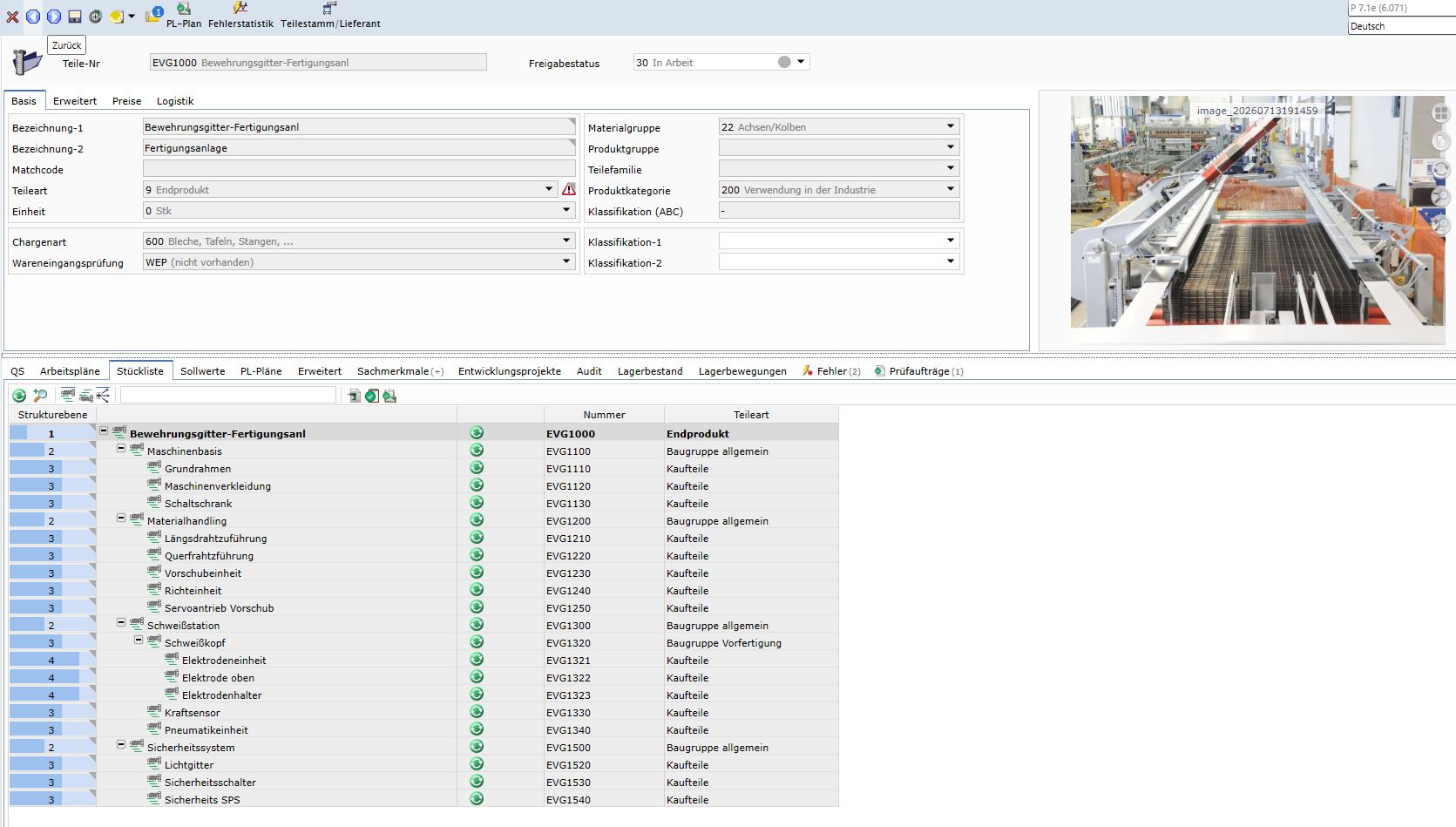
Standardization, however, does not imply that every machine receives an identical checklist. Driven by seamless ERP integration, QS1 automatically generates the appropriate checklist inspection order based on existing ERP data (production order, routing operation, bill of materials, subassembly hierarchy, etc.). The required modules are assembled on a project-specific basis, mapping the precise assembly and acceptance scope of the respective order.
Illustrated by a Practical Example
Regardless of the specific machine configuration, a base machine frame requires recurring mechanical and safety inspections. Additional modules—such as those for material handling, pneumatics, or a dedicated manufacturing process—are only added if the corresponding subassembly is incorporated into the specific machine.
QS1 determines the required inspection modules directly from the underlying ERP and production order information. In this way, standardized building blocks yield a tailored acceptance checklist for each machine—eliminating the need to redefine inspection criteria for every project.
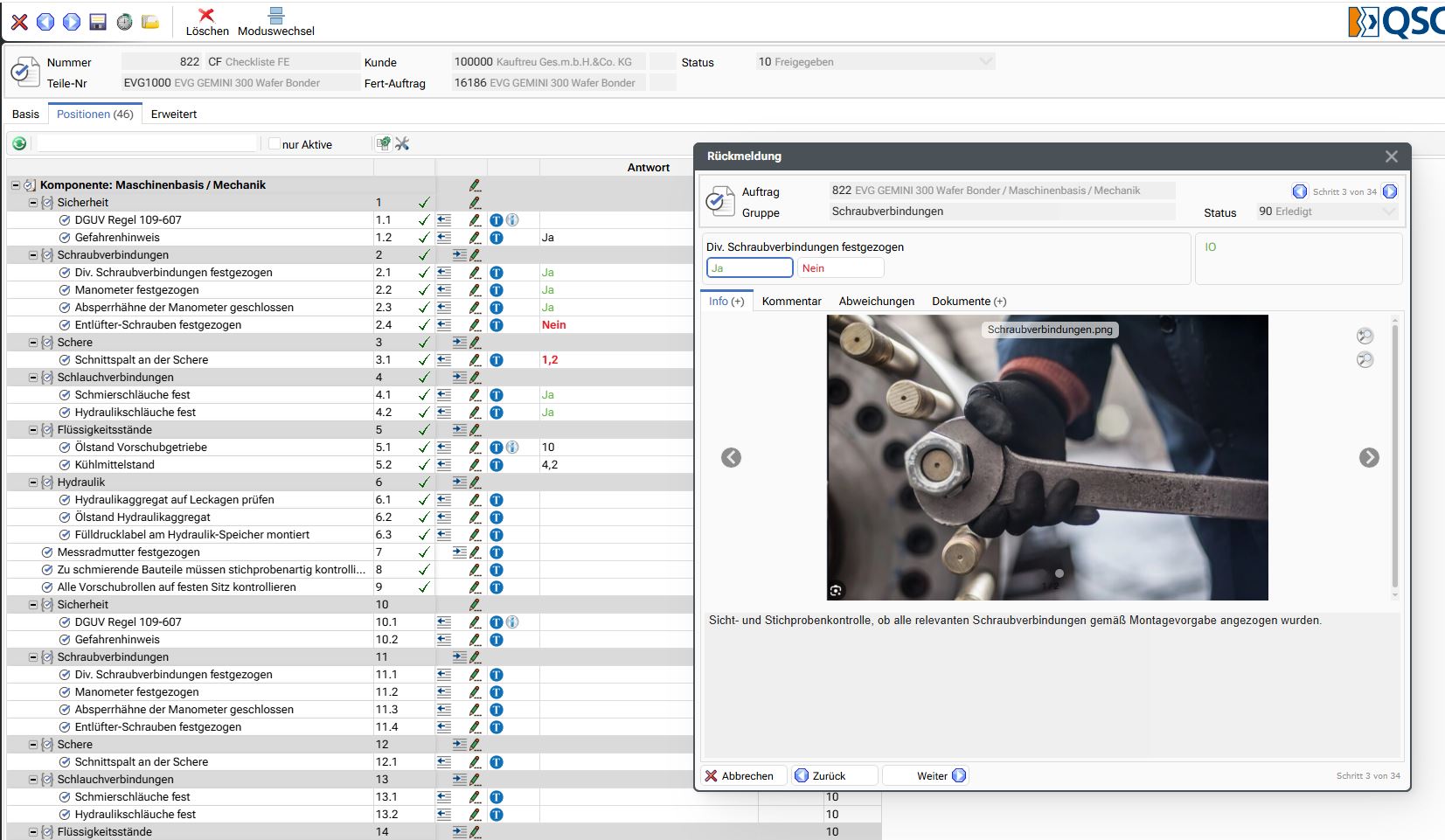
Supplementary inspection steps or documented work instructions are displayed dynamically only when strictly required by a product variant, specific ERP parameters, or preceding inspection results. This keeps the verification process lean while maintaining maximum operational flexibility.
The Checklist as an Assembly Information System
The module does far more than merely document acceptance testing. It actively guides operators through the entire assembly and inspection process: work instructions, assembly procedures, images, technical documents, or video guides are accessible directly at each verification step. Assembly personnel receive precisely the documented information required for the current task.
Simultaneously, inspection results, quantitative measurements, serial numbers, lot/batch numbers, as well as photographic evidence and documentation records can be logged immediately—including mobile capture via tablet directly on the shop floor. The acceptance checklist thus transforms into a digital assembly information system that unifies operational guidance, process documentation, and quality verification within a single workflow.
End-to-End Transparency Through Final Commissioning
Particularly for complex machinery, tracking the status of isolated inspection checkpoints is simply not enough. Maintaining a comprehensive overview of overall project progress is critical: multi-level tree hierarchies clearly visualize entire production lines, subassemblies, and discrete components. Processing status remains fully transparent at all times, from individual verification steps to the fully accepted installation.
Directly at each inspection step, operators can record parameters such as:
- Pass/Fail (conformant / nonconformant) decisions
- Quantitative measurements
- Serial and lot / batch numbers
- Photographic evidence and supporting documentation
- Operational comments and direct feedback
All data is contextualized and guarantees complete traceability—a decisive advantage during external and customer audits.
Nonconformities as an Integral Part of the Quality Process
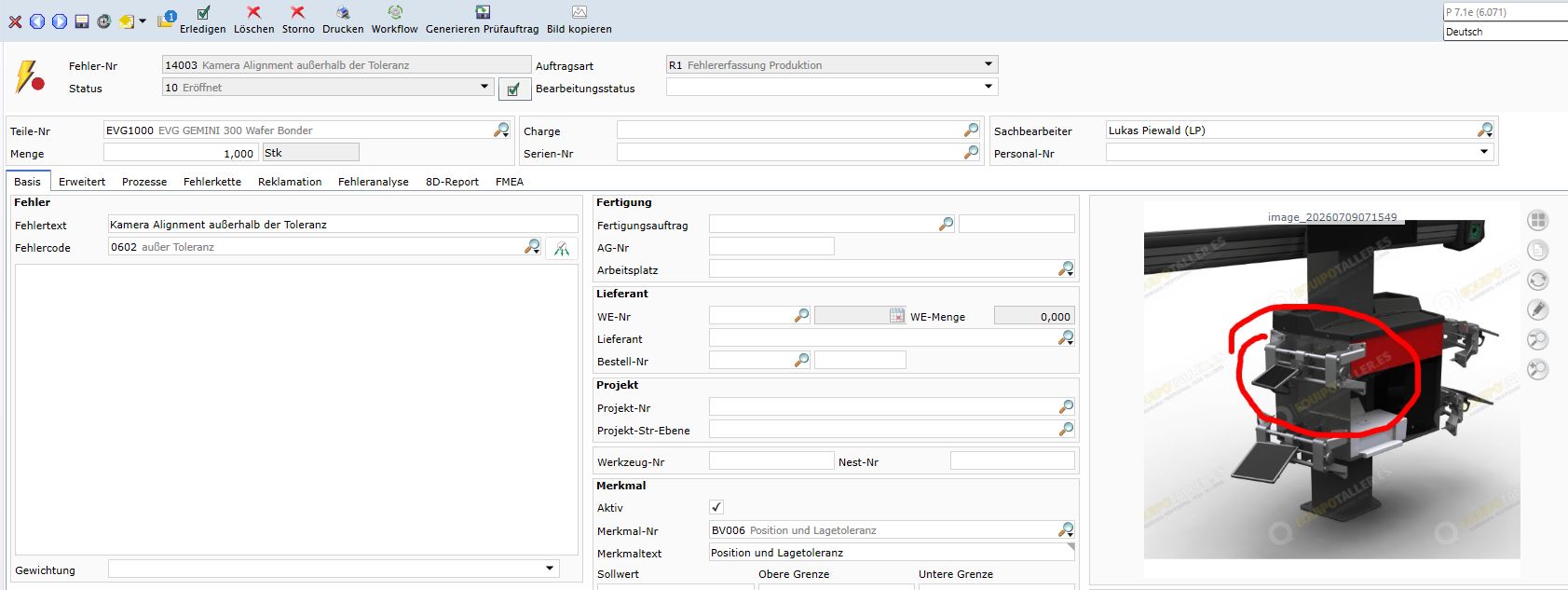
The process does not end with a documented nonconformance decision (fail): QS1 automatically initiates subsequent workflows whenever necessary. Action items, complaints, or 8D reports can be generated and tracked directly from the acceptance inspection.
As a result, nonconformities, root cause analysis, and corrective actions remain permanently linked to the originating verification step. Acceptance testing is thus transformed from mere documentation into the catalyst for sustainable, continual quality improvement.
Quality Does Not End at Acceptance Testing
Particularly in machinery and plant engineering, complex equipment comprises numerous internally manufactured and externally procured components. When a nonconformity is identified during acceptance testing, documenting the defect is only the first step—establishing complete traceability back to its origin is equally vital.
For instance, if a nonconformity can be traced to a specific batch of procured raw material, the QS1 Lot & Serial Number Traceability Network reveals at a glance where that material was processed or assembled. This provides an unbroken genealogy of a lot/batch or serial number—from raw materials through semi-finished goods and subassemblies up to the final machine installation—making it immediately evident which additional production orders might be affected.
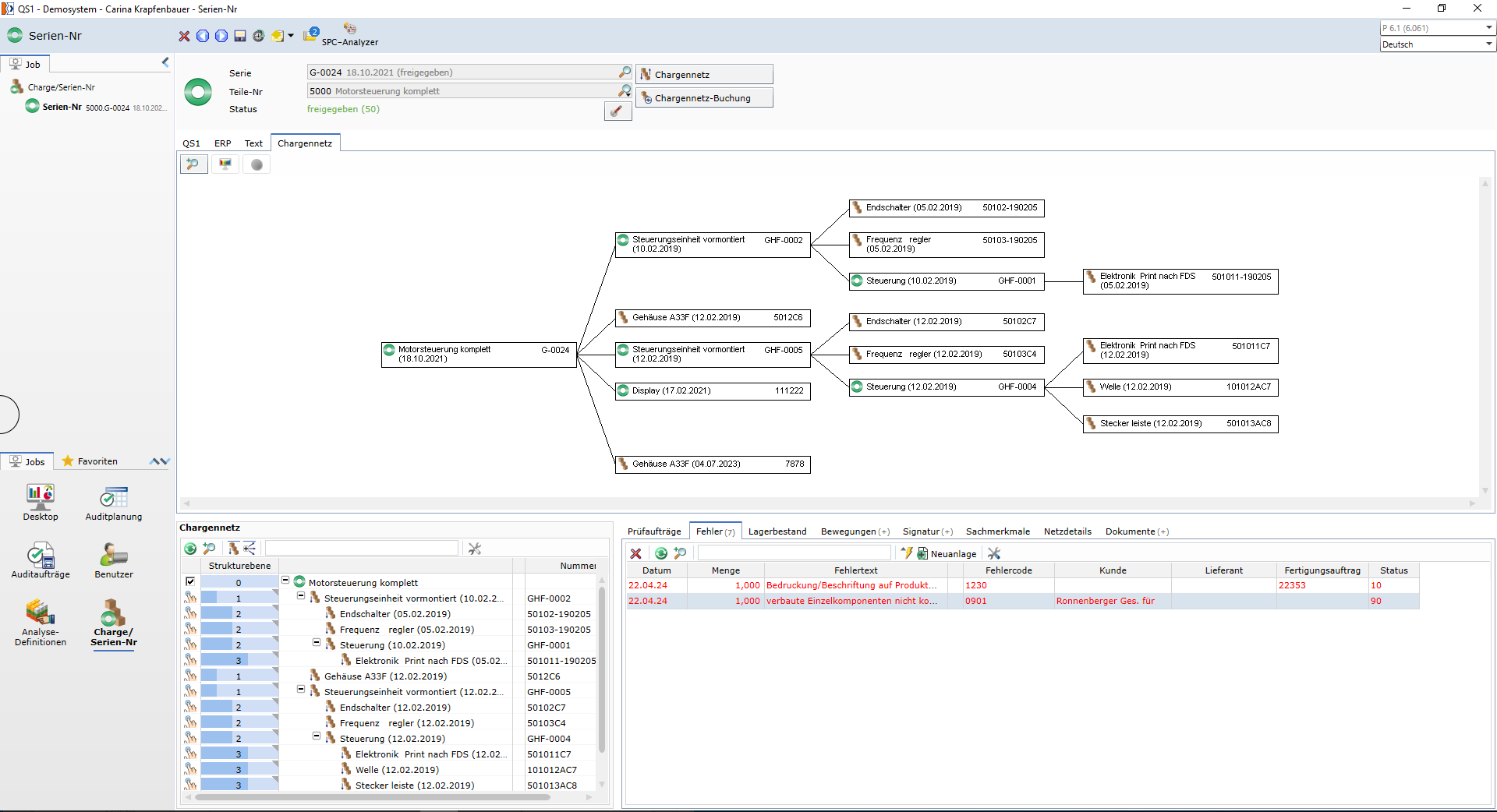
If the root cause of a nonconformity lies in purchased material or an external component, the loop closes directly back to external supplier management: using the integrated supplier portal, the nonconformance complaint can be resolved collaboratively with the supplier. Incurred nonconformance and subsequent failure costs can be systematically documented and utilized as the basis for potential cost recovery or debit notes.
Conclusion
Today, organizations no longer have to compromise between standardized processes and project-specific flexibility. With the new "Acceptance Checklists" module, QS1 bridges both requirements within a single, integrated platform. Reusable checklist modules, automated inspection workflows, and integrated worker guidance ensure consistent quality standards alongside high operational adaptability.
In this way, traditional acceptance checklists evolve into a seamless digital workflow that unifies assembly, inspection, documented verification, and continual quality improvement—driving efficiency and freeing up resources for what truly matters: productivity and operational reliability.
