
From Supplier Evaluation to Comprehensive Supplier Performance
How Sielaff Integrates Quality and ERP Data with QS1 into a Meaningful Holistic View
At Sielaff GmbH & Co. KG, QS1 by QSC Systems serves as the central quality platform. Seamless integration with the Proalpha ERP system enables incoming goods inspection, supplier evaluation, complaint management, and other quality management processes to interact continuously on a unified data foundation.
![[Translate to English:] Sielaff Firmenstandort](/fileadmin/user_upload/sielaff.jpg)
Decision-Making
The decision in favor of QS1 was preceded by an extensive evaluation process in 2019, during which a total of nine vendors were assessed. Initially, none of the solutions proved entirely convincing. "We simply couldn't find the right fit," recalls Frank Kropp from the Quality Management department at Sielaff.
It was only toward the end of the selection process that QSC Systems entered the running with its QA/QM solution QS1. A key differentiator became apparent right from the product demonstration: rather than relying on prepared sample data, QSC connected directly to Sielaff's Proalpha test environment. A reference customer with a comparable manufacturing structure and the software's comprehensive range of modules also proved decisive.

The decisive factors for Sielaff included, in particular:
- Deep, seamless integration between QS1 and Proalpha
- Live demonstration conducted using Sielaff's own ERP test data
- Tangible, practical use cases
- A well-matched reference customer
- Modular architecture and flexible scalability
From Project Launch to Quality Platform
In 2020, productive operations went live with inspection planning and gauge management, followed subsequently by incoming goods inspection and nonconformity management. Supplier evaluation was added in 2021.
Today, Sielaff's use of QS1 extends to business intelligence and audit management, among other areas. As a result, supplier evaluation no longer exists in an isolated silo, but actively leverages insights and data across diverse quality management processes.
Conventional ERP systems primarily provide logistical performance data.
QS1 supplements this logistical perspective with comprehensive quality information. Standard logistical performance indicators (KPIs) typically include:
- On-time delivery (OTD)
- Quantity accuracy / quantity adherence
- Delivery capability / fulfillment capability

The quality perspective provided by QS1 enhances these indicators with parameters such as:
- Receiving inspection quality and PPM rates (parts per million)
- Complaint history and nonconformance data
- Certifications and validity periods
- Audit results and additional qualitative criteria
This fundamentally shifts the evaluation focus: the decisive factor is no longer solely whether an external supplier delivered in full and on schedule, but also the level of quality and conformance achieved.
Directly Leveraging Quality Data from Incoming Goods Inspection
At Sielaff, supplier evaluation currently places a strong emphasis on quality data. The results are prepared as quarterly, semi-annual, and annual performance evaluations, serving among other things as an essential information base for procurement. A primary data source is the receiving inspection: quality data recorded at goods receipt is made immediately available for supplier evaluation.
From Delivery to Evaluation:
- The goods receipt is assigned to the supplier.
- Quality-relevant inspection results are recorded in QS1.
- The data feeds directly into the supplier evaluation process.
- Performance trends become transparent across defined review periods.
- Deviations can be targeted for supplier reviews and corrective actions.
Complaint and nonconformance data is likewise captured at Sielaff and integrated into the overall assessment of external supplier performance.

Deep ERP Integration Instead of Parallel Data Silos
Against this backdrop, the interface between QS1 and Proalpha plays a pivotal role. As a result, vendor, item, and quality data do not have to be manually compiled from disparate systems for each analysis. Wolfgang Horlacher, Head of Quality Assurance at Sielaff, emphasizes this precise point: "The deep integration is definitely an aspect I would highlight in an extremely positive light." For example, the supplier evaluation makes it fully traceable whether a classification stems from receiving inspection results or from complaints and nonconformities. This establishes a consistent, robust data foundation rather than isolated information silos.
Evaluation Aligned with Your Supplier Strategy
In addition, QS1 enables customizable evaluation schemes. Organizations can specify parameters such as:
- Which performance indicators (KPIs) are incorporated and how they are weighted
- Applicable scoring scales, graduated thresholds, and quality metrics
- How overall evaluations and vendor classifications are determined
- The defined observation and review periods
- Performance trends and developments compared to prior periods
Sielaff is not yet utilizing these capabilities across their full scope, choosing instead to advance and refine its supplier evaluation process step by step.

Performance of External Suppliers Beyond Quantitative Metrics
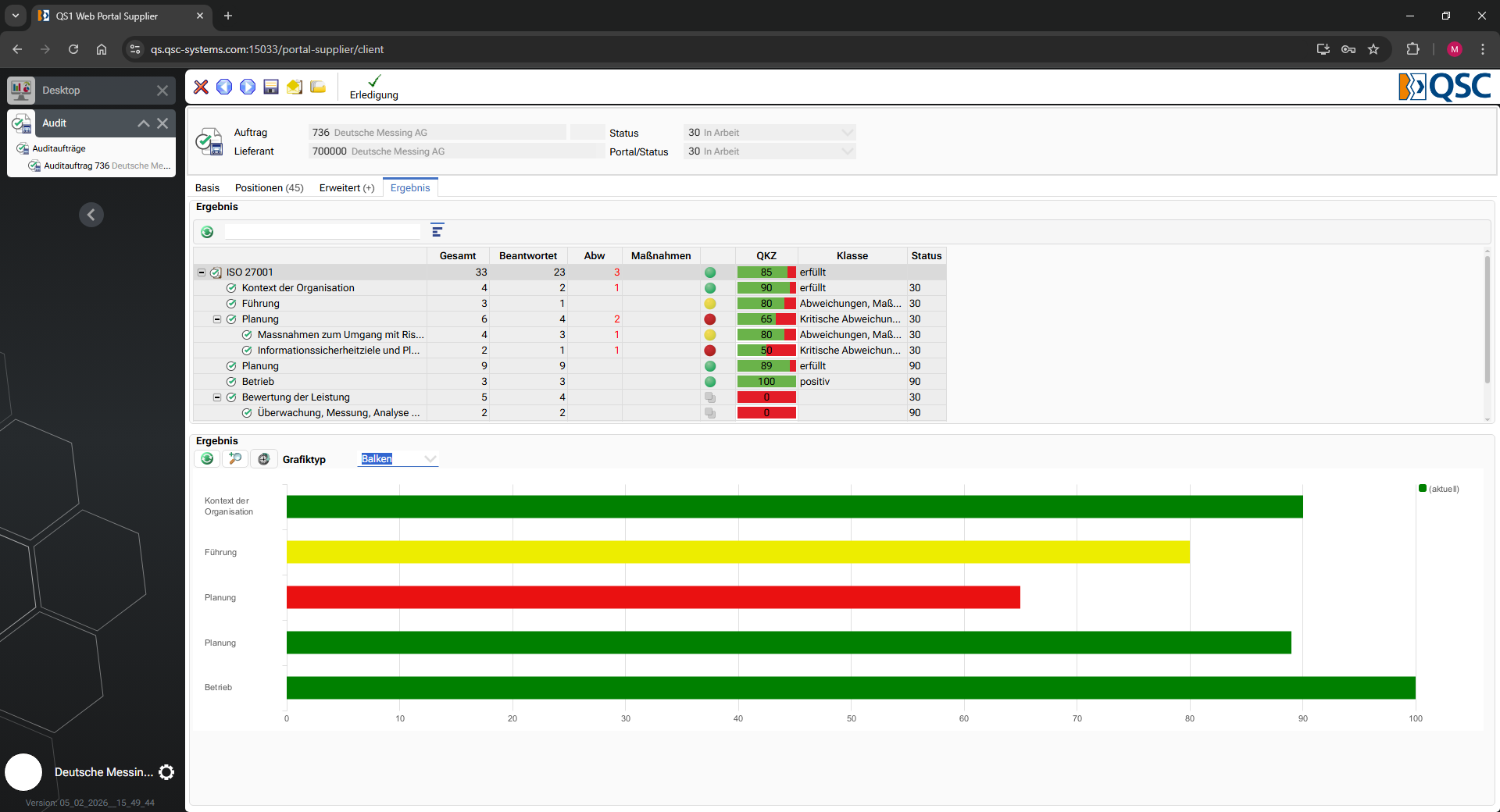
However, assessing delivery and quality metrics alone is not sufficient to obtain a truly comprehensive picture. For example, QS1 can clearly highlight whether mandatory certifications remain valid, how complaint trends and nonconformities develop over time, or which findings and corrective actions emerge from external supplier audits.
Qualitative criteria—so-called soft facts—can likewise be integrated into the evaluation. In addition to monitoring current performance, this approach makes it transparent where action is required and how an external supplier is continually progressing.
Integrating Quality Directly into the Value Stream
In parallel, Sielaff is expanding QS1 into further operational areas. Nonconformities and defects are increasingly logged directly on the assembly line; in the future, final inspection personnel will also record their findings immediately within the system. As a result, quality data is made available more rapidly right where it is needed. What began as an initial software selection project has thus evolved into a continually expanding quality platform. Supplier evaluation forms an integral part of this ecosystem: quality and ERP data are consolidated to assess external supplier on a far more differentiated basis. This creates a more meaningful, holistic picture of actual supplier performance—far beyond mere on-time delivery and quantity adherence.
